India is set to host the 18th BRICS Summit at Delhi’s Bharat Mandapam from 12 to 13 September 2026 under the theme “Building for Resilience, Innovation, Cooperation and Sustainability”, concluding the year-long period as the grouping’s Chair. Several events are planned for the 2-day summit, including the BRICS Business Forum and the BRICS Leaders’ Summit, an exhibition, a gala dinner and tree plantation. The sessions and conferences will be organised around the themes “Inclusive Global Governance and Strengthening Multilateralism” and “Resilience, Innovation, Cooperation and Sustainability: Shaping the Future for Inclusive Global Growth”.
World leaders and officials from 11 BRICS countries, partner countries, and outreach invitees will participate in the summit. Russian President Vladimir Putin, Chinese President Xi Jinping, South African President Cyril Ramaphosa, Iranian President Masoud Pezeshkian, Egyptian President Abdel Fattah el-Sisi, Ethiopian Prime Minister Abiy Ahmed, Indonesian President Prabowo Subianto, and UAE President Sheikh Mohamed Zayed Al Nahyan are among the world leaders visiting India for the BRICS Summit.
India’s BRICS Chairship arrives at a historical moment, as 2026 marks twenty years since the establishment of the grouping. The association emerged in 2006 at the St. Petersburg Economic Forum, with the founding members Brazil, Russia, India and China at the helm. South Africa became the fifth country to join the grouping in 2011, followed by Egypt, Ethiopia, Iran, Saudi Arabia and the United Arab Emirates in 2024. Three pillars guide the functioning of BRICS – Polity and Security; Economy and Finance; and Cultural and People-to-People Exchanges.
India has previously chaired BRICS in 2012, 2016 and 2021. As the BRICS Chair for the fourth time, the country aims to centre the “people-centric” and “humanity-first” approach of the Indian Prime Minister, Hon. Narendra Modi, besides fortifying cooperation among the BRICS countries along the lines of development, mutual interests and global affairs.
BRICS Meetings
Over 350 meetings and high-level engagements have been held across India leading up to the summit, till September 2026. Political, economic and cultural perspectives were on the forefront of these meetings. The multisectoral exchanges between ministers, businesses and experts from varied fields affirm India’s commitment to inclusive and wide-ranging development.
The meetings conducted from April onwards included the 1st BRICS Culture Working Group (CWG) Meeting with the agenda of growing creative sectors, handling artificial intelligence’s (AI) impact on copyright, and protecting cultural heritage. The BRICS Foreign Ministers’ meeting discussed geopolitical challenges, global economy, and multilateralism and governance. The BRICS Young Diplomats Forum brought together mid-career diplomats for “collaborative exercises, policy simulations and cultural immersions” aimed at greater diplomatic cooperation between BRICS nations. The BRICS Tourism Ministers’ Meeting encouraged connectivity, sustainable and community-centred tourism, and protection of natural and cultural heritage. The inaugural BRICS MSME Forum was convened that highlighted MSMEs’ importance in shaping resilient economies. The 10th BRICS Industry Ministers’ Meeting also explored MSME ecosystems, photovoltaics, startups, and logistics.
The 11th BRICS Foreign Policy Dialogue, 16th BRICS National Security Advisers’ Meeting, 3rd BRICS Ministerial Meeting on Disaster Risk Reduction, and BRICS Sports Ministers’ Meeting were also held. The BRICS WAVES Bazaar was organised by the National Film Development Corporation (NFDC) for businesses to explore opportunities in the creative economy. Additionally, four knowledge compendiums were launched during the 12th BRICS Environment Ministers’ Meeting.
Most recently, the Meeting of the Heads of Intellectual Property (IP) Offices of BRICS countries and the Chief Justices’ Forum were held earlier in September. The meeting of IP Offices’ Heads promoted innovation by strengthening global IP standards. There were discussions on forthcoming projects such as BRICS Intellectual Property Awareness Series, IP BRICS FinTech Innovation Monitor, BRICS Industrial Property Commercialisation Forum and Best Practices Repository, et cetera. The Chief Justices’ Forum deliberated on international law, judicial cooperation, justice delivery, human rights, Alternative Dispute Resolution mechanisms, and judicial leadership.
Key Declarations
The 16th BRICS Agriculture Ministers’ Meeting adopted the historical “Indore Declaration” to strengthen global agricultural cooperation in food security, farmer welfare, climate-resilient agriculture, agricultural trade, and digital agriculture. The nations agreed to establish the BRICS Network of Centres of Excellence on Agroecology and Regenerative Agriculture, Network on Digital Agriculture among BRICS countries, and BRICS AGRIN (Agro-Inputs, Genetic Resources and Information Network) Framework. The Global Forum on Farmers’ Rights in Seed Systems was launched. India also hosted the Special Dialogue on BRICS Grain Exchange.
During the 16th BRICS Health Ministers’ Meeting, establishment of the BRICS Network of Centres of Excellence (CoEs) on Mental Wellness, coordinated by India’s National Institute of Mental Health and Neuro Sciences (NIMHANS), was announced. The leaders also endorsed BRICS Training Hub Network and BRICS Operational Frameworks on Health Equity and Public Health Cooperation. The “Ministerial Declaration” outlines cooperation in pandemic prevention, mental health, traditional medicine, and collaborative research.
11th BRICS Energy Ministers’ Meeting adopted the “BRICS Guiding Principles on Smart Grids and Energy Storage” and launched the BRICS Digital Centre of Excellence for Smart Grids and Energy Storage. The “Ministerial Declaration” of the 3rd BRICS Transport Ministers’ Meeting outlined cooperation in Sustainable Aviation Fuel (SAF), transport decarbonisation, urban mobility, logistics supply chain, and BRICS Railway Research Network. The 12th BRICS Labour and Employment Ministers’ Meeting adopted the “BRICS Labour and Employment Ministers’ Declaration” focussed on social security, women’s labour force participation, skill development, and digital transformation. The digital platform proposed by India for exchange of knowledge and best practices, BRICS Connect, was also launched during this meeting.
The BRICS Science Academies Forum convened by the Indian National Science Academy (INSA) sought to diversify the usage of AI into domains such as drug development, climate modelling, and engineering through its draft declaration on “AI for Science and Sustainable Development.” The 13th BRICS Education Ministers’ Declaration encapsulated the priority areas under consideration, including early childhood care and education, skill development, research and innovation, Mutual Recognition of Qualifications, and academic and institutional excellence.
Road Ahead
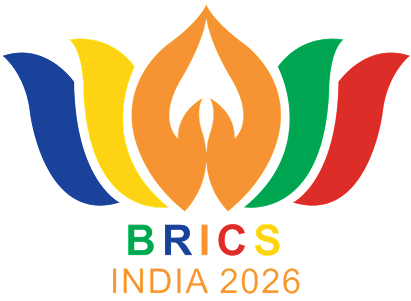
India’s External Affairs Minister, Dr. S. Jaishankar had remarked when unveiling the BRICS 2026 logo, “BRICS remains an important forum that encourages dialogue and cooperation, and practical responses, taking into account national priorities and different stages of development.” This objective stays on its forward momentum, with China taking over the BRICS presidency in 2027.