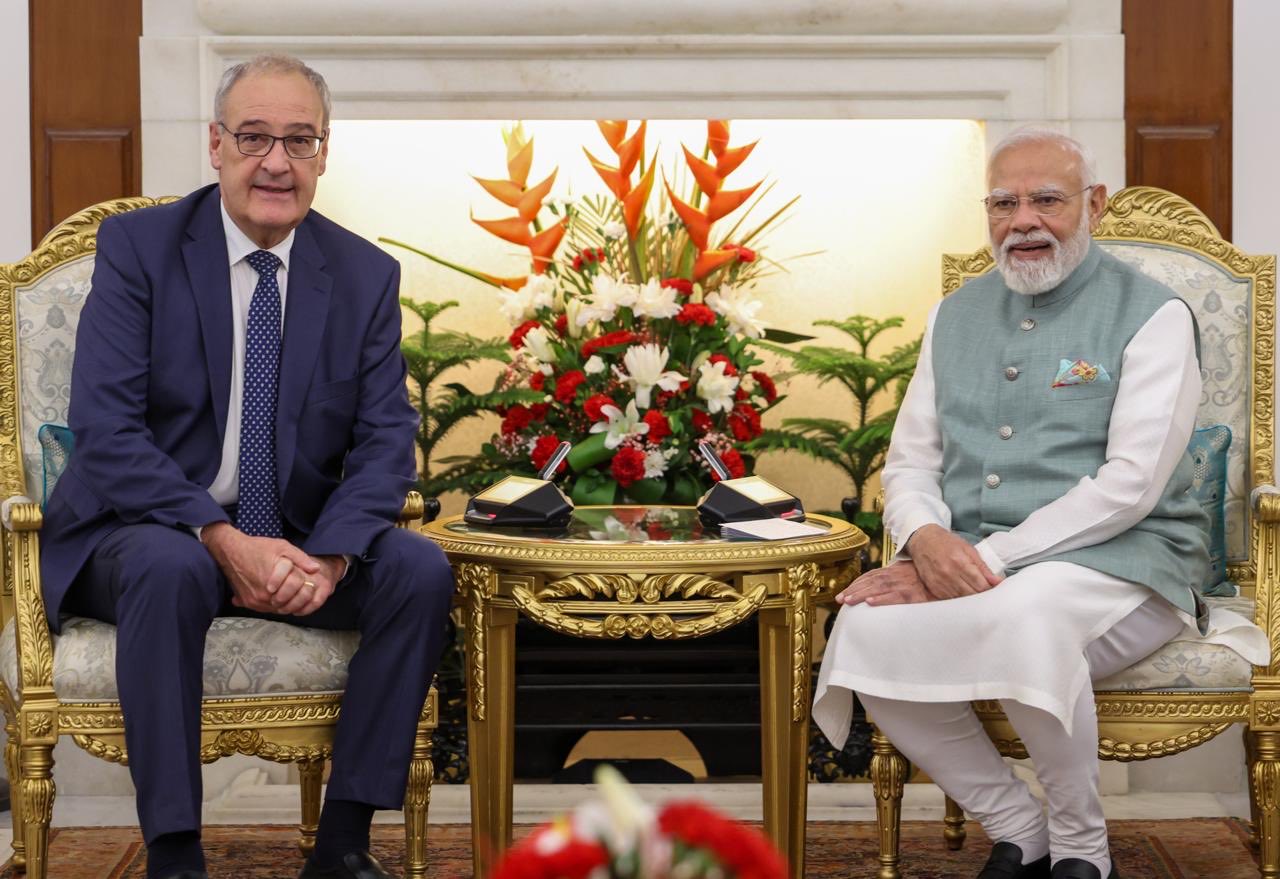
The President of the Swiss Confederation,Guy Parmelin, is visiting India from 5 to 7 October 2026 on a state visit intended to give fresh momentum to the long-standing relationship between Switzerland and India. The three-day visit comes at an important moment for bilateral economic relations, coinciding with the first anniversary of the India-European Free Trade Association (EFTA) Trade and Economic Partnership Agreement (TEPA), which entered into force on 1 October 2025. President Parmelin, who is accompanied by a high-level Swiss business and scientific delegation, has held talks with President Droupadi Murmu and Prime Minister Narendra Modi. The discussions have covered trade and investment, infrastructure, science and technology, education, migration and mobility, defence cooperation, nuclear energy and international affairs.
The visit is also significant in the longer history of relations between the two countries. India and Switzerland are due to mark the 80th anniversary of their diplomatic relations in 2028. Both governments have sought to broaden the relationship beyond traditional commercial ties, with research, innovation, advanced technology and people-to-people exchanges now forming important parts of the partnership.
On 5 October, President Droupadi Murmu received President Guy Parmelin at Rashtrapati Bhavan in New Delhi and hosted a banquet in his honour. The two Presidents reviewed the broad relationship between India and Switzerland, including trade and investment, science, technology and innovation, culture and people-to-people contacts. President Murmu highlighted Switzerland’s importance as a trade and investment partner for India and pointed to the opportunities created by India-EFTA TEPA. She also noted the contribution of Swiss companies to Indian infrastructure, particularly in roads, railway bridges and tunnels, and identified clean and green technologies and artificial intelligence as areas where further cooperation could be explored. She also welcomed the agreements concluded during the visit on migration and mobility, research and technology transfer. Both Presidents expressed confidence that closer cooperation could produce significant benefits for the people of the two countries.
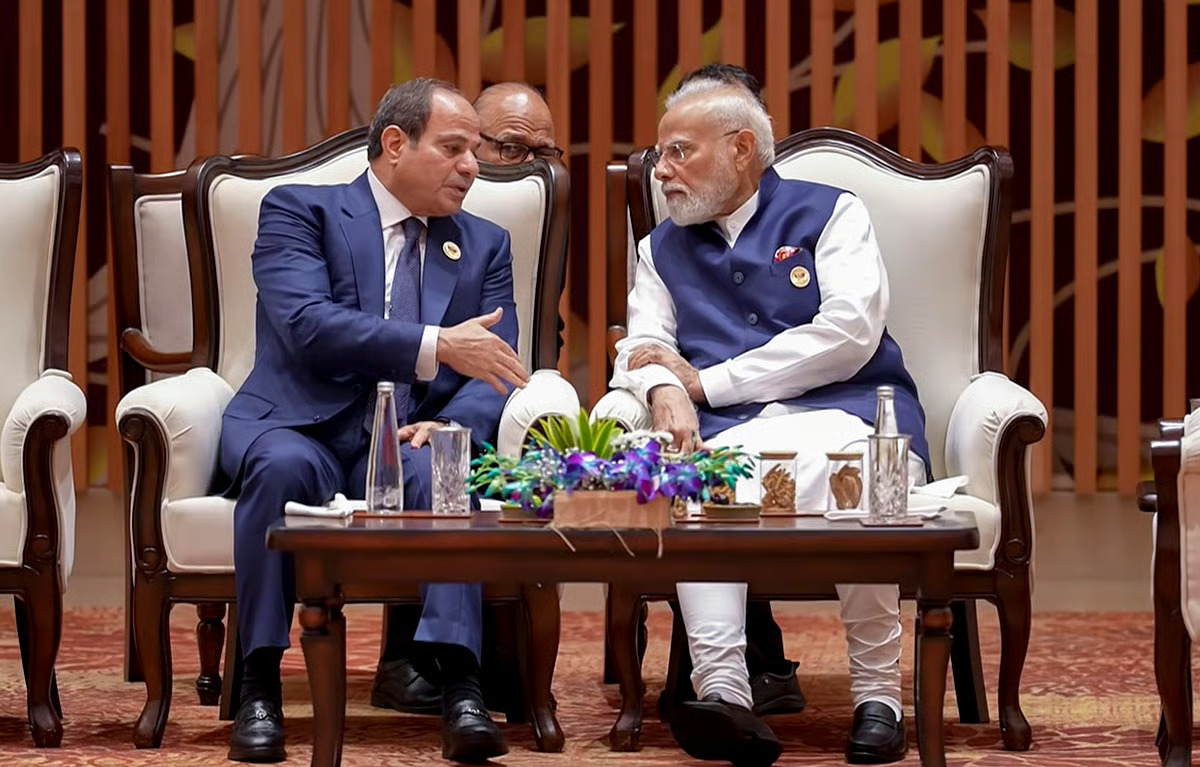
Prime Minister Modi and President Parmelin held detailed discussions, with the economic relationship at the centre, particularly following the implementation of TEPA between India and the four EFTA countries — Switzerland, Norway, Iceland and Liechtenstein. Prime Minister Modi described the agreement as India’s first free trade agreement with a European economic bloc and said it represents a wider framework for investment, innovation, employment and shared prosperity. Under the agreement, India and EFTA have set a target of mobilising US$100 billion in investment in India over 15 years and supporting the creation of one million direct jobs. PM Modi also pointed to opportunities for greater Indian exports to Switzerland in sectors including agricultural products, pharmaceuticals, textiles and engineering goods. India, in turn, is seeking increased Swiss investment in areas such as biotechnology, life sciences, banking, insurance, food processing and sustainability.
The two sides also discussed negotiations on a new bilateral investment protection agreement and continuing talks on intellectual property protection, suggesting that the economic relationship is moving beyond tariff reduction towards a broader investment and regulatory framework. Switzerland regards India as an increasingly important economic partner. More than 330 Swiss companies currently operate in India, underlining the depth of existing commercial links.
One of the most tangible outcomes of the presidential visit has been the conclusion of five agreements and arrangements between Indian and Swiss institutions. The first is a Memorandum of Understanding on Migration and Mobility Partnership. It seeks to strengthen cooperation on migration and mobility while providing mechanisms to address irregular migration, human exploitation and human trafficking in accordance with national laws. The agreement also provides for multiple-entry visas of up to five years, with stays of up to six months on each visit, alongside renewable one-year student permits.
A second agreement concerns the Exchange of Young Professionals. It will create opportunities for young professionals from India and Switzerland to undertake temporary employment in the other country, allowing them to gain professional experience and improve their language skills. The programme provides for the exchange of 300 people annually from each country, with the possibility of increasing the number to 500.
A third agreement focuses on transportation technologies, mobility systems and infrastructure. It is designed to promote cooperation in sustainable infrastructure, including electric vehicles, ropeways, tunnels, circular-economy applications and other transport-related technologies. The agreement has particular relevance because Swiss expertise is already visible in a number of Indian infrastructure projects. Prime Minister Modi referred to the Varanasi ropeway, Jewar Airport and railway and tunnelling projects in mountainous areas as examples of existing cooperation. India has also invited Swiss infrastructure companies to expand their participation in the country’s infrastructure development.
The fourth outcome is a Letter of Intent between India’s Department of Science and Technology and the Swiss National Science Foundation. It is intended to encourage long-term collaboration between Indian and Swiss researchers, including exploratory scientific cooperation and the development of future joint research programmes.
The fifth is an implementation arrangement between India’s Department of Science and Technology and the Zurich University of Applied Sciences covering innovation, technology transfer and entrepreneurship. The arrangement includes the Indo-Swiss Academia-Industry Training programme for early-stage start-ups, with exchanges, workshops, capability building and networking forming part of the initiative.
Science and innovation have featured prominently throughout the visit. On 6 October, Dr. Jitendra Singh, Union Minister of State for Science and Technology, held discussions with President Parmelin on strengthening the India-Switzerland scientific partnership. The discussions covered areas including artificial intelligence, biotechnology, vaccine development, genome sequencing, quantum technology, space and deep-ocean research. The Indian government has described the talks as part of an effort to move the scientific relationship towards a more structured and long-term framework. President Parmelin said Switzerland views India as an emerging global research and development power and wants Switzerland to be a long-term partner in education, research and innovation. Switzerland has earmarked a further CHF 45 million for strengthening the Indo-Swiss research partnership. The two countries have also agreed to develop new joint research projects in areas including health, clean energy and space. AI cooperation received particular attention: Switzerland will host the Geneva AI Summit in 2027, following the AI summit India hosted earlier in 2026, and presents it as a continuation of that global discussion on the responsible and inclusive development of AI.
Switzerland’s experience in mountain railways, tunnelling and transport engineering complements India’s major investment in connectivity and urban infrastructure. On 6 October, President Parmelin visited Noida International Airport in Jewar, Uttar Pradesh. The airport is operated by a subsidiary of Zurich Airport, providing a direct example of Swiss participation in India’s expanding aviation infrastructure. The new transport and infrastructure arrangement offers further openings for Swiss companies in ropeways, tunnels, electric mobility and sustainable infrastructure.
Prime Minister Modi said the two countries had identified new possibilities for cooperation in military exchanges and defence production. The two sides also agreed to deepen cooperation in nuclear energy. These areas add a strategic dimension to what has historically been a relationship strongly associated with trade, finance, science, education and tourism.
The visit concluded with the second India-EFTA Prosperity Summit, which brings together government and business representatives from India and the EFTA countries to examine investment and cooperation opportunities. The summit is particularly important because it takes place one year after TEPA entered into force. The agreement covers trade in goods and services, investment promotion and cooperation, intellectual property, government procurement, competition, sustainable development and other areas of economic cooperation. The first anniversary therefore provides an opportunity for governments and businesses to assess the early implementation of the agreement and identify areas where its provisions can translate into greater commercial activity. EFTA and India have jointly set the long-term objective of $100 billion in investment and one million direct jobs over 15 years.