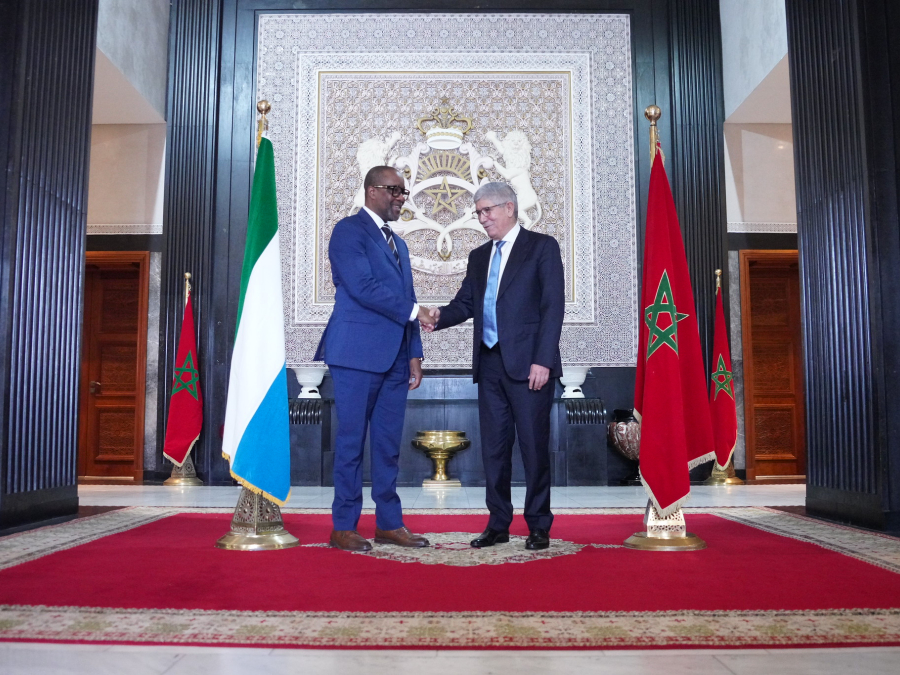
Morocco and Sierra Leone have renewed their commitment to strengthening bilateral relations, with economic partnership, African integration and parliamentary cooperation emerging as key priorities during high-level talks in Rabat on 9 November 2026. The meeting between the Speaker of Morocco’s House of Representatives, Rt. Hon. Ahmed Touizi, and Sierra Leone’s Minister of Foreign Affairs and International Cooperation, Mr. Mohamed Rahman Swaray, highlighted the two countries’ shared interest in translating their longstanding diplomatic friendship into practical cooperation. Mr. Swaray was visiting Morocco on a working visit when the discussions took place. The meeting provided an opportunity to review the positive development of relations between the two African nations and consider ways to expand collaboration across areas of mutual interest, particularly trade, investment and institutional ties.
During the meeting, Rt. Hon. Touizi welcomed the positive direction of bilateral relations and emphasised the importance of strengthening the economic partnership. He also acknowledged Sierra Leone’s support for Morocco’s territorial integrity, an issue that has featured prominently in their diplomatic engagement. Mr. Swaray reiterated Sierra Leone’s support for Morocco’s sovereignty over its entire territory and for the autonomy plan advanced by the Kingdom. His remarks reinforced a political relationship that both sides have presented as grounded in friendship, mutual respect and solidarity.
However, the emphasis on economic cooperation was equally significant. Strong diplomatic relations provide a foundation for closer commercial engagement, but sustained progress depends on identifying viable projects, facilitating investment and creating opportunities for businesses to work across borders. Morocco and Sierra Leone have previously established frameworks for cooperation in areas including agriculture, trade, investment, energy, health, education and technical training. These provide a basis for exploring practical initiatives that could support economic diversification, skills development and stronger commercial links.
Economic cooperation remains central to the relationship. The two countries have previously taken steps to establish a framework for collaboration through their third Joint Commission for Cooperation, whose agreements were signed in Dakhla on 28 April 2023. The agreements covered a range of fields, including agriculture, trade, investment, healthcare, energy, infrastructure and technical and vocational education. Agriculture and food security are particularly relevant areas for further engagement. Cooperation in agricultural research, food safety and technical expertise could help strengthen production systems and improve the exchange of knowledge. Investment in renewable energy and vocational training also offers opportunities to address development priorities while building local capacity.
The September 2026 joint communiqué identified additional priorities, including fertilisers, water management, maritime fisheries, mining, culture and capacity-building. These areas provide a broad agenda for future engagement, although progress will depend on the development and implementation of specific projects. The discussions also placed bilateral relations within the wider context of African economic integration. Rt. Hon. Touizi highlighted initiatives promoted by His Majesty King Mohammed VI, including the African Atlantic States Process, the Royal Initiative to facilitate Atlantic Ocean access for Sahel countries and the Atlantic African Gas Pipeline project.
The gas pipeline, commonly referred to as the Nigeria-Morocco Atlantic African Gas Pipeline, was discussed as a potential contributor to regional energy cooperation and economic connectivity. Mr. Swaray welcomed progress on the project, emphasising its relevance to South-South cooperation and the expansion of trade across Africa. The intergovernmental agreement relating to the pipeline was signed at a summit of African heads of state and government in Freetown in July 2026, according to the September joint communiqué. While the project remains a regional undertaking, its longer-term significance could extend to participating countries through improved energy access, industrial development and stronger economic connections.
Alongside economic matters, parliamentary cooperation featured prominently in the Rabat discussions. Rt. Hon. Touizi stressed the importance of regular coordination, consultation and the exchange of experience between the legislative institutions of Morocco and Sierra Leone. He also extended an invitation to the Speaker of Sierra Leone’s Parliament to undertake a working visit to Morocco. The proposed visit would provide an opportunity for the two legislatures to explore avenues for closer institutional cooperation. Parliamentary engagement can complement diplomatic and economic initiatives by facilitating exchanges on legislative practices, governance and the oversight of public programmes. It can also create channels through which lawmakers share experience in addressing development challenges and strengthening public institutions.
As African countries seek to strengthen regional economic links and reduce dependence on external market fluctuations, partnerships built around shared development priorities are gaining importance. Morocco and Sierra Leone have signalled their intention to contribute to that process through closer bilateral engagement. The November discussions did not announce a new package of economic agreements, but they reinforced the political commitment to advancing cooperation. Continued dialogue, supported by concrete projects and regular parliamentary exchanges, will be important in determining how far the two countries can take their partnership in the coming years