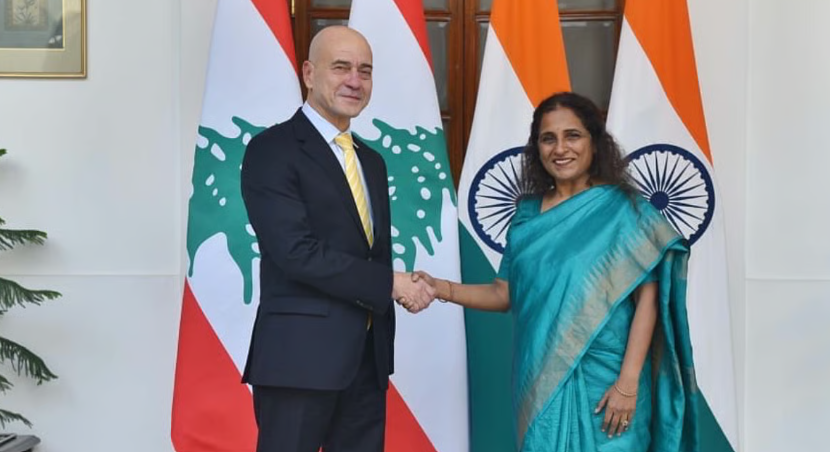
India and Lebanon held their first-ever Foreign Office Consultations in New Delhi on November 9, 2026, marking an important step in efforts to strengthen bilateral relations and establish a more structured dialogue between the two countries. The discussions covered political and security cooperation, economic ties and socio-cultural relations, with both sides identifying trade and investment, digital public infrastructure and pharmaceuticals as priority areas for future engagement. The consultations were co-chaired by Ambassador Sripriya Ranganathan, Secretary for Consular, Passport and Visa and Overseas Indian Affairs in India’s Ministry of External Affairs, and Ambassador Abdel Sattar Issa, Secretary-General of Lebanon’s Ministry of Foreign Affairs and Emigrants.
According to India’s Ministry of External Affairs, the meeting provided an opportunity for the two delegations to review the full range of bilateral relations and explore ways to expand cooperation across areas of mutual interest. The officials also exchanged views on regional and international developments. The inaugural consultations establish a formal platform for regular diplomatic engagement, allowing both governments to review existing cooperation, identify emerging opportunities and discuss issues that affect their respective regional and international interests.
Trade and investment featured among the principal areas identified for closer cooperation. India and Lebanon have scope to explore opportunities for stronger commercial engagement, particularly through business contacts, improved market access and exchanges between their private sectors. India’s large domestic market and established manufacturing base offer potential opportunities for Lebanese businesses, while Lebanon’s geographical position in the eastern Mediterranean provides a possible point of engagement for Indian companies seeking connections across the wider region. Translating this potential into tangible results will depend on business conditions, market demand and the ability of companies to establish sustainable commercial partnerships.
The consultations also highlighted pharmaceuticals as a priority. India has a substantial pharmaceutical manufacturing industry and is an established supplier of medicines to international markets. Greater engagement in this sector could create opportunities to strengthen commercial links and explore areas of mutual interest in medicine supply and healthcare-related cooperation. However, the official announcement did not specify individual pharmaceutical projects, investment commitments or new agreements signed during the meeting. The emphasis was on identifying priority areas for cooperation rather than announcing a detailed programme of commercial initiatives.
Digital public infrastructure was another important subject. India has developed digital systems for delivering public services and supporting digital payments, identity-related services and other aspects of economic activity. Discussions around this area provide an opportunity for both countries to consider whether their respective experience and requirements could support future exchanges of knowledge and technical cooperation. The identification of these three priorities gives the bilateral economic agenda a practical direction. Their eventual impact will depend on follow-up discussions and the development of specific initiatives that can be implemented by the two governments and relevant institutions.
The November consultations follow earlier diplomatic contacts between Indian and Lebanese officials during 2026. In August, Ambassador Sripriya Ranganathan visited Lebanon as part of an official trip that also included Egypt and Palestine from August 16 to 21. During her stay in Beirut, she met Ambassador Abdel Sattar Issa to review bilateral relations and discuss opportunities to strengthen cooperation. The two officials also exchanged views on the evolving regional situation. Ambassador Ranganathan also called on Dr Nawaf Salam, Prime Minister of Lebanon. Their discussions focused on building on the existing foundation of India-Lebanon cooperation and exchanging perspectives on regional and international developments. She also met Nabih Berri, President of Lebanon’s National Assembly, with discussions including the potential for stronger parliamentary exchanges.
The talks also reflect the importance both countries attach to maintaining diplomatic communication at a time of wider regional uncertainty. For Lebanon, regional security and political stability remain significant concerns. India, meanwhile, has longstanding interests in the stability of West Asia and in maintaining constructive relations with countries across the region.The two delegations discussed regional and international issues of mutual interest during the November meeting. The official announcement did not identify individual issues in detail, so the precise subjects covered should not be assumed beyond what the two governments confirmed.
India and Lebanon’s relationship extends beyond government-to-government contacts. Cultural exchanges, educational links, people-to-people connections and cooperation in international forums provide additional foundations for engagement. Continued diplomatic dialogue can help both sides identify practical ways to develop these connections alongside economic cooperation. India also contributes personnel to the United Nations Interim Force in Lebanon (UNIFIL), reflecting its involvement in international efforts supporting peace and stability in the country. Lebanese officials have previously acknowledged India’s contribution to the UN peacekeeping mission, underlining the importance of this dimension of the relationship. For India and Lebanon, the next step will be to translate the discussions into concrete initiatives. Continued consultations and follow-up at the diplomatic and institutional levels will be important in determining how effectively the two countries can turn their shared interests into lasting cooperation.