India and Japan share a longstanding partnership spanning trade, investment, infrastructure, technology and strategic cooperation. Bilateral trade reached around US$27.5 billion in FY 2025–26, with Japan remaining India’s fifth-largest source of foreign direct investment. The partnership gained further momentum during Japanese Prime Minister Sanae Takaichi’s visit to India in July 2026 for the 16th India-Japan Annual Summit, where both sides reviewed progress on cooperation in economic security, investment, technology, critical minerals and AI, and reaffirmed the target, first agreed at the 15th Annual Summit in Tokyo in August 2025, of mobilising ¥10 trillion in private Japanese investment in India over the next decade.
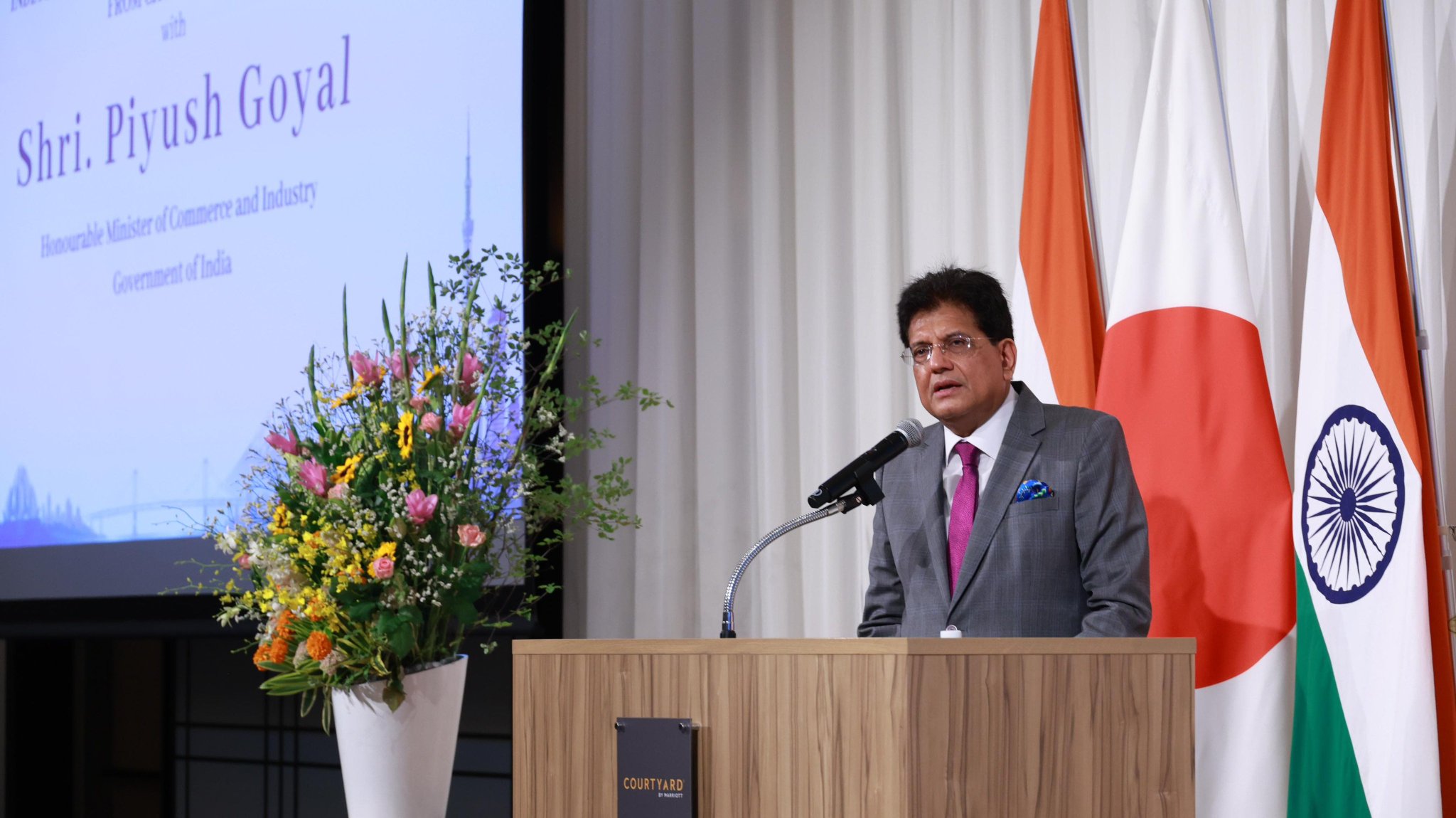
Against this backdrop, Union Minister for Commerce and Industry, Mr. Piyush Goyal undertook an official visit to Japan from 24–27 August 2026, travelling to Tokyo, Nagoya and Osaka. He led India’s largest-ever business delegation to Japan, comprising more than 200 representatives from sectors including manufacturing, semiconductors, clean energy, steel, automobiles, financial services, healthcare and start-ups. The visit was designed to take forward the discussions held during the July summit and deepen trade and investment ties through direct engagement with Japanese government and industry leaders.
At the government level, Mr. Goyal met Japan’s Minister of Economy, Trade and Industry, Mr. Akazawa Ryosei, on 25 August in Tokyo to discuss strengthening bilateral trade and investment, the ongoing review of the India-Japan Comprehensive Economic Partnership Agreement (CEPA) and cooperation in semiconductors, AI and advanced manufacturing. He also chaired an India-Japan industry roundtable on semiconductors and AI, where around 21 Japanese companies expressed confidence in India’s growing technology ecosystem and reaffirmed their commitment to “Make in India, Design in India and Develop in India.”
At the Semiconductor and AI Roundtable, Mr. Goyal highlighted India’s projected USD 150 billion semiconductor demand by 2032 and its six-pillar strategy covering chip design, machinery and materials, fabrication, ATMP/OSAT, R&D and talent development. Discussions also explored partnerships involving Tier-II and Tier-III suppliers and MSMEs, strengthening their integration into global production networks.
The visit also focused on business-to-business engagement, with Mr. Goyal addressing Japan’s leading business federation, Keidanren and encouraging greater Japanese investment in India. As 2026 marks the “India-Japan Year of Shared Horizons,” commemorating 75 years of diplomatic relations, the delegation engaged businesses across Tokyo, Nagoya and Osaka on manufacturing, technology, innovation and resilient supply chains. Mr. Goyal called Japan a “trusted partner”, emphasising partnerships combining capital, technology and manufacturing capabilities.
Investment was another major pillar of the visit. Mr. Goyal held discussions with senior representatives of Japanese financial institutions including Mitsubishi UFJ Financial Group (MUFG), Mizuho, Development Bank of Japan (DBJ), Morgan Stanley, Nomura and Nippon Life. Highlighting the resilience of the Indian economy, he noted that India had recorded 7.7% growth despite global headwinds and remained on course towards its ambition of becoming a USD 30 trillion economy by 2047. The engagement sought to encourage greater Japanese institutional capital into India and strengthen investment linkages. The discussions also highlighted opportunities associated with India’s financial ecosystem, including Gujarat International Finance Tec-City (GIFT City), while emphasising the importance of long-term investment, technology partnerships and integration with global value chains.
In Nagoya, Mr. Goyal led a business roadshow with Chukeiren and the Nagoya Chamber of Commerce & Industry, engaging Aichi Prefecture leaders and major investors and companies from the automotive and steel sectors to promote greater Japanese investment and manufacturing partnerships in India.
The visit concluded in Osaka with an Investors and Business Roadshow and meetings with Japanese companies across the electronics, industrial and consumer sectors, highlighting opportunities in India’s manufacturing, clean-energy and consumer markets.
The broader significance of the visit lies in linking economic cooperation with technology, supply-chain resilience and economic security. The next priority is implementation—turning investment commitments into projects, expanding technology partnerships and strengthening manufacturing linkages. Alongside the ¥10 trillion Japanese private-investment target, these efforts could shape the next phase of the India-Japan economic partnership.