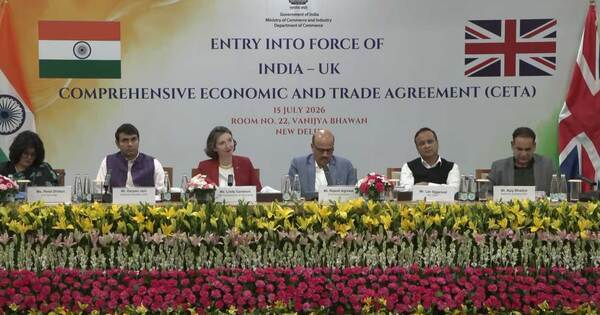
The India–United Kingdom Comprehensive Economic and Trade Agreement (CETA) formally entered into force on 15 July 2026, together with a companion Agreement on Social Security Contributions, also known as the Double Contribution Convention (DCC). The agreements mark a new phase in India’s economic diplomacy, with the period of exemption under the DCC increased from three years to five years for temporary Indian workers.
CETA was signed by Commerce and Industry Minister Piyush Goyal and UK Secretary of State for Business and Trade Jonathan Reynolds, in the presence of the two prime ministers, following the conclusion of negotiations announced on 6 May 2025. The companion DCC was signed subsequently, on 10 February 2026.
With entry into force, tariffs of up to 70% on processed food products, up to 21.5% on marine products, up to 18% on engineering goods and auto components, up to 16% on leather and footwear, up to 12% on textiles and clothing, and up to 8% on chemicals and pharmaceutical products have been reduced to zero. India, in turn, has offered tariff concessions on 89.5% of its tariff lines, covering 91% of the UK’s exports, with 24.5% of UK export value receiving immediate duty-free access and the remainder phased in gradually.
Sensitive sectors, including agriculture and strategically important industries, have been protected through exclusions or phased tariff reductions, covering products such as dairy, cereals and millets, pulses, edible oils, gold, jewellery and lab-grown diamonds. Separately, both governments have reached an understanding on steel. The UK’s new steel measures on 188 tariff lines, effective from 1 July 2026, affect only around 14% of India’s total steel exports by value, and the two sides have worked to ease their impact through quotas and access mechanisms.
Commerce and Industry Minister Piyush Goyal wrote on X that the deal marked a “defining milestone in India-UK ties”, adding that CETA delivers zero-duty market access for nearly 99% of India’s exports, covering almost 100% of trade value.
Prime Minister Narendra Modi, in a post on X, described the day as “a significant moment in the India-United Kingdom partnership”, noting that the agreements would help “translate our shared ambition into tangible opportunities for our people”.
Trade Context
Merchandise trade between India and the UK reached USD 25.12 billion in 2025-26, with India’s exports valued at USD 13.44 billion and imports at USD 11.68 billion, giving India a trade surplus of USD 1.76 billion. Bilateral services trade touched USD 35.44 billion in 2024, with India recording a services surplus of USD 7.88 billion. The UK is India’s sixth-largest inward investor, with a cumulative equity investment of USD 35 billion until September 2024, while 971 Indian companies operating in the UK employed over one lakh people as of July 2025.
Trade began moving under the new arrangement on the first day itself. The first commercial consignments, valued at USD 446,046, were flagged off from Chennai on 15 July 2026. A separate flag-off ceremony was held at the Surat Diamond Bourse, where consignments of studded and plain gold jewellery, cotton embroidered fabrics, prebiotic soda drinks and perfumery compounds were dispatched, alongside a consignment of mixed spices and chemicals from the Bharuch district.