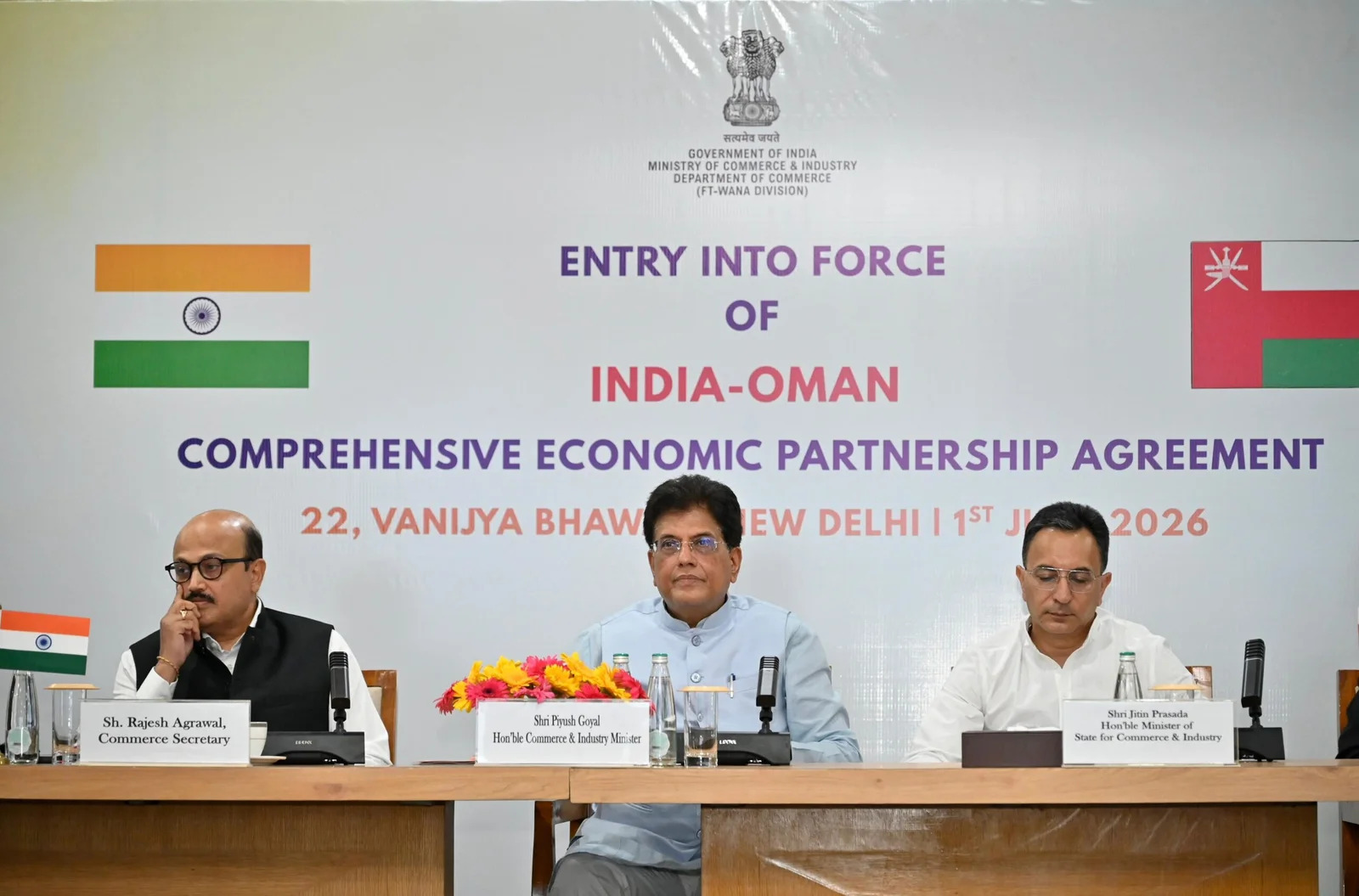
The Comprehensive Economic Partnership Agreement (CEPA) between India and Oman came into force on 1 June 2026, following the completion of the internal ratification processes by both countries. The agreement was signed on 18 December 2025 in Muscat. This marks the fifth free trade agreement implemented under the current Indian government since 2014.
To commemorate the occasion, approximately ten consignments of agricultural products and gems and jewellery products were shipped from Mumbai, Kolkata, and Chennai to Oman under preferential tariff rates.
Commerce and Industry Minister Piyush Goyal highlighted the importance of CEPA in a written article titled ‘India-Oman pact holds promises for farms, factories and small businesses’. He further posted, X: “A new chapter unfolds. As the India-Oman Comprehensive Economic Partnership Agreement (CEPA) comes into force today, I write about how it will deepen the economic & strategic ties between the two nations. Guided by PM Narendra Modiji’s vision of expanding India’s global trade partnerships, the agreement will significantly benefit India’s students, artisans, women, farmers, fishermen, and MSMEs by opening new markets, boosting exports, attracting investments, and accelerating job creation.”
Under CEPA, India gains 100% duty-free market access for its exports to Oman, covering 98.08% of Oman’s tariff lines. This represents 99.38% of bilateral trade value, based on 2022–23 trade data. Currently, only 15.33% of India’s export value enters Oman duty-free under the Most Favoured Nation (MFN) regime.
Sectors on the Indian side set to benefit from immediate duty-free access include textiles, leather goods, plastics, marine products, automobiles, sports goods, agricultural items, gems and jewellery, iron and steel, and electrical machinery. Indian agricultural exports such as natural honey, potatoes, cashews, boneless meat, and bakery items will also receive immediate duty-free entry.
India has protected sensitive domestic sectors by placing 2,789 tariff lines on an exclusion list. These include dairy products, cereals, fruit and vegetables, spices, and products of animal origin, among others.
The agreement includes services commitments from Oman. The Intra-Corporate Transferees (ICT) ceiling has been raised from 20% to 50%, allowing Indian firms to deploy more managerial and specialist personnel. For the first time in any of Oman’s bilateral trade pacts, Oman has made specific commitments for professional service providers in sectors including information technology, accounting, engineering, medicine, education, construction, and consulting.
Bilateral trade between India and Oman reached USD 11.18 billion in the financial year 2025–26, up from USD 10.61 billion in 2024–25. India’s goods exports to Oman stood at USD 4.02 billion, while imports from Oman were valued at USD 7.16 billion.
Oman is India’s second-largest trading partner in the Gulf region and serves as a strategic gateway to the wider Gulf Cooperation Council (GCC) market through its port infrastructure. This CEPA is the first bilateral trade agreement Oman has signed with any country since its agreement with the United States in 2006. Nearly 700,000 Indian nationals reside in Oman, contributing approximately USD 2 billion in annual remittances. Over 6,000 Indian establishments operate in the country.
The agreement is expected to create “a strategic economic corridor” that will “significantly boost bilateral trade, exports, and employment generation”.