The economic and commercial relations between Oman and India have evolved into a robust partnership built on mutual respect, shared strategic interests, and expanding trade and investment linkages. Bilateral trade between Oman and India has maintained a strong trajectory, increasing from USD 5.44 billion in FY 2020–21 to USD 12.39 billion in FY 2022–23, before stabilising at USD 8.95 billion in FY 2023–24 and USD 10.61 billion in FY 2024–25, in line with commodity price normalisation, reflecting the growing dynamism in economic engagement.
Investment flows in both directions have also been impressive, underscored by the presence of over 6,000 Oman-India joint ventures in Oman with an estimated investment of over USD 7.5 billion. Indian companies have emerged as major investors, particularly in the Sohar and Salalah Free Zones, while new investments are steadily increasing in the Duqm Special Economic Zone. The cumulative FDI equity inflow from Oman to India during April 2000 to March 2025 stands at USD 605.57 million, further affirming the strength of bilateral economic ties.
Institutional Mechanisms and Cooperation
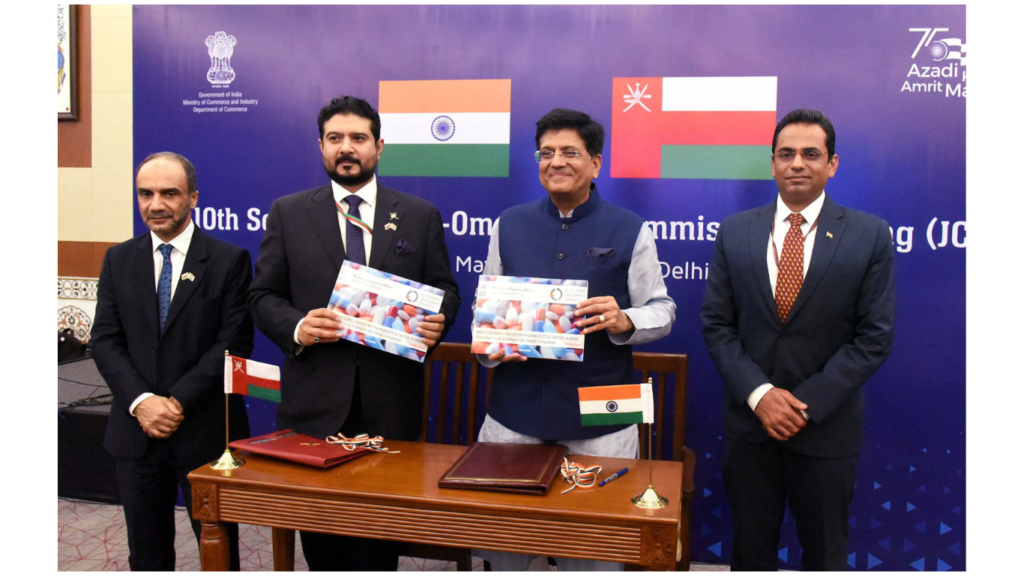
Both countries attach high priority to strengthening their economic and commercial cooperation through institutional mechanisms such as the India-Oman Joint Commission Meeting (JCM) and the Joint Business Council (JBC). The 10th Session of the JCM was held in May 2022 in New Delhi, co-chaired by Shri Piyush Goyal, India’s Minister of Commerce & Industry, and H.E. Qais bin Mohammed al Yousef, Oman’s Minister of Commerce, Industry and Investment Promotion. The meeting provided an opportunity to review the full spectrum of bilateral economic ties and to explore cooperation in trade, technology, tourism, renewable energy, health, mining, and information technology.
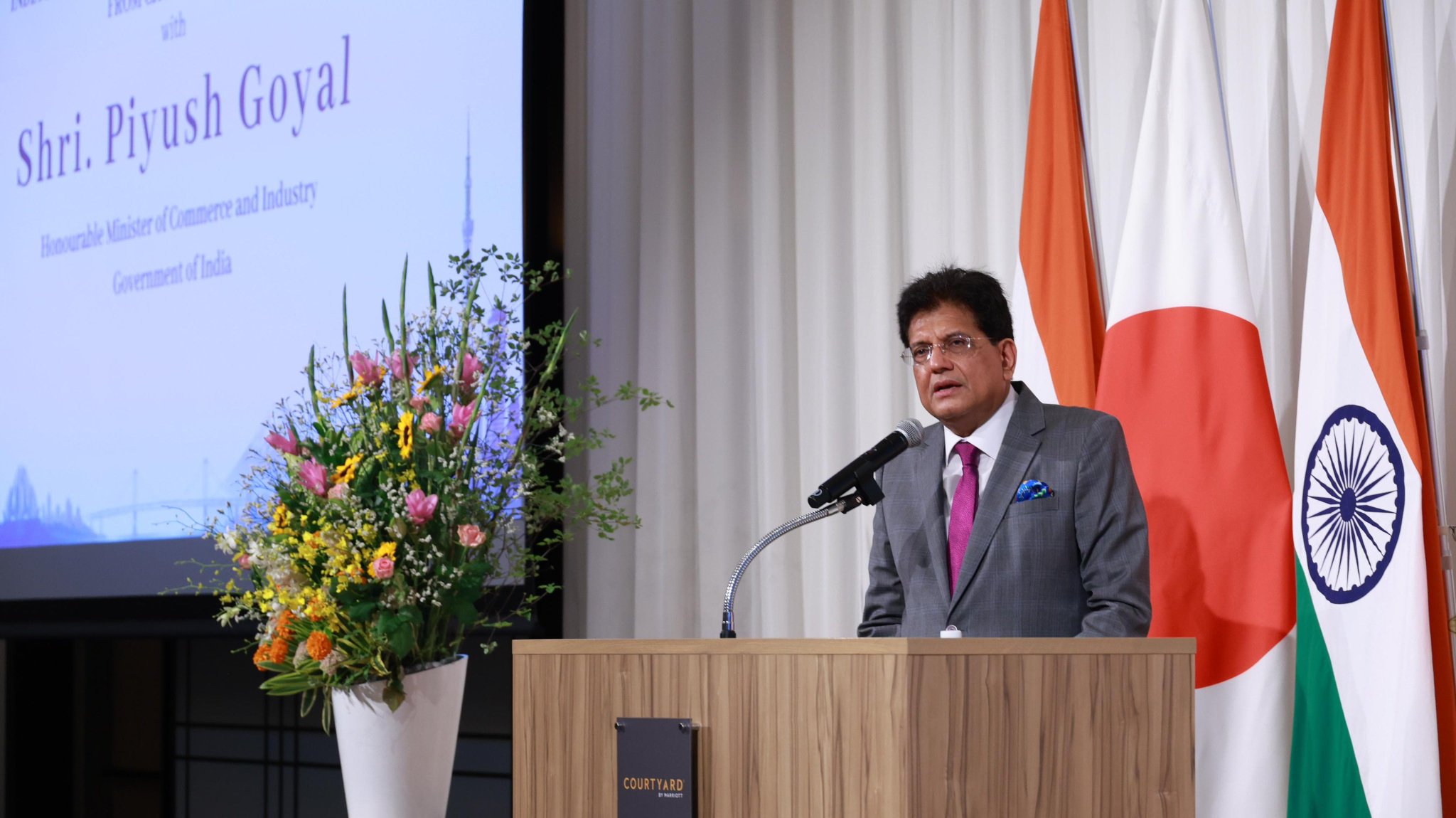
Building upon that momentum, Shri Piyush Goyal concluded a successful visit to the Sultanate of Oman from 27 to 28 January 2025. During this visit, he co-chaired the 11th Session of the India-Oman JCM with H.E. Qais bin Mohammed Al Yousef. Both sides held productive discussions on enhancing cooperation across trade, investment, technology, food security, and renewable energy. A detailed review of bilateral economic relations was undertaken, and concrete steps were identified to further deepen business engagement.
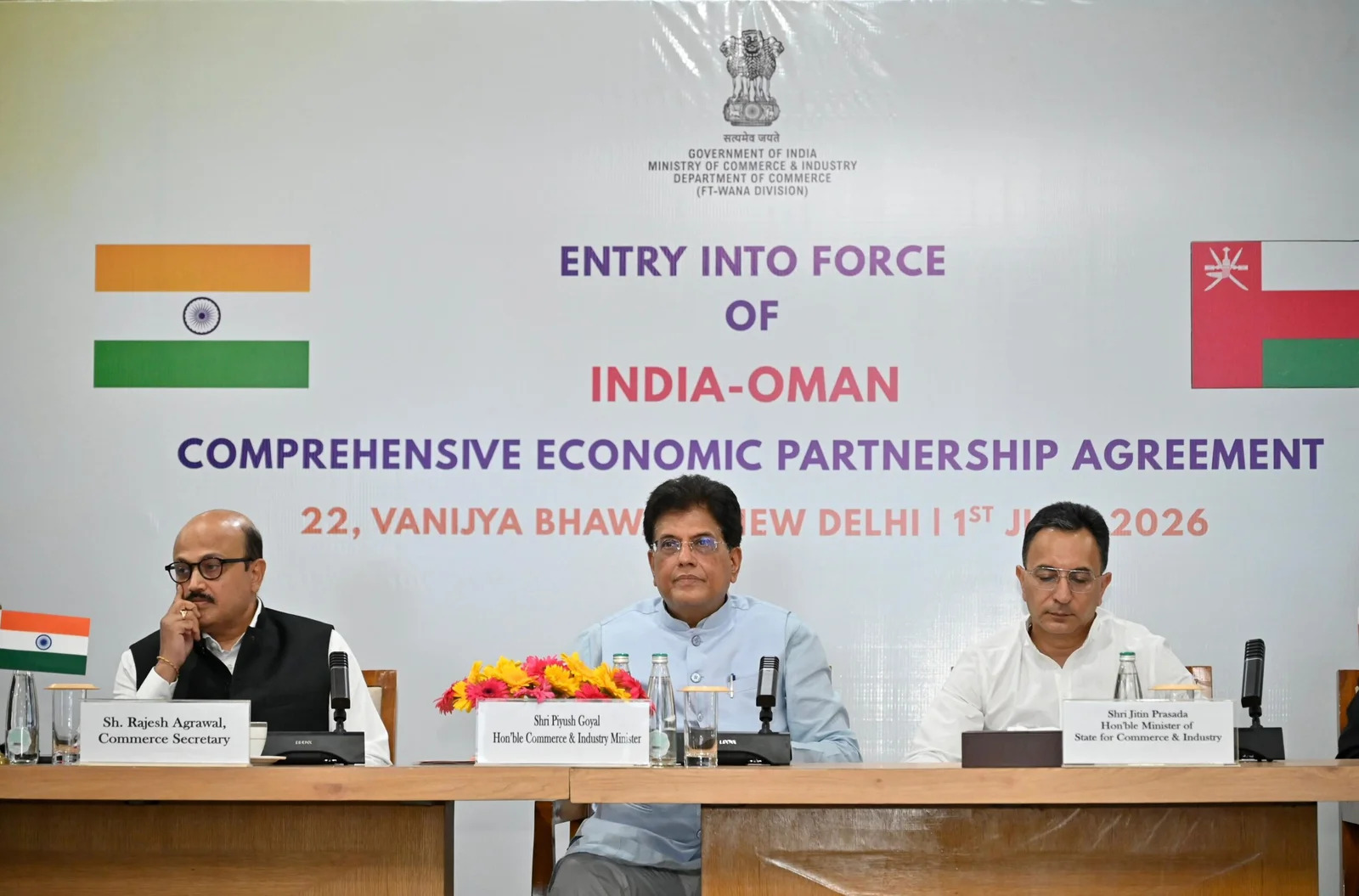
A major outcome of the visit was the agreement to expedite negotiations on the proposed India-Oman Comprehensive Economic Partnership Agreement (CEPA), which, upon its signing, is expected to become a milestone in bilateral trade, scaling up two-way investments and market access. On the sidelines, the two countries signed a protocol amending the Double Taxation Avoidance Agreement (DTAA) to align it with international taxation standards and streamline cross-border tax procedures. Shri Goyal also met with H.H. Sayyid Asa’ad bin Tariq Al Said, Deputy Prime Minister for International Relations, as well as H.E. Sultan bin Salem Al Habsi, Minister of Finance, and H.E. Ali bin Masoud Al Sunaidy, Chairman of OPAZ, to discuss deeper cooperation in economic zones and free-zone development.
He further attended the India-Oman Joint Business Council meeting, hosted by the Oman Chamber of Commerce and Industry with FICCI’s support, facilitating wide-ranging discussions between the business communities of both nations.
Bilateral trade
Between April 2000 and March 2025, Oman sent a total of US$605.57 million in cumulative FDI equity inflow to India.
The composition of bilateral trade between Oman and India remains diversified, with India’s primary exports including light oils and preparations, alumina, rice, and machinery, while its key imports comprise crude oil, liquefied natural gas (LNG), urea, ammonia, sulphur, plastics, and ores.
The Government of Oman has expressed its keenness to establish direct trade links with India. During the COVID-19 pandemic, India served as a reliable supplier of essential commodities such as fruits, vegetables, and food items to Oman.
Bilateral Investment Cooperation
Investment remains a central pillar of Oman-India relations. The Oman-India Joint Investment Fund (OIJIF) represents a key institutional initiative fostering mutual investment. Established in July 2010 as a 50-50 joint venture between the State Bank of India and the State General Reserve Fund (now the Oman Investment Authority), the Fund began operations in 2011 with an initial seed capital of USD 100 million, fully invested across seven diversified Indian companies. The second tranche of USD 200 million was launched in 2017, supporting additional projects in India.
Building on earlier successes, the announcement of the third tranche of the OIJIF worth USD 300 million during the visit of His Majesty Sultan Haitham Bin Tarik to India in December 2023, stands out among the key outcomes of the visit. This development underscores the growing confidence in India’s economic fundamentals and positions OIJIF as an anchor for directing smart capital into high-growth Indian sectors.
Digital Payment Linkage (CBO-NPCI)
The Central Bank of Oman (CBO) and the National Payments Corporation of India (NPCI) signed a Memorandum of Understanding (MoU) in October 2022 to link their national payment systems. The agreement enables interoperability between Oman’s domestic payment network and India’s RuPay and Unified Payments Interface (UPI) systems, paving the way for wider acceptance of Indian digital payment instruments in Oman. The initiative also lays the groundwork for future low-cost, real-time remittance solutions between the two countries.
Conclusion
Oman and India enjoy a strong and growing trade partnership driven by mutual economic interests and strategic cooperation. With expanding engagement in sectors such as energy, manufacturing, food security, and technology, both nations are working to deepen their economic linkages. Oman and India stand poised to build a more resilient, diversified, and future-ready economic partnership.