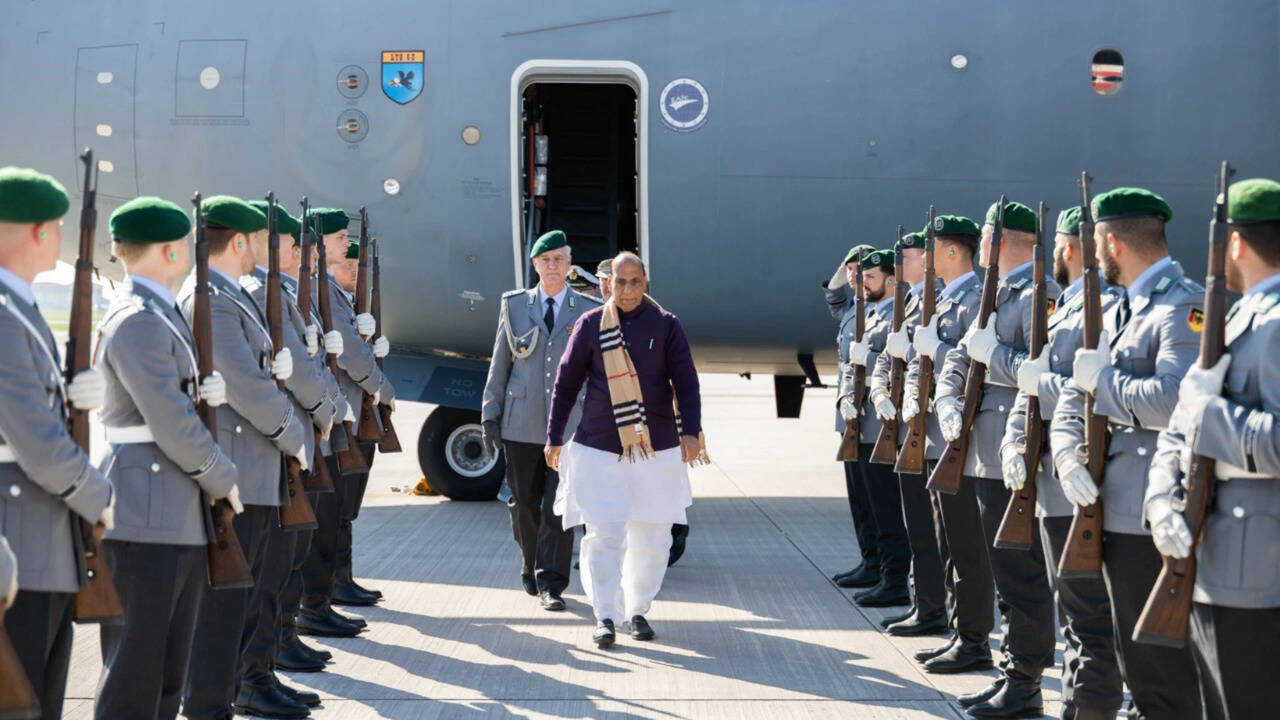
India’s Defence Minister Shri Rajnath Singh undertook an official visit to Germany from 21 to 23 April 2026 to further strengthen the strategic defence partnership between the two countries. The visit included bilateral talks with the German Federal Minister of Defence, Mr Boris Pistorius, and other senior leaders, with discussions focused on enhancing defence industrial collaboration, strengthening military-to-military engagements, and exploring opportunities in emerging domains such as cybersecurity, artificial intelligence, and drones.
Address to German Parliamentarians
On the first day of the visit, Shri Rajnath Singh addressed the German Parliamentary Standing Committee on Defence and Security in Berlin. He made a strong pitch for enhanced collaboration between the defence industrial ecosystems of India and Germany. He said, “Aatmanirbhar Bharat is not merely a procurement programme; it is an invitation to co-create, co-develop, and co-innovate.” He further stated, “Prime Minister Shri Narendra Modi and German Chancellor Mr Friedrich Merz have placed strong emphasis on advancing this strategic partnership. We also see a clear convergence of views at the European Union level, reflected in the growing momentum to engage with India.”
Earlier the same day, he paid floral tributes to Gurudev Rabindranath Tagore at the premises of Humboldt University in Berlin, underscoring the cultural and intellectual ties between the two nations.
Bilateral Talks and Agreements in Berlin
On 22 April 2026, Shri Rajnath Singh held bilateral talks with Mr Boris Pistorius in Berlin. Prior to the meeting, he was accorded a ceremonial Guard of Honour at the German Ministry of Defence and placed a wreath at the Bundeswehr Memorial. The two Ministers discussed a range of bilateral security and defence issues, including priority areas for co-development and co-production of defence equipment, especially in niche technologies. They reaffirmed their commitment to enhancing military-to-military cooperation as a key pillar of the Strategic Partnership.
During the meeting, the two sides signed and exchanged the Defence Industrial Cooperation Roadmap and the Implementing Arrangement for Cooperation in UN Peacekeeping Training. He termed his visit to Germany a symbol of deep friendship, synergy, and trust.
Visit to TKMS Submarine Facility in Kiel
The Defence Minister visited the ThyssenKrupp Marine Systems (TKMS) submarine building facility in Kiel, accompanied by Mr Pistorius. In a post on X, he described the visit as “an insightful visit showcasing cutting-edge technologies and advanced naval capabilities, which will be mutually beneficial for cooperation in the maritime domain.”
Defence Investor Summit in Munich
On the final day of the visit, 23 April 2026, the Raksha Mantri addressed Indian and German defence industry leaders at the Defence Investor Summit in Munich. He invited the German industry to co-develop and co-produce with India, particularly in niche technologies. He stated: “We see self-reliance as the ability to design, develop, and produce in India, in collaboration with trusted partners. We are moving towards a model where India is not merely a buyer of defence equipment, but a partner in design, development, and production.” He referred to the significant untapped potential under the ReArm Europe and Aatmanirbhar Bharat initiatives, in areas including advanced radar and sensor technology, multi-sensors, AI-enabled Unmanned Aerial Systems, sonobuoys, and high power low frequency underwater transmitters.
Context of the Visit
The visit took place against the backdrop of India and Germany commemorating 75 years of diplomatic relations and completing 25 years of their Strategic Partnership in 2026. The Defence Industrial Cooperation Roadmap follows the Joint Declaration of Intent signed during German Chancellor Friedrich Merz’s visit to India on 12-13 January 2026, which envisaged long-term industry-level collaboration, technology partnerships, and co-production of defence platforms and equipment.