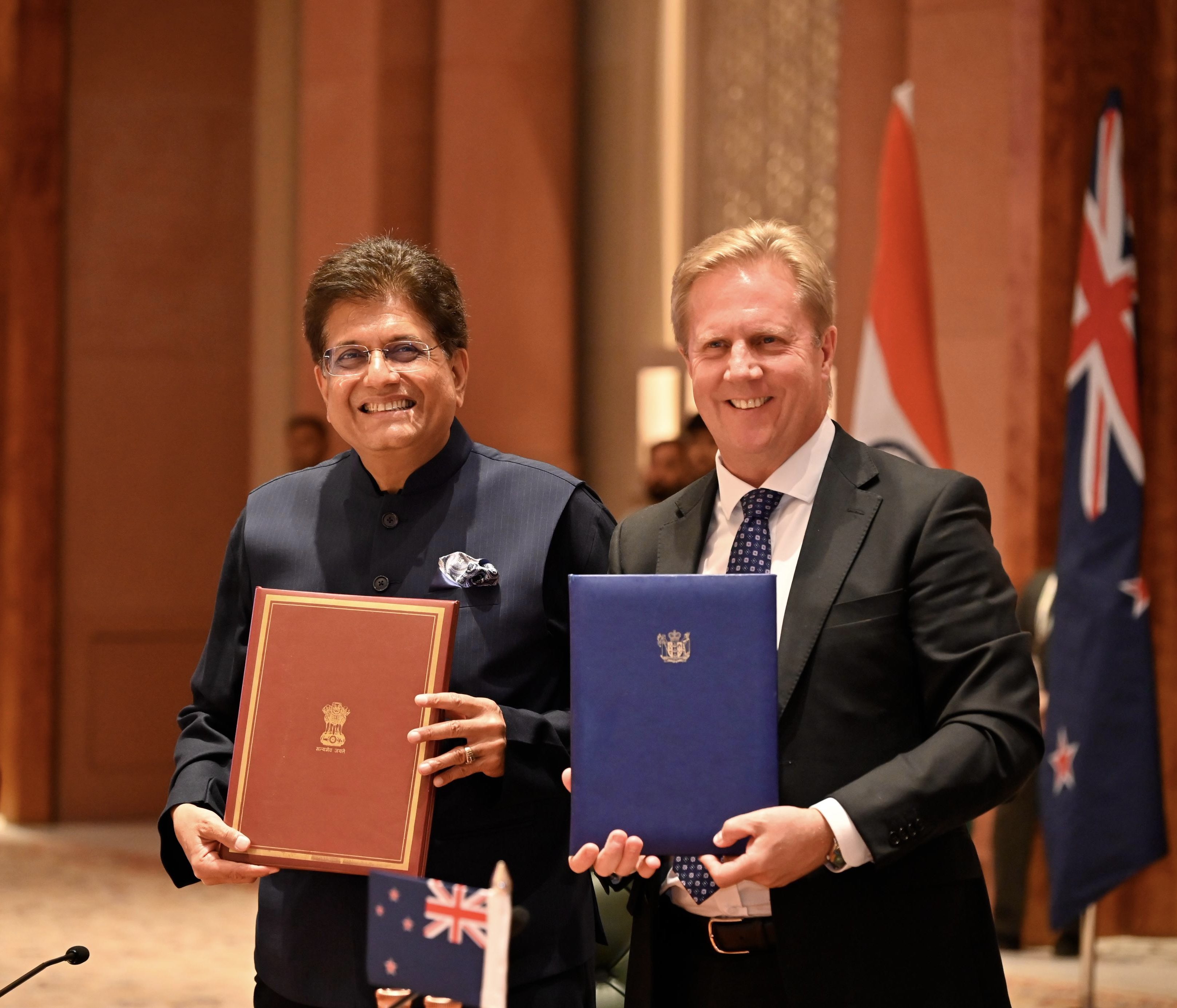
The landmark India-New Zealand Free Trade Agreement is a major step forward in bilateral economic relations, opening new avenues for trade, investment, services, and mobility between the two countries. The agreement was signed under the visionary leadership of Hon’ble Prime Minister Narendra Modi at Bharat Mandapam, New Delhi by India’s Commerce and Industry Minister, Mr. Piyush Goyal and New Zealand’s Minister for Trade and Investment, Mr. Todd McClay. This agreement reflects both nations’ commitment to deepening economic cooperation and strengthening their strategic partnership.
New Zealand’s Minister for Trade and Investment called this FTA a “Once-in-a-Generation” opportunity, as it is expected to reduce trade barriers, improve market access, create employment opportunities, and enhance bilateral trade ties. According to India’s “Viksit Bharat 2047” mission, this initiative is a defining milestone in increasing India’s engagement with developed economies. With this agreement, India continues to expand its network of trade partnerships with advanced economies, strengthening its role in global trade and investment.
A major highlight of the agreement is that New Zealand will provide duty-free access to 100 per cent of India’s exports from the date the FTA comes into force. This includes products from sectors such as textiles, apparel, leather, footwear, gems and jewellery, engineering goods, and processed foods. India will reduce tariffs on around 70 per cent of tariff lines, while excluding sectors such as dairy, selected agricultural products, and some industrial goods.
The agreement provides duty-free imports of selected industrial inputs from New Zealand, including cooking coal, wooden logs, and metal scraps. These provisions apply under the tariff schedules agreed upon by both countries.
In the services sector, the agreement provides market access for Indian service suppliers in 118 sectors in New Zealand. These sectors include information technology, business services, education, financial services, and tourism. The agreement also includes Most-Favoured-Nation commitments in specified service sectors for India, as New Zealand offers to any other country in the same service sectors.
The mobility provisions under the agreement allow for up to 5,000 visas at a time for Indian professionals in selected skilled occupations, with visa durations of up to three years. The occupations covered under this agreement are information technology, healthcare, engineering, education, construction, yoga instruction, AYUSH practice, culinary services, and music teaching.
The agreement also provides a dedicated pathway for student mobility and Post Study Work Visas with India. It guarantees a minimum of 20 hours of work per week during study. It provides extended post-study work opportunities up to three years for STEM Bachelor’s and Master’s graduates, and up to four years for Doctorate holders, creating pathways for skill development and global careers. In addition, New Zealand will provide 1,000 working holiday visas annually for Indian nationals.
In terms of investments, New Zealand has committed to facilitating investment flows worth US$ 20 billion into India. The sectors identified for investment include renewable energy, infrastructure, digital services, research, and innovation.
The Free Trade Agreement includes provisions to facilitate market access for pharmaceuticals and medical devices by allowing the acceptance of Good Manufacturing Practice (GMP) and Good Clinical Practice (GCP) inspection reports from recognised regulatory authorities, including the US Food and Drug Administration (US FDA), the European Medicines Agency (EMA), the UK Medicines and Healthcare products Regulatory Agency (MHRA), Health Canada, and other comparable regulators. These provisions are expected to reduce repeated inspections, lower compliance requirements, and speed up product approval processes for Indian pharmaceutical and medical device exports to New Zealand.
In agriculture, the agreement establishes cooperation in areas such as agricultural productivity, research, improved planting materials, orchard management, beekeeping, and food safety. It also permits imports of selected agricultural products from New Zealand under tariff quotas, with safeguard measures included to address sensitive sectors and protect domestic producers.
The agreement contains provisions for trade facilitation and cooperation aimed at improving the participation of micro, small and medium enterprises, women entrepreneurs, start-ups, and youth-led enterprises in bilateral trade and global value chains.
The agreement includes a chapter on culture, trade, traditional knowledge, and economic cooperation to strengthen collaboration between India and New Zealand in areas such as traditional medicine, creative industries, sports, and tourism. It provides dedicated market access for health and traditional medicine services, including India’s AYUSH systems, Ayurveda, Yoga and Naturopathy, Unani, Sowa-Rigpa, Siddha, and Homoeopathy, as well as Māori health practices. The chapter also promotes cooperation in audio-visual industries, preservation of traditional knowledge systems, and cultural exchange, while creating opportunities for collaboration in wellness and related service sectors.
Through five formal rounds of negotiations and several intersessions, both sides concluded the Agreement on 22 December 2025, just nine months after the launch of negotiations. The FTA will enter into force after the completion of all domestic procedures and ratification in both countries.