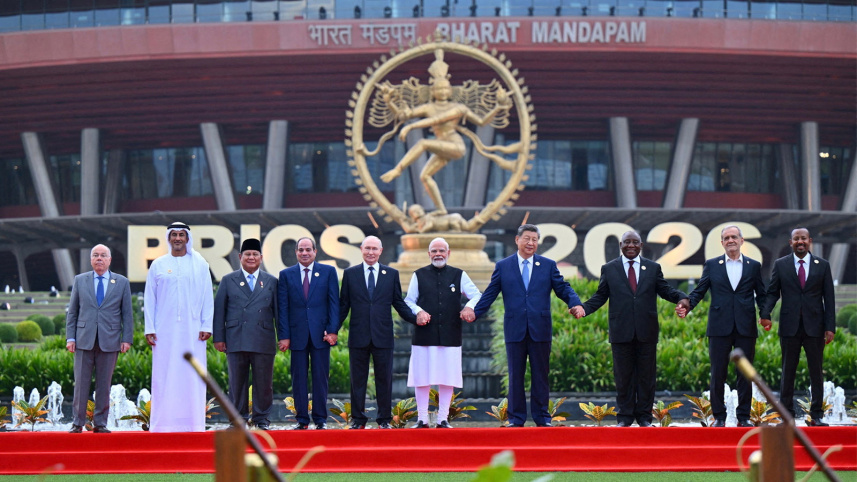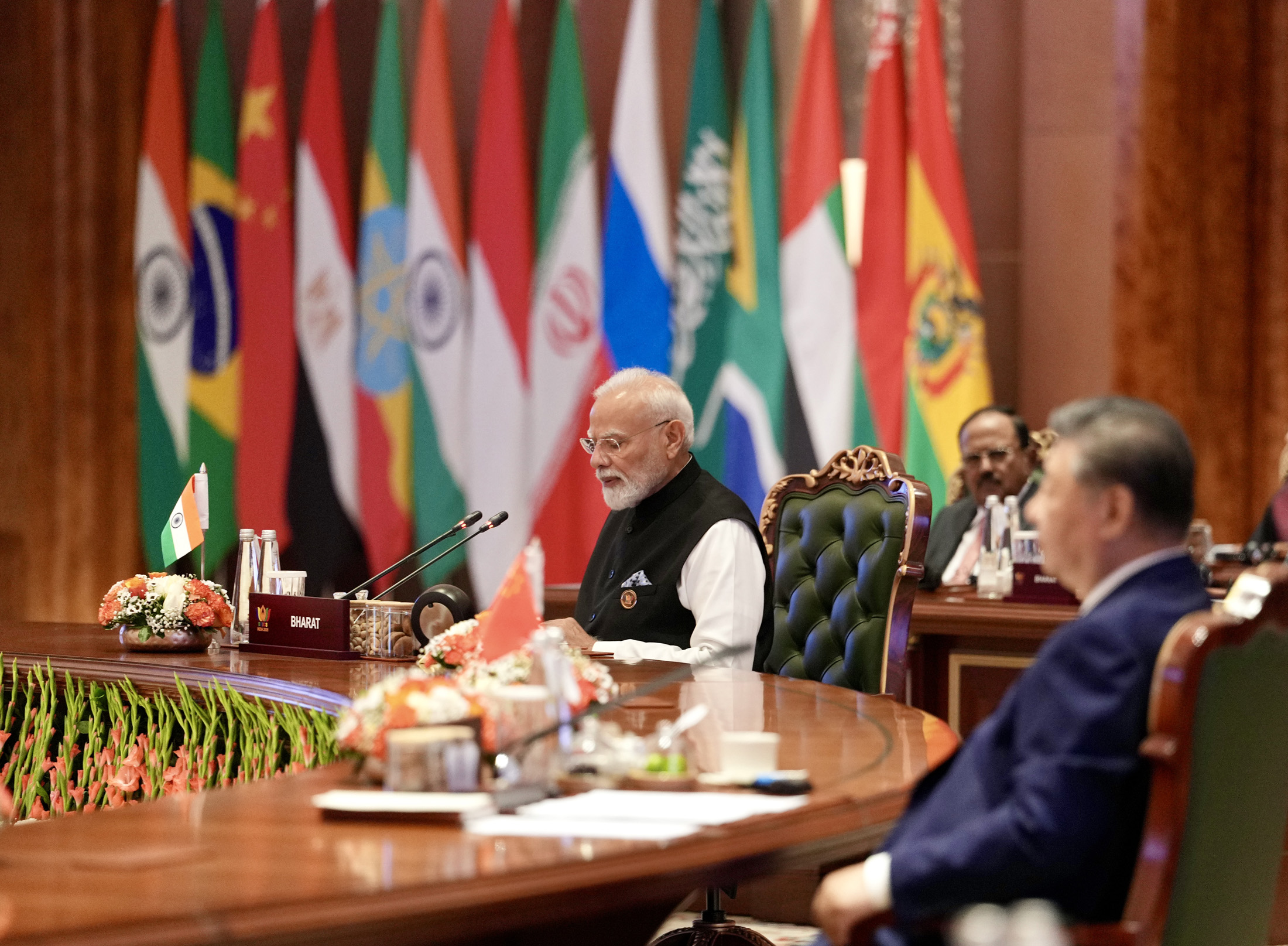
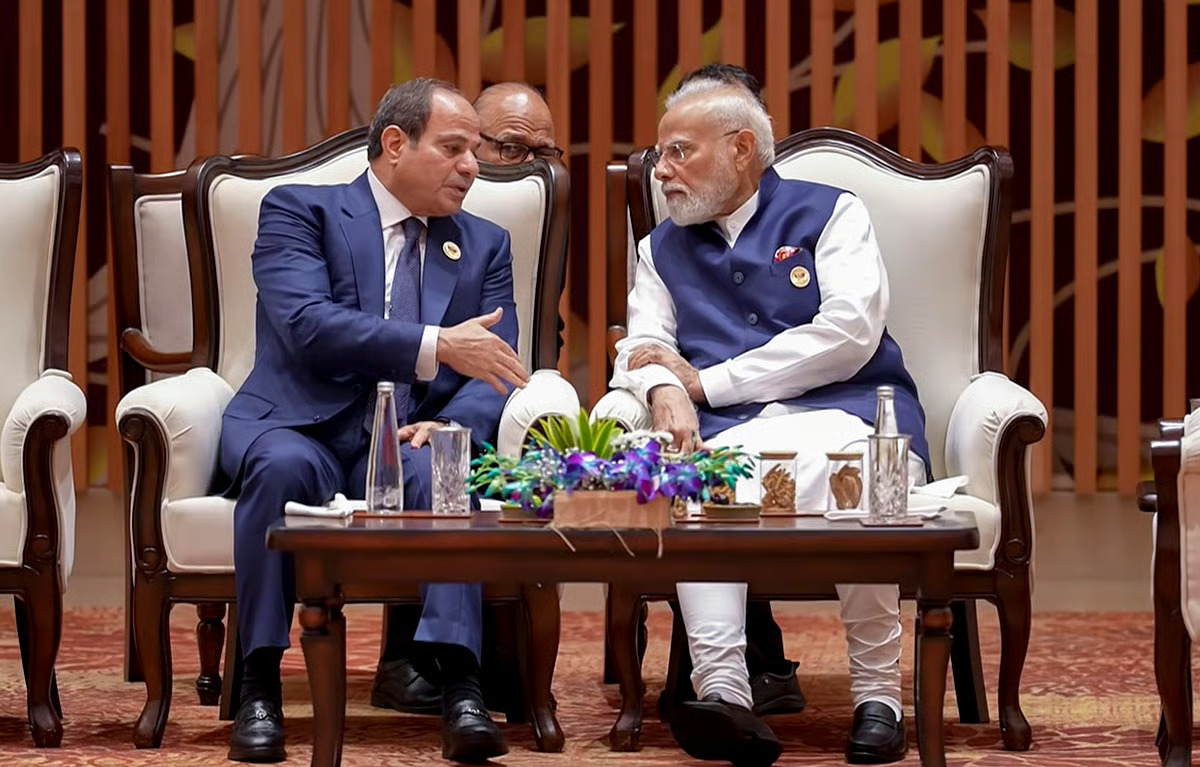
India and Egypt are looking to give greater economic weight to their strategic partnership, with Prime Minister Narendra Modi and Egyptian President Abdel Fattah El-Sisi discussing ways to increase bilateral trade, expand Indian investment in Egypt and open new areas of cooperation during their meeting in New Delhi. The two leaders met on September 13 on the sidelines of the 18th BRICS Summit in the Indian capital. According to the Egyptian Presidency, the discussions focused on building on the momentum in bilateral relations since India and Egypt elevated their ties to a Strategic Partnership in 2023.
The economic side of the relationship was central to the conversation. El-Sisi called for concrete steps to raise bilateral trade to $12 billion, while also seeking greater Indian investment in Egypt. The Egyptian president specifically highlighted manufacturing, technology, clean energy and automobile production as sectors where cooperation could be expanded. PM Modi, for his part, reaffirmed India’s interest in developing relations with Egypt across a broad range of areas. He encouraged Indian companies to look more closely at investment opportunities in Egypt and stressed the importance of stronger links between the two countries’ business communities.
The emphasis on private-sector cooperation marks an important part of the next phase of the relationship. The Egyptian Presidency said the two leaders discussed ways of increasing joint projects, transferring expertise and technology, and giving businesses in both countries a larger role in the partnership.
Trade relationship shows room for expansion
The push for higher trade comes as commercial links between the two countries already form an important part of their relationship. India’s Ministry of Commerce and Industry records exports to Egypt of $3.87 billion and imports of $2.60 billion in financial year 2025-26 on a year-to-date basis, with data updated through June 2026. That puts the combined value of merchandise trade at roughly $6.47 billion for the period covered by the government’s latest trade dashboard. The figures also point to a change in the composition of the relationship. Indian exports to Egypt rose by 13.59 percent in the period covered, while imports from Egypt increased by 95.95 percent, according to the Department of Commerce’s Trade Intelligence and Analytics portal.
The two governments now want to move beyond simply increasing the value of goods traded. Investment, manufacturing and technology are increasingly being placed at the centre of the relationship. Egypt has been presenting itself as a platform from which Indian companies can reach wider regional markets. During their September meeting, El-Sisi pointed to Egypt’s strategic geographical position, skilled workforce, network of free-trade agreements and investment incentives. He also highlighted opportunities available through the Suez Canal Economic Zone and other industrial areas. For Indian companies, the attraction is not limited to Egypt’s domestic market. Its location connects the Mediterranean, Africa and the Middle East, while the Suez Canal remains one of the world’s most important trade routes.
From strategic partnership to commercial projects
The current push builds on decisions taken three years ago. India and Egypt formally upgraded their bilateral relationship to a Strategic Partnership during Prime Minister Modi’s state visit to Egypt in June 2023. The agreement was intended to provide a broader framework for political, economic, trade, scientific and other forms of cooperation. The 2023 visit also produced agreements covering agriculture and allied sectors, archaeology and antiquities and competition law, while earlier cooperation had expanded into areas including information technology, cyber security, culture, youth affairs and broadcasting.
The relationship has continued to develop through regular official contacts. India’s Ministry of External Affairs said in its 2024 annual report that the India-Egypt Strategic Partnership continued to strengthen, while the two countries held the 13th round of Foreign Office Consultations in New Delhi in December 2024. The discussions examined different aspects of the partnership and ways to deepen cooperation. The sixth meeting of the India-Egypt Joint Trade Committee was held in New Delhi in September 2024, followed by a Joint Business Commission meeting. India also reported that a Special Rupee-Vostro account had become operational, creating an additional mechanism through which the two countries could explore trade in local currencies.
New sectors on the agenda
The September 13 meeting suggests that the next phase of cooperation will be more technology- and investment-oriented. The two leaders discussed new and renewable energy, green hydrogen, pharmaceuticals and information technology, according to the Egyptian Presidency. These areas fit with both countries’ efforts to expand industrial capacity and develop new sources of investment and technology cooperation.
Automobiles and manufacturing were also singled out by Egypt as priority areas for increased Indian investment. The focus reflects a broader ambition to create projects that produce goods and technology locally rather than relying solely on conventional import-export activity. Egypt’s participation in BRICS has added another layer to the relationship. Egypt became a full BRICS member in January 2024, and its presence at the New Delhi summit provided an additional platform for the two governments to coordinate on economic and wider Global South priorities.
A broader economic partnership
The September meeting therefore came at a moment when both governments appear keen to translate political confidence into measurable commercial outcomes. The immediate target is clear: increasing bilateral trade towards $12 billion and attracting more Indian capital into Egypt. But the longer-term objective is broader — creating stronger links between companies, encouraging joint ventures and developing cooperation in industries such as clean energy, automobiles, pharmaceuticals and digital technology.
For Egypt, Indian investment offers an opportunity to deepen industrialisation and use the country’s geographical advantages to connect production with wider markets. For India, Egypt offers a significant gateway into Africa and the Middle East, alongside access to infrastructure and trade networks centred around the Suez Canal. The political relationship has already moved into strategic territory. The challenge now is to ensure that the economic relationship catches up. The latest PM Modi-El-Sisi meeting indicates that both governments see business and investment as the next major engine of that process.