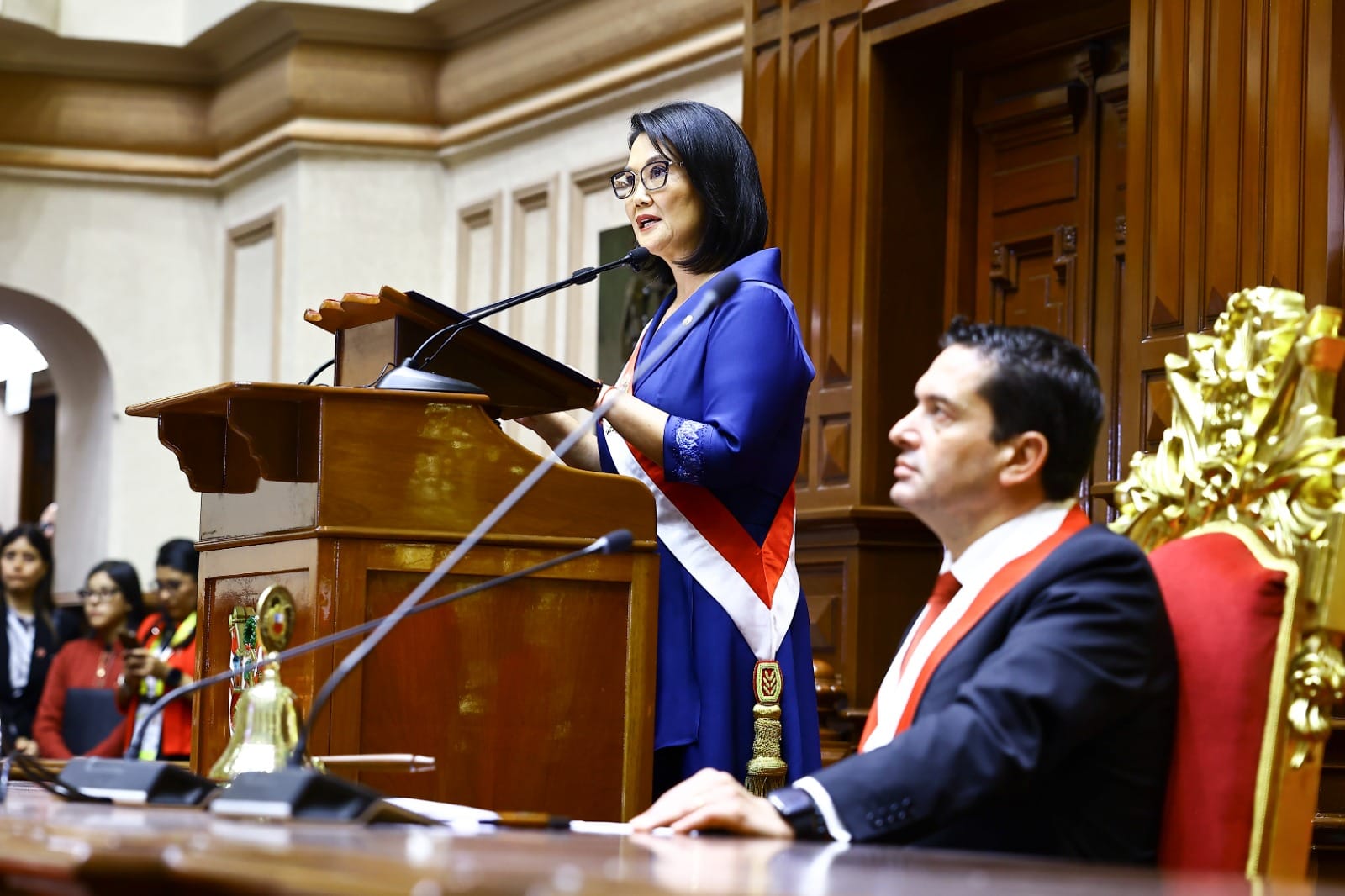
Keiko Sofía Fujimori Higuchi was sworn in as President of the Republic of Peru 28 July 2026, becoming the first woman elected to the office by popular vote in the country’s history. The distinction is specific: Peru had a woman president before her, Dina Boluarte, who took office in 2022 after succeeding Pedro Castillo following his removal by Congress, rather than through a direct presidential election.
Fujimori, 51, was born in Lima on 25 May 1975, the eldest daughter of former President Alberto Fujimori and former congresswoman Susana Higuchi. She studied business administration at Boston University, graduating in 1997, before completing an MBA at Columbia University in New York, where she briefly worked in pension fund management. She entered elected politics in 2006 as a congresswoman for Lima, and founded her party, Fuerza Popular, in 2010. This was her fourth presidential bid, after narrow run-off defeats in 2011, 2016 and 2021.
The National Elections Board (JNE) confirmed her victory where Fuerza Popular won the 7 June run-off with 9,223,396 votes (50.135 per cent) against 9,173,755 (49.865 per cent) for Roberto Sánchez of Juntos por el Perú, a margin of fewer than 50,000 votes. JNE president Roberto Burneo said the moment should symbolise not only the culmination of an electoral process, but also the start of a period of dialogue, stability and commitment to Peru.
The inauguration took place at the Congress of the Republic in Lima, coinciding with Fiestas Patrias and the 205th anniversary of independence. The oaths were taken by First Vice-President Luis Fernando Galarreta Velarde and Second Vice-President Miguel Ángel Torres Morales alongside Fujimori’s.
Attendees included the presidents of Argentina, Chile, Bolivia, Ecuador, Honduras, Panama, Uruguay and Paraguay, alongside King Felipe VI of Spain and the United States Deputy Secretary of State.
In her first address to the nation, Fujimori said that power only has meaning when it is exercised in the service of others, adding she had not come to promise immediate miracles. She pledged to serve only her constitutional five-year term, “not one day more,” and announced a rise in the minimum wage to S/1,300, a doubling of the Pensión 65 benefit, and a new National Digital Authority.
Ahead of the ceremony, Fujimori held bilateral talks at the Torre Tagle Palace, the Foreign Ministry’s seat. Peru’s Foreign Ministry noted that her meeting with Argentine President Javier Milei had underlined the deep historical ties between the two countries and the importance of strengthening cooperation in economic, security and scientific fields. She also met Colombia’s vice-president-elect, José Manuel Restrepo, representing President Abelardo de la Espriella, and received King Felipe VI.
Global representation of elected women leaders
Fujimori’s inauguration adds to a small global cohort. According to UN Women, as of January 2026, women served as Heads of State and/or Government in 28 countries, with only 16 holding the position of Head of State and 21 countries have a woman Head of Government – a figure UN Women notes leaves gender parity in top leadership roughly 130 years away at current rates.