Thailand’s Songkran Festival 2026, the traditional Thai New Year celebration, was officially observed from 13 to 15 April, with wider celebrations and major events running from 11 April onwards in Bangkok and other cities. The festival, recognised by UNESCO as an Intangible Cultural Heritage of Humanity since 2023, brought together millions of Thai and foreign visitors for water festivities, cultural rituals, and community events in every region of the kingdom.
The centrepiece of this year’s celebrations was the Maha Songkran World Water Festival 2026, held at Benchakitti Park in Bangkok. The Tourism Authority of Thailand (TAT) reported that attendance at the park reached 108,640 people over the first three days alone, of whom 52,272 were foreign tourists. The event generated an estimated 283.68 million baht in economic circulation. A drone light display involving over 1,200 drones formed an elephant silhouette above the main stage during the opening night. The park was divided into zones representing all five regions of the country, featuring cultural demonstrations, sand pagoda building, a Buddha bathing ceremony, a temple fair area, a children’s zone, an EDM stage, and more than 100 food vendors.
Alongside these events, the Saneh Art by Songkran Festival 2026 took place at Lumphini Park, coinciding with the 100th anniversary of the park.
Ms Thapanee Kiatphaibool, TAT Governor, stated at the opening ceremony, “Maha Songkran World Water Festival 2026 is a celebration designed for everyone — across generations, regions, and the world. It brings together the very best of Thai culture and contemporary festivity, reinforcing Songkran’s standing as a truly global festival.”
The TAT projected total tourism revenue during the 11–15 April period at approximately 30.35 billion baht, a 6 per cent increase year-on-year. Around 500,000 foreign arrivals were expected during this period, up 4 per cent, generating roughly 8.1 billion baht. On the domestic side, the TAT forecasts nearly 5.96 million Thai visitor trips, with revenue of about 22.25 billion baht.
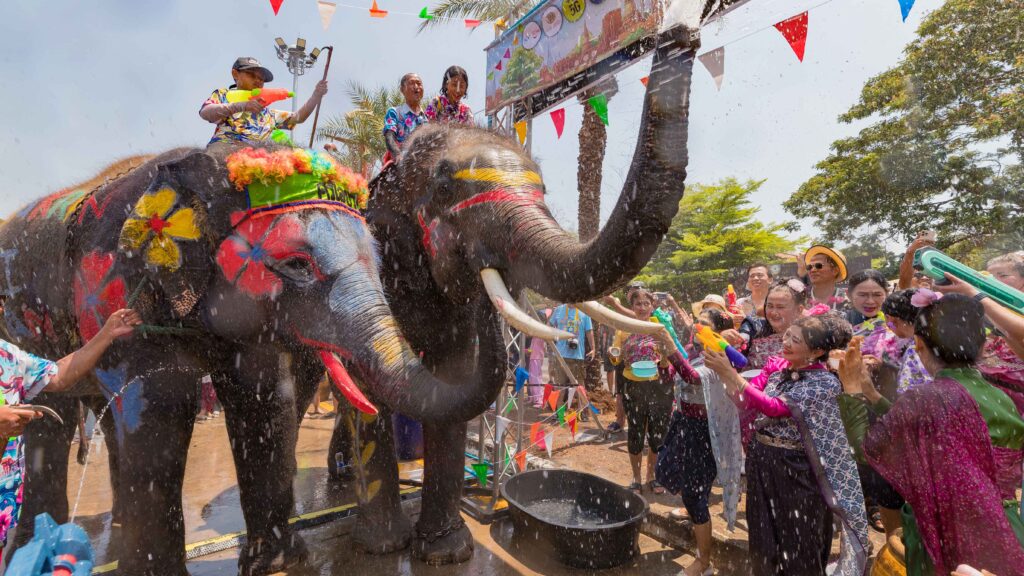
Beyond Bangkok, celebrations extended across all five regions. In Ayutthaya, the traditional elephant splashing events remained a major draw for both Thai and international visitors. In the south, the Hatyai Midnight Songkran festival attracted more than 500,000 people over four days, while border towns in Yala and Narathiwat provinces drew visitors from Malaysia.
UNESCO Intangible Cultural Heritage of Humanity
On 6 December 2023, “Songkran in Thailand, traditional Thai New Year festival” was inscribed on the UNESCO Representative List of the Intangible Cultural Heritage of Humanity. The decision was made during the 18th Session of the Intergovernmental Committee held in Kasane, Botswana. It was the fourth Thai cultural element to receive this status, following Khon masked dance drama (2018), Nuad Thai traditional massage (2019), and Nora dance drama (2021). Since then, Thailand has added Tom Yum Kung (2024) and Kebaya (2024, a multinational nomination), bringing its total to six inscribed elements.