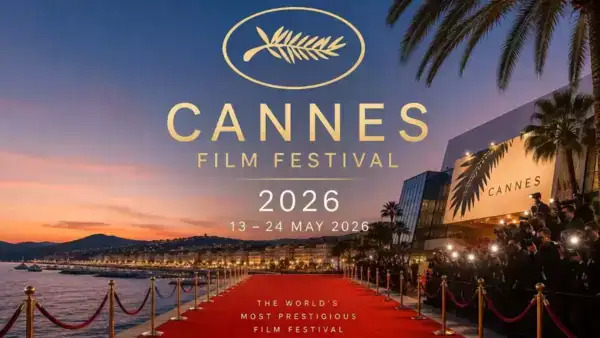
The 79th edition of the Festival de Cannes opened on 12 May 2026 and runs until 23 May at the Palais des Festivals on the French Riviera. The Official Selection for this edition was announced on 9 April 2026 by the festival’s President, Iris Knobloch, and General Delegate, Thierry Frémaux, at a press conference held at the Pathé Palace in Paris. Frémaux noted that 2,541 feature films were submitted for consideration, with the main competition lineup featuring 21 films from three continents and five female directors.
The jury for the main competition is chaired by South Korean filmmaker Park Chan-wook, joined by Demi Moore, Chloé Zhao, Stellan Skarsgård, Laura Wandel, Diego Céspedes, Isaach De Bankolé, Ruth Negga, and Paul Laverty.
Films in the main competition include Pedro Almodóvar’s Amarga Navidad, Fukada Koji’s Nagi Notes, and Ira Sachs’s The Man I Love. World premieres include Kurosawa Kiyoshi’s Kokurojo, John Travolta’s Propeller One-Way Night Coach, and Tiago Guedes’s Aquí. The Un Certain Regard section features Jordan Firstman’s Club Kid, Katharina Rivilis’s I’ll Be Gone in June, and Rakan Mayasi’s Yesterday the Eye Didn’t Sleep.
The festival is also marking the 25th anniversary of The Fast and the Furious with a midnight screening at the Grand Lumière Theatre, and Guillermo del Toro attended a pre-opening screening of the restored Pan’s Labyrinth, the film that famously received the longest standing ovation — 22 minutes — in the festival’s history when it was first shown at Cannes two decades ago.
The 3rd Immersive Competition selected nine works from eight countries, screened at the Carlton Hotel from 12 to 22 May 2026, with a new technical setup enabling collective experiences for up to 200 participants.
India at Cannes 2026
India’s presence at this year’s festival spans jury leadership, regional cinema debuts, and official institutional participation.
Indian filmmaker Payal Kapadia, whose All We Imagine as Light won the Grand Prix at Cannes in 2024, is serving as president of the jury for the 65th Cannes Critics’ Week, running alongside the main festival from 13 to 21 May. In a statement released at the time of her appointment, Kapadia said: “At a time when independent cinema is being eroded in every country, supporting the first works of filmmakers is almost a resistance to market forces. Film criticism is one of the key components of the independent and art-house film ecosystem. The first films are often freer, more daring, and fearless, having an individual voice, and to champion those is absolutely essential.”
Filmmaker Ashutosh Gowariker is attending as part of India’s official delegation in his capacity as Director of the International Film Festival of India (IFFI). Punjabi actor-singer Ammy Virk is making his Cannes debut with the film Chardikala, alongside co-star Roopi Gill, marking a notable moment for Punjabi cinema on the global stage.
Marathi cinema also has a visible presence through veteran actors Ashok Saraf and Nivedita Saraf, actress Prajakta Mali, and producer Kedar Joshi. Malayalam director Chidambaram’s Balan: The Boy, a film releasing in four languages – Malayalam, Hindi, Tamil, and Telugu is being screened in the Marché du Film section. The director said of his film: “Balan: The Boy is a film about what we carry without knowing… the weight of where we come from, and the hunger to find where we belong.”
FTII student Mehar Malhotra’s short film Shadows of the Moonless Night and the Malayalam cult classic Amma Ariyan by John Abraham, restored in 4K, are also part of the Cannes Classics section this year.
India’s official interface at Cannes is managed through the Ministry of Information and Broadcasting’s dedicated portal, cannes-india.com, which this year published an Indians at Cannes 2026 directory listing filmmakers available for international co-production partnerships.
Industry observers note that India’s growing presence at Cannes increasingly reflects the international rise of regional cinema alongside mainstream Hindi film, with Indian creators now participating not only on the red carpet but also across jury panels, film markets, and global content discussions.