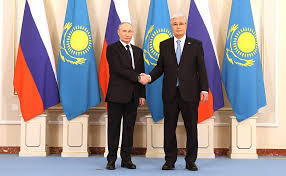
Russian President Vladimir Putin arrived in Astana on 27 May 2026 for a three-day state visit to the Republic of Kazakhstan at the invitation of President Kassym-Jomart Tokayev. Tokayev personally received Putin on his arrival. The visit also coincided with the 5th Eurasian Economic Forum and a meeting of the Supreme Eurasian Economic Council, both held in Astana.
The trip marks President Putin’s second state visit to Kazakhstan during his current presidential term. Kremlin aide Yury Ushakov noted that, as a rule, only one state visit takes place during a single presidential term, adding that the second visit was intended to highlight the “unprecedentedly high level of relations” between the two countries.
Ahead of the visit, President Putin published an article in the Kazakh state newspaper Kazakhstanskaya Pravda titled “Russia–Kazakhstan: Alliance in the Heart of Eurasia.” In the article, he described how the strategic partnership serves as an important enabler of peace, stability, and socioeconomic development across Eurasia.
On 28 May, the Palace of Independence hosted the main summit events. At the media statements following the talks, President Tokayev said the visit had “exceptional importance in terms of enhancing the strategic partnership and allied relations between Kazakhstan and Russia.”
Following the talks, both leaders signed and exchanged the Joint Statement “On Seven Pillars of Friendship and Good-Neighbourliness of the Peoples of Kazakhstan and Russia.” The statement was adopted against the backdrop of growing global instability and geopolitical challenges, with the leaders describing the shared border as a symbol of trust and economic connectivity, and pledging to deepen trade, investment, and industrial cooperation, and to expand the use of national currencies.
Russia is Kazakhstan’s leading direct investor. President Tokayev stated at the media talks that bilateral trade is expected to reach USD 30 billion, with Russian direct investment in Kazakhstan’s economy exceeding USD 29 billion. He noted that 177 joint economic cooperation projects are under way, of which 122 have entered their operational cycle.
The centrepiece outcome of the visit was the signing of an agreement on the construction of Kazakhstan’s first nuclear power plant. Kazakhstan’s Agency for Atomic Energy and Russia’s Rosatom exchanged intergovernmental agreements on the construction project and on the provision of a Russian export loan to finance it. The plant will feature two VVER-1200 III+ reactors at a total projected cost of approximately USD 16.5 billion, including around USD 2 billion for security and infrastructure. Russia’s export credit will cover roughly 85 per cent of costs, with commissioning expected around 2035–2036.
Speaking at the signing ceremony, President Tokayev said: “The agreement signed today on the construction of the Balkhash NPP has an important role.” President Putin stated, “Putting the plant into operation will make a significant contribution to the energy supply of the Kazakh economy.”
Among other results, the two sides signed a currency swap agreement to reduce dependence on the dollar in bilateral trade and inaugurated the world’s first continuous 3,000-kilometre autonomous freight route using Kamaz trucks. The ministries of education of both countries also signed an agreement on the establishment of a Sirius school in Kazakhstan, and the two energy ministries agreed to expand cooperation in the oil sector.
On the evening of 28 May, Putin addressed the plenary session of the Eurasian Economic Forum. On 29 May, he participated in the meeting of the Supreme Eurasian Economic Council. The meeting addressed current issues in EAEU activities and developed guidelines for deepening integration within the Union. Heads of state of Russia, Belarus, Kazakhstan, and Kyrgyzstan participated, alongside Armenia’s Deputy Prime Minister.