South Africa and India share deep-rooted bilateral ties where both countries have gifted the world outstanding champions of human rights and social justice, such as Mahatma Gandhi and Nelson Mandela. Mandela, who symbolised South Africa’s anti-apartheid struggle and its transition towards a non-racial democracy, was deeply influenced by Gandhian philosophy, especially the non-violent method of ‘Satyagraha’, which had also inspired India’s national freedom movement.
India stood at the forefront of the international community in opposing apartheid and made persistent efforts to place the issue of apartheid on the agenda of the United Nations, the Non-Aligned Movement (NAM), and other multilateral organisations. The African National Congress (ANC) maintained a representative office in New Delhi from the 1960s. India enthusiastically worked for the ‘Africa Fund’ to sustain this struggle by providing assistance to frontline states. For his role in the anti-apartheid movement, Nelson Mandela was conferred with India’s highest civilian honour, the ‘Bharat Ratna’.
Following negotiations between the ANC and the South African government, a cultural centre was established in Johannesburg. India’s relations with South Africa were restored after a break of more than four decades. In May 1994, the Indian High Commission opened in Pretoria, and the same month a Consulate General opened in Durban. Since the South African Parliament meets in Cape Town, the High Commission built a permanent office in 1996. As of January 2011, this office has been renamed the Consulate General of India. In April 1994, South Africa opened a Consulate General in Mumbai and a High Commission in Delhi. Both countries have underscored the need for greater representation within the United Nations (UN), the Non-Aligned Movement, and the World Trade Organisation (WTO), and have consistently called for UN reform to create a more equitable and representative global architecture. Both nations have consistently underscored the significance of their bilateral strategic ties and multilateral engagements through forums such as BRICS (Brazil, Russia, India, China, South Africa) and IBSA (India, Brazil, South Africa). South Africa and India together with Australia, Kenya, Mauritius, Oman, and Singapore were among the seven founding members of the Indian Ocean Rim Initiative. It was launched in March 1997 in Mauritius under the name ‘Indian Ocean Rim Association for Regional Cooperation’ (IOR-ARC).
Political Relations
South Africa and India signed a strategic partnership agreement titled the ‘Red Fort Declaration’ during President Nelson Mandela’s visit to India in March 1997, thereby making South Africa India’s first strategic partner. The year 2023 marked the completion of 30 years since the re-establishment of diplomatic relations with South Africa. Against the backdrop of India’s unwavering support during the anti-apartheid struggle, close and friendly relations with South Africa have been consistently strengthened, whether at the bilateral level or through forums such as BRICS, IBSA, and others. Since the inception of diplomatic relations, numerous bilateral agreements have been concluded between the two countries across various sectors; these areas include defence, economic and commercial cooperation, culture, health, public administration, and science and technology. India’s ‘Technical and Economic Cooperation Programme’ (ITEC) has served as a valuable medium for fostering cooperation in human resource development.
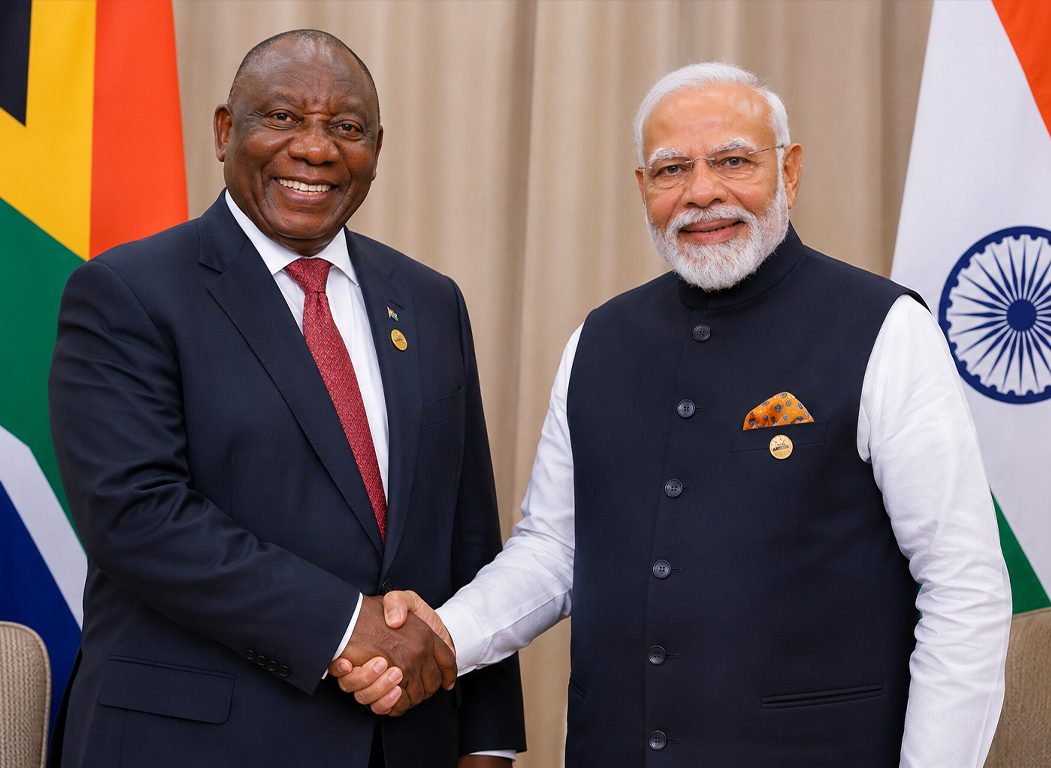
The Honourable Prime Minister Narendra Modi visited South Africa from 21 to 23 November 2025 to attend the 20th G20 Leaders’ Summit held in Johannesburg. The Prime Minister also held a bilateral meeting with the President of South Africa, Cyril Ramaphosa and also participated in the IBSA Leaders’ Meeting held during the G20 Leaders’ Summit.
Economic and Trade Relations
Economic and trade relations have grown since the establishment of diplomatic relations in 1993. Both countries are crucial players in the world economic landscape, recognised as the fastest-developing economies in the 21st century, and their relationship is mutually beneficial. South Africa remains India’s largest trading partner in the African continent. India mainly exports refined petroleum, vehicles and components, transport equipment, drugs and pharmaceuticals, textiles, rice, and gems and jewellery while importing raw commodities such as gold, steam coal, copper ores & concentrates, phosphoric acid and precious stones.
The bilateral trade between South Africa and India stood at $19.25 billion in the financial year 2023-24 (FY24) and shows current financial year trade from April 2025 to January 2026 as US$13 billion, which is a partial-year figure.
Recently, the High Commission of India, Pretoria hosted 2nd edition of India and South Africa Business conclave in Pretoria in March 2026 where the Deputy Minister of Trade, Industry and Competition, H.E. Mr. Zuko Godlimli delivered the keynote address. The event was attended by more than 200 entrepreneurs from South Africa and India. The highlights of the conclave were the panel discussions & case study presentations aimed at deepening economic ties between both countries.
Defence and Strategic Cooperation
The Defence Cooperation between South Africa and India officially commenced in 1996 with the signing of a Memorandum of Understanding on “Cooperation in the Field of Defence Equipment,” which was further revised in 2000 through another MoU on “Defence Cooperation.” Consequently, the India-South Africa Joint Defence Committee (JDC) was constituted, co-chaired by the Defence Secretaries of both nations. Furthermore, both countries are strengthening their defence cooperation through strategic partnerships, military exercises, defence production, and multilateral agreements. Their collaboration is driven by shared interests in maritime security, counter-terrorism measures, and regional stability particularly within the Indian Ocean Region (IOR) and Africa. The India-Brazil-South Africa (IBSA) Dialogue Forum serves as a pivotal platform for trilateral defence cooperation. IBSA’s primary focus lies in enhancing ‘South-South Cooperation’ in the fields of defence technology, military training, and strategic dialogues. Similarly, under the BRICS framework, South Africa and India engage in security-related discussions, specifically concerning counter-terrorism measures and cyber security issues.
Both countries also regularly exchange high-level military delegations to enhance military cooperation between them. In August 2024, an MoU on ’Submarine Rescue Cooperation and Coordination’ was signed and exchanged with the Chief of Naval Staff, Admiral D.K. Tripathi; concurrently, an assurance was provided that rescue assistance would be rendered by the Indian Navy should an emergency arise. As part of this MoU, the two navies signed a contract in June 2025, enabling ‘Submarine Rescue Hatch Certification’ for South African ‘Type 209’ submarines.
Indian Naval Ships (INS) regularly visit South African ports. INSV Tarini visited Cape Town from March to April 2025, for the final leg of the ‘Navika Sagar Parikrama II’ expedition. INS Talwar visited Cape Town in October 2024, to participate in the 8th edition of the maritime exercise (IBSAMAR) involving India, Brazil, and South Africa. INS Trishul visited Durban in June 2023, to strengthen bilateral ties during the 30th anniversary of diplomatic relations between the two nations; subsequently, INS Sunayna visited Durban in August 21 to 25 to commemorate the 130th anniversary of the Pietermaritzburg railway station incident widely regarded as the birthplace of Satyagraha. The South African Ship Amatola (a South African Navy frigate) participated in IFR26 and Milan 26 in Visakhapatnam in February 2026. The Chief of the South African Navy, Vice Admiral Monde Lobese, led the South African delegation.
Cultural Relations
The two nations share a rich and dynamic relationship, rooted in historical ties, cultural exchanges, and a shared vision for the future. Since the formalisation of diplomatic relations in 1994, both countries have leveraged their cultural and artistic heritage to forge deeper connections through culture, arts, and sports. One of the most significant cultural initiatives strengthening South Africa-India relations has been the series of artistic exchanges and cultural festivals organised by the High Commission of India in Pretoria and the High Commission of South Africa in New Delhi. Events such as Youth Day, Freedom Day, and Heritage Day have been celebrated in New Delhi with great enthusiasm, providing a platform for South African artists to showcase their cultural heritage. For instance, in 2023, on the 29th anniversary of ‘South Africa Day’ hosted by the then High Commissioner of South Africa, dignitaries and stakeholders gathered to reflect upon democratic progress and bilateral relations.
The Indian Council for Cultural Relations (ICCR) has promoted Indian culture in South Africa. It routinely brings empanelled Indian cultural troupes exhibiting India’s numerous creative styles to South Africa. Government and cultural institutions in South Africa host these fully supported programmes. South Africa has hosted Indian classical and folk performances, traditional music concerts, and dramatic shows, showcasing India’s rich artistic heritage. The Consulate and Mission staged Azadi Ka Amrit Mahotsav events around South Africa to celebrate India’s 75th anniversary. In October 2021, ‘Revisiting Gandhian Trail’ promoted peace, non-violence, and unity by following the Mahatma’s footsteps. Diaspora groups joined the High Commission of India, Pretoria, to mark International Mother Language Day (Mataram) on February 28, 2026. The March 2026 Durban India Film Festival was a significant cultural exchange to promote South Africa-India cinematic connections. The three-day festival featured 8 films dubbed isiZulu and a panel discussion with South African and Indian filmmakers such Dr Timothy Ebulus and Ms Rani Sita Ram.
The ICCR offers scholarships for South African arts and culture students to study in India. These scholarships have allowed South Africans to study Indian classical dance, music, and visual arts. After returning to South Africa, several of these students opened dance and music schools to spread Indian culture. The Know India Programme (KIP) lets South African youngsters visit India for a cultural immersion. This project invites young South Africans to India to learn about its history, traditions, and current events after a rigorous selection procedure. Under the ICCR and the Consulate General of India, Durban, the Swami Vivekananda Cultural Centre (SVCC) in Durban promotes Indian arts and culture in South Africa. It holds Indian dance, music, yoga, and language workshops and hosts cultural events for the community.
Cricket has long served as a unifying factor in the relations between South Africa and India. Both nations share a mutual passion for the sport, which has played a pivotal role in strengthening their bilateral ties. The most notable example of this collaboration was the hosting of the Indian Premier League (IPL) in South Africa in 2009.
Conclusion
The South Africa-India relationship stands as one of the most enduring partnerships in the Global South. Since the establishment of relations in 1993, the two countries have built a broad bilateral architecture, active defence cooperation, and vibrant people-to-people ties, all anchored by a common commitment to a more equitable multilateral order through BRICS, IBSA, and the IOR-ARC.