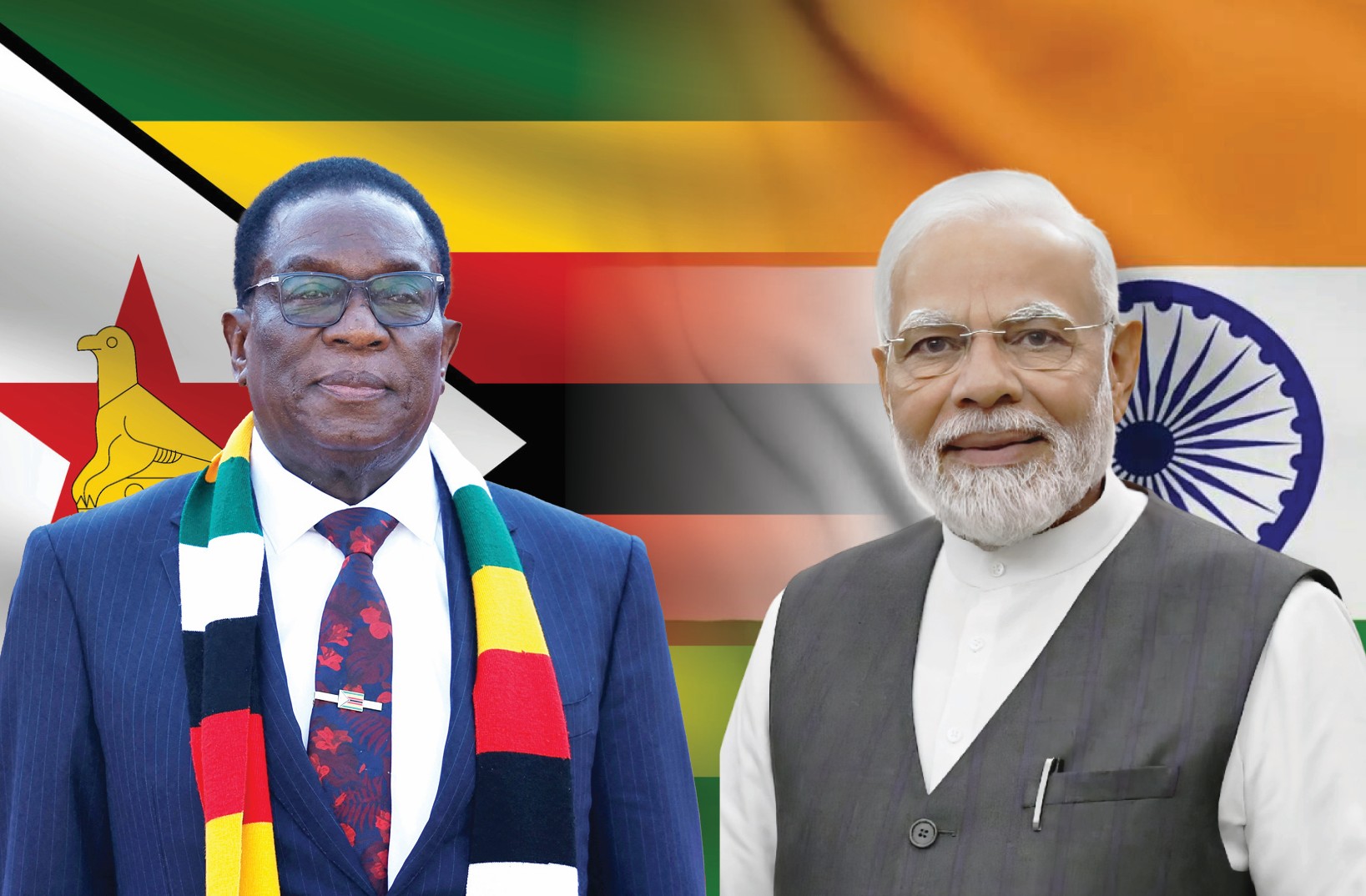
Zimbabwe gained independence in 1980 after a long liberation struggle. It is located in the Southern Africa. English serves as the official language, while Zimbabwe recognizes 16 national languages, with Shona and Ndebele being the predominant native languages.
Zimbabwe and India- Bilateral Relations
The relations between Asia and Africa are advancing at an extraordinary pace within the spectrum of international relations. Although the relationship between India and Africa commenced in the mid-first century, it gained momentum with the establishment of the Non-Aligned Movement. Zimbabwe and India have a long-standing relationship founded on historical solidarity and collaborative efforts in global forums. Despite their geographical distance, the two nations have cultivated a friendly and evolving partnership that encompasses political, economic, cultural, and developmental aspects. India’s engagement with Zimbabwe is also a component of its wider outreach to Africa, which has become increasingly significant in India’s foreign policy during the 21st century. The Zimbabwe-India relationship is marked by mutual respect, South-South cooperation, and a collective commitment to development and multilateralism.
Over the years, Zimbabwe and India have established a multifaceted partnership driven by strategic alignment. The Republic of Zimbabwe, strategically situated in Africa, plays a crucial role in global politics and security. The year 1980 signified the beginning of diplomatic relations between the Republic of Zimbabwe and the Republic of India, paving the way for long-term cooperation. India promptly established formal diplomatic relations and opened its High Commission in Harare. Both nations have maintained embassies in each other’s capitals, thereby strengthening their bilateral ties. The Zimbabwe-India relationship encompasses trade, business partnerships, and positions Zimbabwe as a gateway to Southern Africa, with key elements including defence collaboration, economic partnerships, cultural exchanges, and aligned global security priorities.
CHALO ZIMBABWE: Bilateral Business Opportunities between India & Zimbabwe
To intensify its drive to attract Indian investment, Zimbabwe launched the Chalo Zimbabwe event in Surat, India, expecting it to boost trade, tourism and industrial cooperation between the two nations. Zimbabwe and India already enjoyed strong diplomatic ties, but the recent visit by the Honourable Vice President General (Rtd.) Dr Constantino Chiwenga further strengthened this relationship, from manufacturing to mining, from agriculture to tourism, as new opportunities opened up between Harare and New Delhi. Zimbabwe’s top envoy to India, Ambassador Stella Nkomo, and the Honourable Vice President General (Rtd.) Dr Constantino Chiwenga attended the Chalo Zimbabwe 2025 Business Engagement held in August 2025 in India. They also embarked on a busy programme that included tours of diamond processing houses, dairy companies and other key manufacturing firms in Gujarat state.
In her message, Ambassador Stella Nkomo explained that “Chalo” meant an invitation to visit and go to Zimbabwe, adding that the Honourable Vice President was going to make a clear call on Indian businesspeople to come and trade with, invest in, and visit Zimbabwe. She noted that he was accompanied by a high-level delegation comprising the Hon. Deputy Minister of Industry and Commerce as well as the Hon. Deputy Minister of Tourism and Hospitality Industry.
President of the Southern Gujarat Chamber of Commerce and Industry, Mr Nikhil Madrasi, said that Zimbabwe had been the key focus for the initiative due to its strategic position in Southern Africa and its abundant resources, such as gold, platinum and lithium. He added that there were significant opportunities for trade, investments and collaborations, particularly in agriculture, mining, manufacturing and technology.
Zimbabwe’s push for reindustrialisation and India’s global edge in pharmaceuticals, machinery and technology saw both sides banking on the visit to chart a new era of economic cooperation. For Zimbabwe, it was more than diplomacy; it was about creating a gateway for Indian businesses into Southern Africa.
Political Relationship
The political relationship between Zimbabwe and India has been characterised by friendliness and cooperation. Both nations are part of international organisations, including the United Nations (UN), the Non-Aligned Movement (NAM), and others. Their mutual commitment to multilateralism and South–South cooperation has enhanced diplomatic interactions. India has upheld a policy of constructive engagement with Zimbabwe, high-level visits have significantly contributed to the enhancement of relations. Numerous Indian leaders have travelled to Zimbabwe, and in turn, Zimbabwean leaders have made similar visits. Leaders from Zimbabwe have also taken part in the India–Africa Forum Summit, which act as a vital platform for discussion.
Economic and Trade Relations
Economic engagement serves as one of the fundamental aspects of the relations between Zimbabwe and India. Over the years, the economic ties between Zimbabwe and India have progressed steadily, characterised by trade, investment, development cooperation, and initiatives aimed at capacity building. India is recognised as one of Zimbabwe’s key trading partners.
The bilateral trade encompasses India’s exports to Zimbabwe, which include pharmaceuticals, machinery, vehicles, textiles, chemicals, and consumer goods. Conversely, Indian imports from Zimbabwe include minerals and cotton.
Furthermore, Indian companies maintain a significant presence in Zimbabwe across various sectors, including mining, manufacturing, agriculture, pharmaceuticals, and information technology. The Indian-origin business community has significantly contributed to Zimbabwe’s economy through trade and investment. Additionally, India has provided Lines of Credit (LoCs) to Zimbabwe aimed at supporting development projects. These projects include funding for power generation, agricultural, mechanisation, and infrastructure development. Such financial support underscores India’s dedication to supporting Zimbabwe’s economic development.
Tourism as a Pillar of Relationship
For Indian travellers, Zimbabwe provides a visa-on-arrival. Zimbabwe offers a range of accommodations from luxury to standard, catering to diverse preferences. Indian travellers can indulge in a blend of Indian cuisine, traditional Zimbabwean dishes, and international flavours, with numerous restaurants available.
Capacity Building between Zimbabwe and India
Capacity building has emerged as a fundamental aspect of the relationship between Zimbabwe and India, illustrating India’s comprehensive development partnership strategy with African countries. Instead of solely concentrating on aid, India prioritises skill enhancement, knowledge dissemination, institutional fortification, and the development of human resources. In Zimbabwe’s context, this collaboration has significantly contributed to the improvement of technical skills, governance capabilities, and socio-economic progress.
A key element of capacity building is the Indian Technical and Economic Cooperation (ITEC) Programme. Through ITEC, professionals, government officials, and students from Zimbabwe receive training in India across various fields, including information technology, public administration, banking, agriculture, and entrepreneurship. India has extended its support to Zimbabwe in several domains, including skill development, education, and information technology. India has also played a role in establishing IT centres and vocational training institutes within Zimbabwe.
Cultural and People-to-People Relations
Cultural connections represent a significant aspect of the relationship between Zimbabwe and India. The existence of a modest yet impactful Indian diaspora in Zimbabwe has contributed to the enhancement of these cultural ties. Although the Indian community in Zimbabwe is relatively small, it has been instrumental in trade and business activities. The community has preserved their cultural traditions and has made valuable contributions to Zimbabwe’s diverse society. Additionally, India fosters cultural exchange through various means, including cultural festivals, the promotion of yoga and Ayurveda, as well as Indian films and television. Bollywood enjoys a substantial fan base in Zimbabwe, thereby enhancing soft power.
India’s Africa Policy and Zimbabwe
The relationship between Zimbabwe and India can be viewed within the framework of India’s broader engagement with Africa. The significance of Africa to India has grown due to several factors: energy and resource requirements, trade prospects, and strategic alliances. Furthermore, Zimbabwe plays an important role in India’s outreach to Africa through initiatives like the India–Africa Forum Summit (IAFS) and the Pan-African e-Network Project, which focuses on tele-education and telemedicine. India’s strategy towards Africa prioritises collaboration, capacity enhancement, and mutual benefits.
Recent Developments
In recent years, India has revitalised its commitment to enhancing relations with Zimbabwe: the expansion of Lines of Credit for infrastructure and agriculture, increased engagement through diplomatic visits, and ongoing participation in India–Africa cooperation frameworks. India has also extended assistance during emergencies, including the provision of essential medicines and support for development initiatives. In response, Zimbabwe has expressed a desire to strengthen its relationship with India, especially in areas such as agriculture, mining, and renewable energy.
Conclusion
Zimbabwe-India relations exemplify a model of South–South cooperation founded on mutual respect, a shared history, and common development objectives. By enhancing cooperation in trade, technology, agriculture, and energy, both nations cultivate a dynamic and mutually advantageous relationship in the forthcoming years.