The story of modern diplomacy is not written solely in treaties and communiqués. Sometimes, its most enduring chapters are found in the extraordinary bonds formed between individuals across cultures, faiths, and continents, bonds that catalyse movements capable of reshaping the world order. Few such relationships are as historically significant, or as underexplored, as the friendship between Mohandas Karamchand Gandhi and Hermann Kallenbach, a Lithuanian-born Jewish architect whose partnership with Gandhi helped lay the philosophical and organisational groundwork for one of the twentieth century’s most consequential political movements. The two men first met around 1903 to 1904. By 1907, their acquaintance had deepened into what historians now describe as one of the most intimate and consequential friendships of the Gandhian era.
Tolstoy Farm: A Laboratory of Ideas
The most concrete expression of their partnership was Tolstoy Farm, established in June 1910 on a 1,100-acre property near Johannesburg that Kallenbach generously donated to Gandhi’s cause. Kallenbach gave up the proceeds of this considerable asset to house the families of satyagrahis (those engaged in Gandhi’s campaign of nonviolent resistance). On this farm, Kallenbach abandoned his affluent lifestyle and embraced the austere, vegetarian, community-centred existence that Gandhi advocated. He took on practical responsibilities: managing the farm’s operations, coordinating logistics for the satyagraha movement, and sharing in the manual labour that Gandhi considered essential to moral development. Tolstoy Farm was more than a refuge. It functioned as what scholars have since called a prototype of the Gandhian ashram, a living experiment in the social, moral, and religious dimensions of Gandhi’s emerging philosophy.
A Cross-Cultural Dialogue
The diplomatic reverberations of this friendship extended well beyond South Africa’s borders. The philosophy and tactics developed at Tolstoy Farm and Satyagraha House became the foundation of India’s independence movement, and subsequently inspired civil rights campaigns across the globe, most notably the movement led by Dr Martin Luther King Jr. in the United States. India’s first post-independence UN resolution, a direct continuation of the struggle Gandhi and Kallenbach had waged together decades earlier.
The Gandhi-Kallenbach friendship also represented a remarkable early instance of what might today be termed intercultural civil diplomacy, an engagement between individuals of different religious and national backgrounds, conducted not through formal channels but through shared sacrifice and ideological fellowship. Their voluminous correspondence, now housed in India’s National Archives following the Indian government’s landmark purchase of the Kallenbach Archive in 2012, reveals the texture of this exchange. The letters show men engaged in constant mutual reflection, challenging and encouraging each other on questions of philosophy, politics, personal morality, and human dignity.
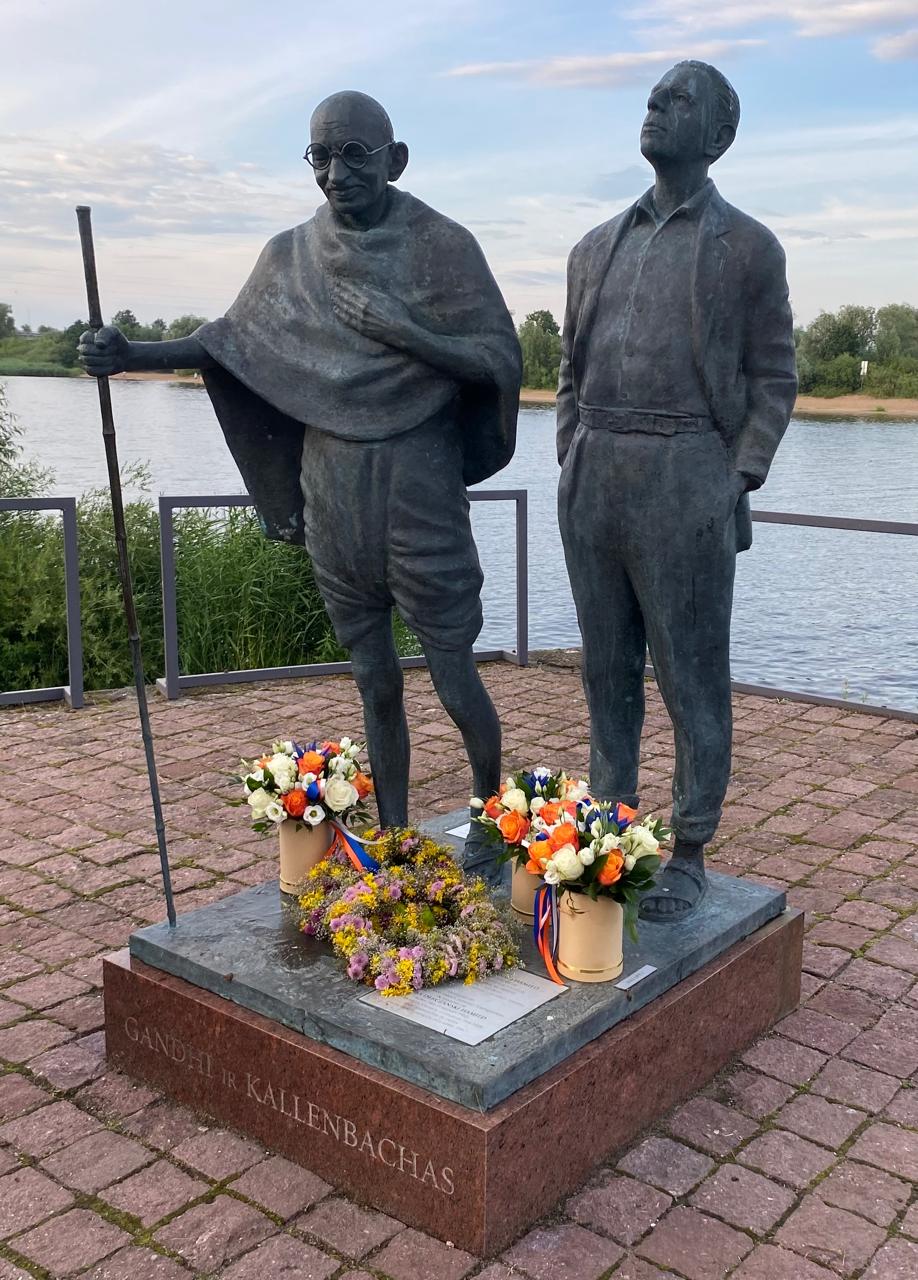
The enduring global significance of the Gandhi-Kallenbach friendship has been formally recognised through monuments, heritage designations, and commemorative acts spanning three continents. On 2 October 2015, Gandhi’s 146th birth anniversary, the town of Rusnė in Lithuania, the birthplace of Hermann Kallenbach, unveiled a 1.9-metre bronze statue depicting the two men side by side. The ceremony was attended by the then Lithuanian Prime Minister, the then Indian Minister of State, and Gandhi’s own grandson, Gopal Krishna Gandhi, making it a bilateral state occasion. The statue has since become an annual site of remembrance, with the Gandhi-Kallenbach friendship celebrated in Rusnė every year.
In Johannesburg, the physical landscape of the city itself bears Kallenbach’s imprint. Satyagraha House, the home he designed and shared with Gandhi in the Orchards suburb, has been restored and recognised with a heritage blue plaque from the City of Johannesburg, and now operates as a museum and guest house.
Since 2019, an annual India-Lithuania Friendship Award has been conferred at a ceremony held in Rusnė in direct tribute to the Gandhi-Kallenbach legacy. Recipients have included Vytautas Toleikis, a teacher who first conceived the idea of the Rusnė monument; Dr Shimon Lev, an author of the definitive Gandhi-Kallenbach monograph; and the Rusnė community itself. The award represents the institutionalisation of personal history into living diplomatic practice, transforming a century-old friendship into an annual act of state recognition.
Vydūnas, one of Lithuania’s most revered philosopher-poets and a towering figure of the Lithuanian national revival, was so deeply immersed in Indian philosophy that he constructed his own philosophical system rooted in Vedanta. He practised Ayurveda, drew parallels between pre-Christian Lithuanian spiritual traditions and Hinduism, and was so aligned with Gandhian values of non-violence and moral self-discipline that he came to be known as the Mahatma Gandhi of Lithuania.
In 2017, on the occasion of the 25th anniversary of formal Indo-Lithuanian diplomatic relations, the Lithuanian Embassy in New Delhi published a commemorative volume exploring the historical personalities who had forged the bond between the two nations. Significantly, the book’s cover featured Gandhi alongside three Lithuanian figures: Hermann Kallenbach, philosopher Vydūnas, and traveller Antanas Poška. The publication was a formal diplomatic act of memory, acknowledging that official relations were grounded in connections far older and far more personal.
Conclusion
What binds India and Lithuania at the deepest level is not only the sum of their trade agreements or the frequency of their ministerial exchanges, it is the enduring recognition that a Lithuanian-born architect and an Indian lawyer, working together in the dust of South Africa over a century ago, quietly laid the moral foundations upon which modern Indo-Lithuanian diplomatic relations proudly stand.