
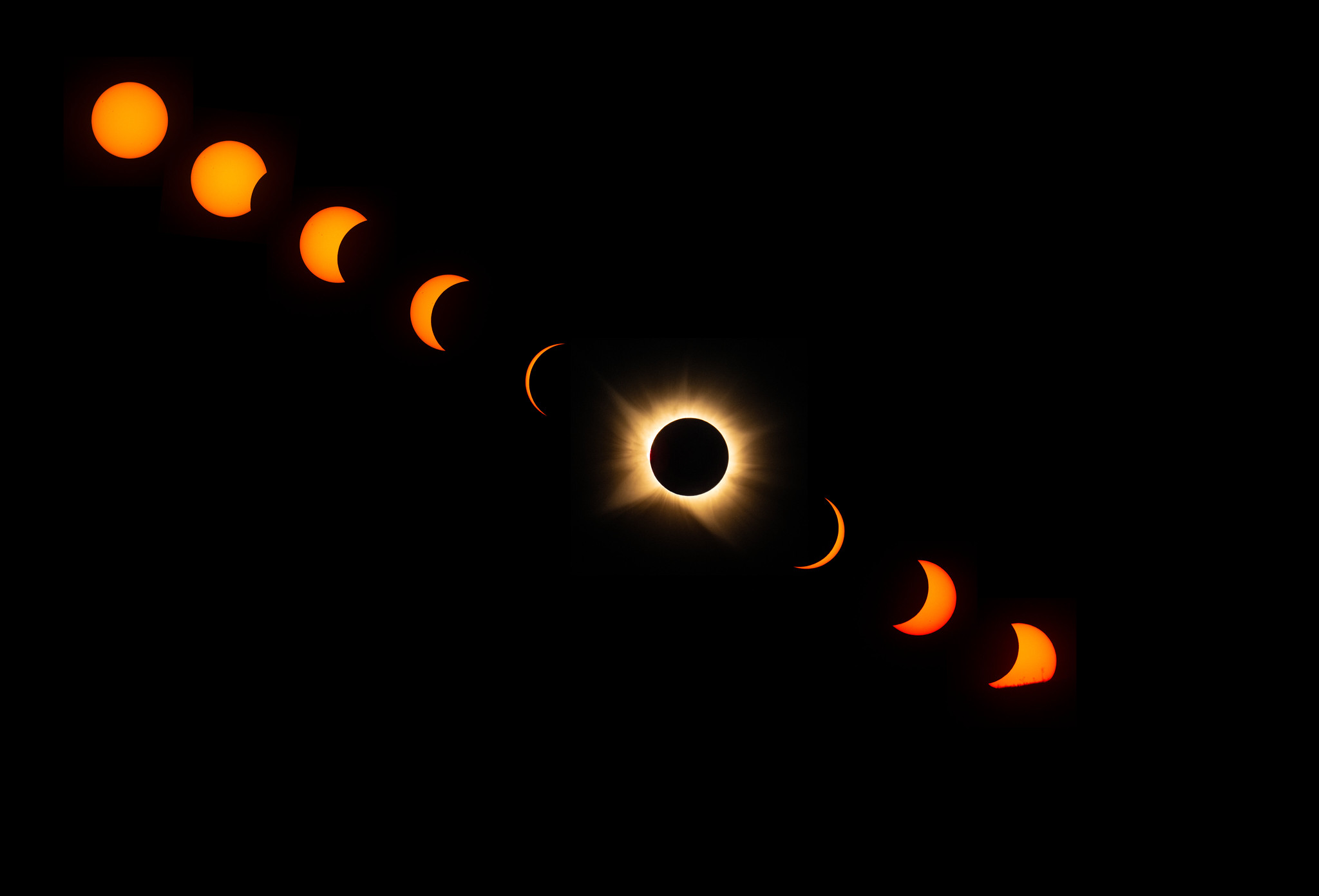
The umbra of the moon swept across several locations as the Northern Hemisphere witnessed a total solar eclipse on 12 August 2026. Eastern Greenland, northern Spain, western Iceland and northern Russia fell in the path of totality. A partial eclipse was also visible from certain locations in Africa, the British Isles, the United States, and Canada.
Though they occur about every year and a half, a total solar eclipse is next visible from a particular location only after a gap of four hundred years. This rare astronomical event occurs when the moon and the sun align in a particular manner. When the moon passes in front of the sun, occasionally, it seems as if its silhouette in the earth’s skies completely covers the sun, despite the latter being four hundred times larger. However, the sun is also located that much farther away. The moon blocking the sun creates a stripe of shadow on the earth’s surface, called the ‘path of totality’.
Eclipses progress slowly over a few hours, but the totality lasts briefly – just a few minutes. However, it creates an atmosphere akin to twilight, accompanied by a drop in temperatures, and birds and animals falling silent. The phenomenon offers the opportunity to observe the sun’s corona clearly in an awe-inspiring sight of a golden ring glowing in a dusky sky. The sun’s corona is its outermost layer, invisible as it is normally engulfed by the brightness of the sun. In certain locations such as Greenland, the planets Mercury, Venus and Jupiter could also be seen in the dimmed sky. The 2026 solar eclipse occurred close to sunset, creating stunning visuals of shifting golden and orange hues. People gathered from far and wide to observe the eclipse, particularly in locations falling in the path of totality such as Palencia, where an eclipse-viewing event was held at the Cerro del Otero.
The eclipse saw collaborations by scientists across the globe to study the sun’s corona and the effects of solar eclipses on the earth’s atmosphere. The National Aeronautics and Space Administration (NASA) conducted experiments in the path of totality. The Canary Islands Institute of Astrophysics (IAC) gathered leading scientists of the world at Palencia on this occasion, launching the North African Telescope Eclipse (NATE) Project. The event became an invaluable educational opportunity as people were engaged in talks, workshops and experiments. Attendees at Cerro del Otero got the opportunity to observe the scientific work carried out on 12 August. Another initiative enabled people with visual impairments to experience the eclipse by creating an immersive soundscape using LightSound devices. The devices transform the altering light intensities into corresponding sounds, making an eclipse a multisensory experience.
The date of 12 August 2026 was special as the eclipse was followed by the Perseids meteor shower. The next total solar eclipse is calculated to fall on 2 August 2027, with a path of totality spanning ten countries in parts of Europe, Africa and Asia.