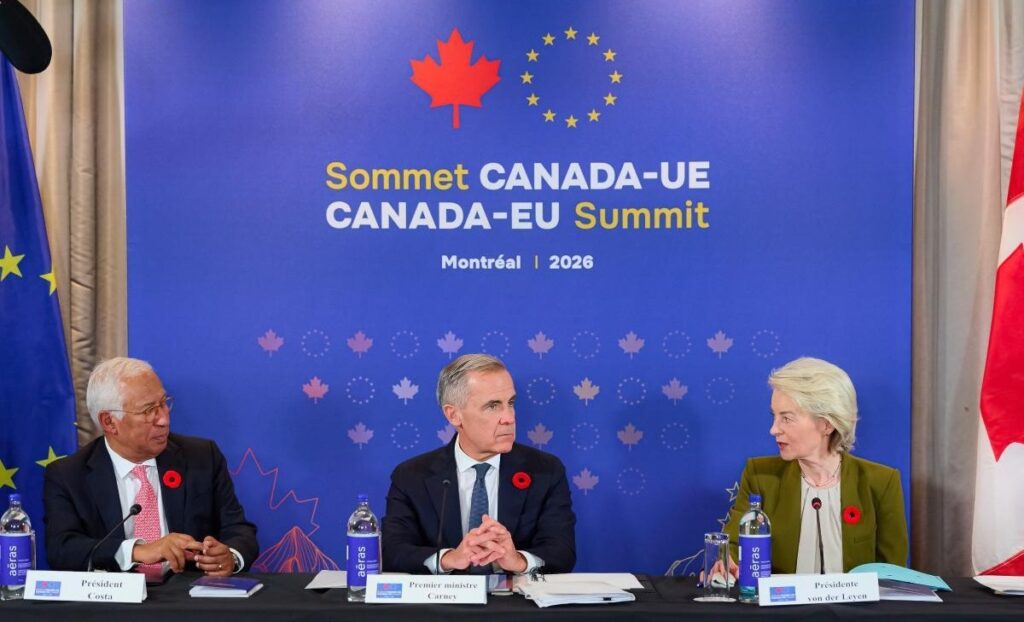
The European Union and Canada have taken a significant step towards a closer political and economic partnership following their 21st bilateral summit in Montréal, Canada, on 29–30 October 2026. The meeting brought together Canadian Prime Minister Mark Carney, European Council President António Costa and European Commission President Ursula von der Leyen, culminating in the launch of the Canada–EU Alliance for the Future. The new initiative represents an important development in a relationship built on decades of diplomatic engagement, economic cooperation and shared democratic principles. Against a backdrop of geopolitical uncertainty, technological change and growing pressure on international supply chains, the leaders agreed to strengthen cooperation in trade, energy, digital technology, defence, research and economic security.
According to the joint statement released on 30 October, the alliance is intended to establish a common space for prosperity and economic security, allowing both sides to make better use of their complementary strengths. Canada brings substantial natural resources, energy supplies and expertise in areas such as artificial intelligence and quantum technology, while the European Union offers a large integrated market, advanced research capabilities and considerable industrial capacity. The summit also signalled an ambition to move beyond existing arrangements towards a more integrated relationship. Leaders agreed to work towards defining an even closer association between Canada and the European Union, short of full membership, by the next summit in 2027.
A central outcome of the summit was the conclusion of negotiations on a new Digital Trade Agreement. The agreement is designed to make cross-border digital commerce more straightforward by establishing clearer rules for businesses, supporting trusted data flows and facilitating the use of electronic contracts, signatures and invoices. It also includes measures to strengthen online consumer protection and address misleading or fraudulent commercial practices. The agreement complements the existing Comprehensive Economic and Trade Agreement (CETA), which has been provisionally applied since 2017. According to the European Commission, trade in goods and services between the two partners increased by more than 80 per cent between 2016 and 2025, reaching over €130 billion in 2025. The new digital framework is intended to support further growth, particularly for small and medium-sized businesses seeking customers across the Atlantic. Formal signature and conclusion will follow the respective procedures on both sides.
Energy security and access to critical raw materials also featured prominently. The leaders committed to strengthening supply chains for minerals, clean technologies, semiconductors, pharmaceuticals and other strategically important goods. Canada’s natural resources and energy capacity offer opportunities to support European industrial needs, while European investment and technology can help develop Canadian projects and manufacturing capabilities. As part of this effort, Canada signed a treaty framework with the European Investment Bank to facilitate investment in Canadian critical-mineral projects. Both sides also agreed to work towards a framework for raw-material stockpiling and investment. In addition, they will examine the feasibility of increasing Canadian liquefied natural gas exports to Europe, taking account of market conditions and infrastructure requirements.
The summit produced further initiatives in research, computing and digital infrastructure. Canada joined the European High Performance Computing Joint Undertaking, opening opportunities for Canadian researchers and businesses to access advanced computing resources, including the JUPITER supercomputer. The partners also outlined plans to strengthen cooperation in artificial intelligence, quantum technologies and scientific research. Discussions will continue on Canada’s participation in future European research programmes, including Horizon Europe, and on expanding opportunities through the Erasmus+ education and exchange programme. Defence and security formed another important pillar of the discussions. Building on the security and defence partnership established in 2025, the leaders agreed to accelerate cooperation on defence industries, maritime and space security, crisis management and responses to hybrid threats. Canada’s participation in the European Union’s Security Action for Europe (SAFE) initiative provides a practical foundation for closer industrial collaboration.
Among the measures announced, Canadian company Galvion secured a contract worth more than $44 million to supply military helmets to Latvia. The agreement builds on an earlier Canadian defence procurement involving tactical radios for Poland. The partners also highlighted cooperation on satellite connectivity, navigation and disaster response, as well as plans to increase Canadian waterbomber production capacity to support wildfire response. On international affairs, Prime Minister Carney, President Costa and President von der Leyen reaffirmed their commitment to democracy, international law and effective multilateralism. They reiterated their support for Ukraine’s sovereignty and territorial integrity, including continued assistance and future reconstruction. They also called for greater cooperation on United Nations reform, sustainable development and international trade rules.
Regarding the Middle East, the leaders stressed the importance of de-escalation, humanitarian assistance and a negotiated two-state solution, under which Israel and Palestine would live side by side in peace within secure and recognised borders. Cooperation in the Arctic was another priority, with both sides seeking to strengthen regional security, sustainable development and engagement with Indigenous Peoples. The summit’s wider significance lies in its ambition to translate political goodwill into practical benefits for businesses, researchers and citizens. The leaders agreed to strengthen regular consultations and institutional exchanges, while working towards a closer association between Canada and the European Union by the 2027 summit. The precise scope of that arrangement remains to be determined.
The Montréal meeting therefore marked more than a reaffirmation of longstanding friendship. Through new commitments on digital trade, critical resources, defence, research and international cooperation, Canada and the European Union have established a broader framework for responding to shared challenges. The success of the Alliance for the Future will ultimately depend on how effectively these commitments are implemented, but the summit has set a clear direction for a deeper and more strategically aligned partnership.