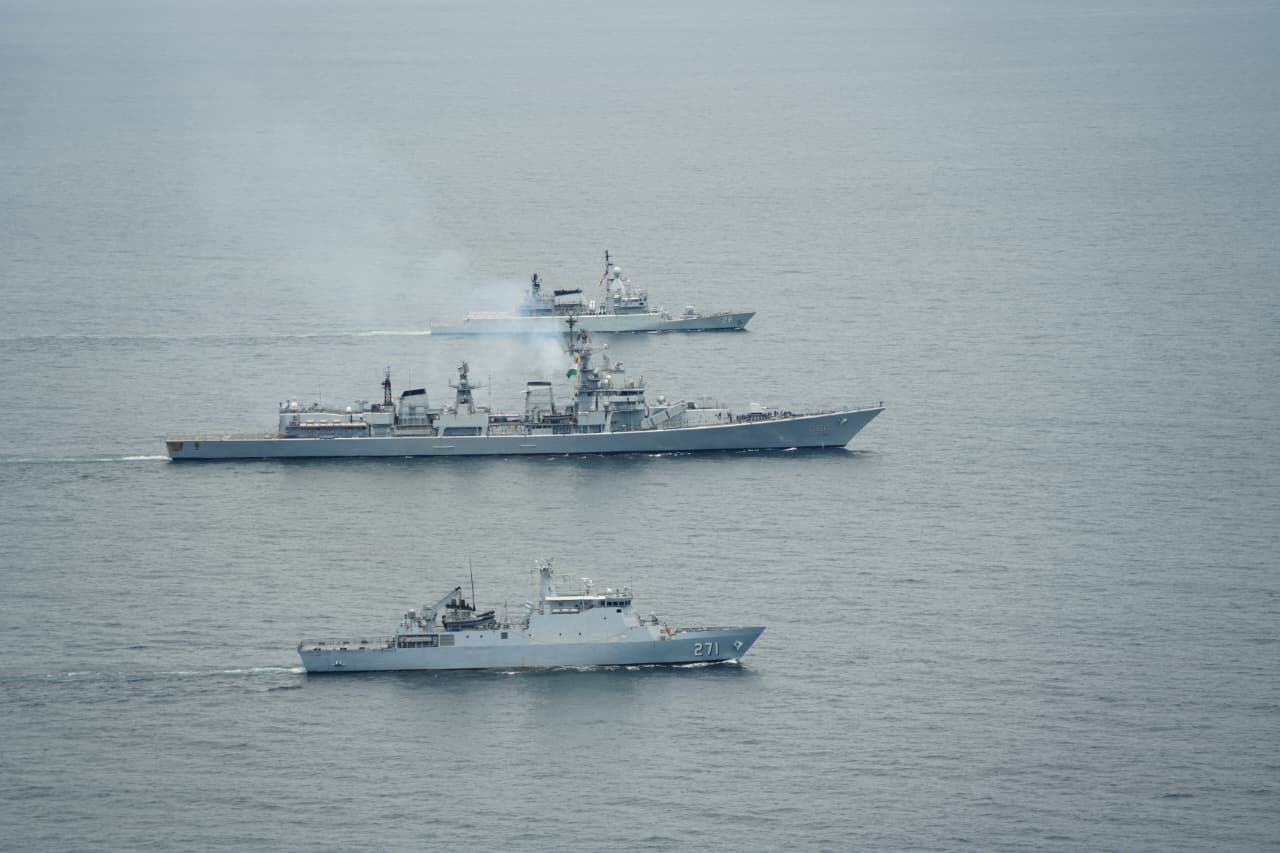
The Indian Navy’s destroyer INS Mysore arrived at Lumut, the principal base of the Royal Malaysian Navy, in September 2026 for the fourth edition of the bilateral maritime exercise ‘Samudra Laksamana’ between the Indian Navy and the Royal Malaysian Navy. The exercise featured professional engagements both in harbour and at sea, including cross-deck visits, operational engagements and sporting events, with INS Mysore operating alongside Royal Malaysian Navy ships KD Lekir and KD Gagah Samudera during the sea phase. The exercise reflects a broader trend: maritime security has emerged as one of the most dynamic dimensions of the Malaysia–India relationship.
The Malacca Gateway
The Indo-Pacific geography holds significance for both nations. Malaysia is a littoral state of the Strait of Malacca, the critical maritime link between the Indian Ocean and the Pacific through which a substantial share of Asia’s energy and trade flows. The strategic significance of this strait is well recognised by major powers, as dependence on this chokepoint shapes the maritime security calculations of Asian economies. India’s Andaman and Nicobar Islands lie close to the Strait’s western approaches and give India a direct interest in the region’s security and stability.
The Momentum in the Maritime Domain
The two nations share deep-rooted ties of friendship and socio-cultural and people-to-people linkages. The elevation of bilateral ties to a Comprehensive Strategic Partnership in August 2024 marked a turning point, with defence and security identified as a core pillar of the relationship. Institutional groundwork was laid in 2025, when the 13th Malaysia–India Defence Cooperation Committee meeting finalised the terms of reference for a Strategic Affairs Working Group and a Su-30 Forum under the defence cooperation framework, and an inaugural Malaysia–India Security Dialogue was held. PM Shri Narendra Modi’s visit to Kuala Lumpur in February 2026 then gave this priority concrete form, with both sides reaffirming their commitment to a rules-based maritime order, including freedom of navigation and overflight in accordance with UNCLOS 1982. This shared endorsement provides a strong normative foundation for deeper cooperation.
Malaysia and India have further strengthened their maritime engagement through operational visits by Indian naval vessels, including INS Sandhayak to Port Klang in July 2025 and INS Sahyadri to Kemaman in October 2025. This cooperation is further supported through multilateral platforms such as MILAN and the ASEAN-India Maritime Exercise (AIME), which advance maritime interoperability and help identify areas of strategic convergence. This convergence was emphasised in the Joint Statement issued in February 2026, wherein both countries welcomed efforts to operationalise the ASEAN-India Joint Statement on Cooperation on the ASEAN Outlook on the Indo-Pacific (AOIP) for Peace, Stability, and Prosperity in the Region. The 11th edition of the Navy-to-Navy Staff Talks, held in New Delhi in July 2026, is evidence of institutional engagement between the Indian Navy and the Royal Malaysian Navy, as the talks were directed towards planned future joint initiatives and strengthened maritime cooperation. The 12th Meeting of the India–Malaysia Joint Sub-Committee on Defence Science, Technology and Industry Cooperation, held in New Delhi days later, reaffirmed the commitment to long-term defence industrial ties. The Su-30 Forum adds a valuable dimension by facilitating the exchange of maintenance expertise between the two air forces, both of which operate Su-30 aircraft.
The complementarity between the AOIP and India’s Indo-Pacific Oceans Initiative (IPOI) contributes to a more coordinated regional approach to maritime cooperation, stability, and security while respecting the sovereignty and strategic interests of regional nations such as Malaysia and India.
Malaysia and India have also advanced cooperation on counter-terrorism and disaster management. They co-chair the ASEAN Defence Ministers’ Meeting-Plus (ADMM-Plus) Experts Working Group (EWG) on Counter-Terrorism for the 2024–2027 cycle and have committed to joint efforts against terrorist financing and transnational organised crime. They also signed a memorandum of understanding on disaster management in February 2026, covering search-and-rescue training and joint exercises.
The partnership between the two nations is further strengthened by a shared commitment to strategic autonomy. Traditionally, Malaysia has followed a balanced foreign policy, engaging with all major powers while preserving its independence in decision-making. It combines strategic neutrality with cooperation in specific domains such as defence, trade and technology. India’s own policy of strategic autonomy and multi-alignment reflects a similar approach. As a major maritime power in the Indian Ocean with growing capabilities and a consistent commitment to ASEAN centrality, India is well placed to support Malaysia’s maritime security needs while respecting its policy preferences. New Delhi’s stake in the Strait of Malacca is concrete, with over 55 per cent of its external trade transiting through these waters, making Kuala Lumpur a significant part of India’s trade and maritime interests. Malaysia offers India a capable and principled partner at the gateway between the Indian and Pacific Oceans. Both countries therefore view security cooperation as a means of strengthening their capabilities, improving interoperability and contributing to regional stability.
Conclusion
Malaysia and India share maritime priorities, a commitment to a rules-based order and a deep interest in the security of the sea lanes that connect the Indian and Pacific Oceans. The relationship has made considerable progress since 2024, indicating that their maritime security partnership has entered a substantive phase. Anchored in mutual respect for each other’s strategic autonomy and in a shared vision of an open and stable Indo-Pacific, this partnership is well placed to become a key pillar of security at the gateway of two oceans.