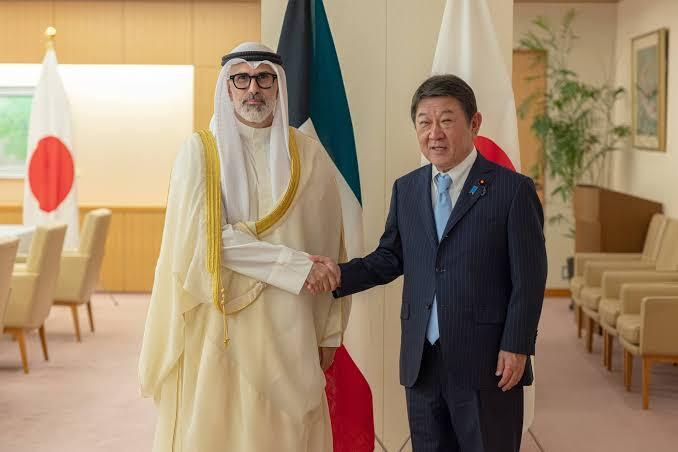
Kuwait and Japan have reaffirmed their longstanding friendship and commitment to closer cooperation, reflecting a relationship built on mutual respect, economic partnership and decades of diplomatic engagement. The latest engagement took place in Tokyo on 13 October 2026, when Dr Mohammed Naser Al-Hajery, Kuwait’s Ambassador-Designate to Japan, met Ambassador Iwamoto Keiichi, Japan’s Assistant Minister and Director-General of the Middle Eastern and African Affairs Bureau. The meeting highlighted the continuing importance of diplomatic dialogue as both countries seek to strengthen their relationship and explore opportunities for further cooperation. The discussions came during a significant year for bilateral ties, marking 65 years since Kuwait and Japan established formal diplomatic relations in December 1961. Over that period, their relationship has grown from its early commercial foundations into a wider partnership encompassing political dialogue, energy, investment and development.
Kuwait and Japan established diplomatic relations on 8 December 1961, shortly after Kuwait gained independence. Their economic connections had begun earlier, in 1958, when the Japanese-owned Arabian Oil Company obtained oil concessions in Kuwaiti territory.Energy has remained a central pillar of the relationship. Kuwait is an established oil-producing country, while Japan relies heavily on imported energy to sustain its industrial economy. This shared economic interest has encouraged continued engagement between their governments and businesses. However, the relationship extends beyond oil. Both countries have maintained diplomatic contacts and demonstrated solidarity during challenging periods. Japan supported international efforts following Iraq’s invasion of Kuwait in 1990, while Kuwait provided substantial assistance to Japan following the devastating earthquake and tsunami of March 2011.
A major development came in May 2025, when Kuwait’s Crown Prince, His Highness Sheikh Sabah Khalid Al-Hamad Al-Sabah, visited Japan and met the country’s then Prime Minister, Mr Shigeru Ishiba. The two governments agreed to elevate their relationship to a Comprehensive and Strategic Partnership. The initiative created a broader framework for cooperation in areas including electricity, water, renewable energy, direct investment and diplomatic training. It also reflected the intention of both countries to develop practical cooperation beyond their traditional energy relationship. The October meeting between Dr Al-Hajery and Ambassador Iwamoto takes place against this wider background. Ambassadorial engagement plays an important role in maintaining diplomatic communication, following up on shared priorities and supporting cooperation between government institutions. As Kuwait and Japan work to advance their partnership, continued dialogue can help identify opportunities for collaboration and strengthen understanding of each country’s priorities.
Energy security remains an important consideration for both governments. Japan’s reliance on imported oil makes stable supplies and secure maritime transport essential, while Kuwait has an interest in maintaining dependable trade relationships and contributing to stability in international energy markets. The two countries have also explored opportunities in infrastructure, investment and technology. Japanese expertise in engineering, water management and advanced industrial systems could complement Kuwait’s development objectives, while closer business engagement could create opportunities for companies in both markets. Education and professional training offer further possibilities for cooperation. Exchanges between institutions can support skills development, share technical knowledge and strengthen long-term connections between the two countries. These areas represent opportunities for future collaboration rather than confirmation that every proposed initiative has entered implementation.
The meeting in Tokyo underscores the continuing importance Kuwait and Japan attach to their bilateral relationship. With more than six decades of diplomatic ties behind them, both countries have a strong foundation on which to build further cooperation. The Comprehensive and Strategic Partnership provides a framework for expanding engagement, while regular diplomatic consultations can help maintain momentum and address emerging challenges. For Kuwait, closer ties with Japan offer opportunities to support economic diversification and infrastructure development. For Japan, the relationship remains valuable for energy security and wider engagement with the Gulf region. The task ahead will be to translate diplomatic goodwill into practical outcomes. Through continued dialogue, investment and cooperation across multiple sectors, Kuwait and Japan can preserve the strengths of their traditional friendship while adapting their partnership to changing economic and international circumstances.