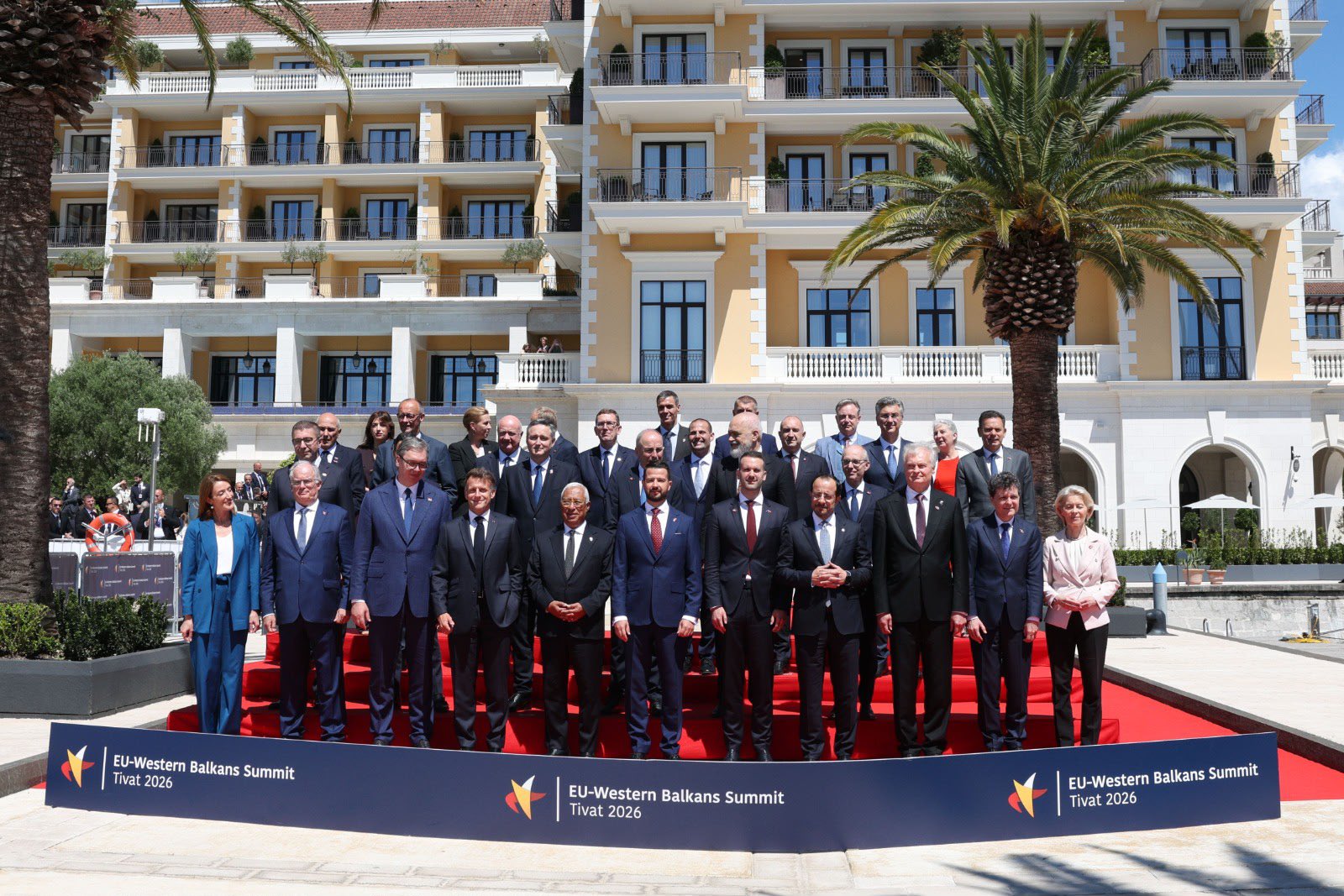
European Union and Western Balkans leaders convened in Tivat, Montenegro, on 5 June 2026, for a summit themed “Shared Prosperity and Stability of the EU and the Western Balkans.” Hosted at Porto Montenegro, this marked the first time Montenegro had held such a high-level gathering. It was the second EU–Western Balkans Summit in six months, following the previous one in Brussels in December 2025.
The summit was chaired by European Council President António Costa and hosted by the President of Montenegro. European Commission President Ursula von der Leyen represented the European Commission, and European Parliament President Roberta Metsola was also in attendance. Among the heads of government and state present were French President Emmanuel Macron, German Chancellor Friedrich Merz, and Italian Prime Minister Giorgia Meloni.
Between 1 and 4 June 2026, President Costa toured the region, meeting leaders from all Western Balkans partners. Discussions during these visits covered opportunities and challenges related to enlargement, gradual integration, regional cooperation, security, and stability. Ahead of his tour, Costa posted on X: “My visit to the region sends a clear signal: our commitment to the Western Balkans is real, and so is the opportunity of enlargement. The momentum is there. Now is the time to deliver.”
Enlargement and Montenegro
Montenegro’s prospective membership was a central focus of the summit. At the post-summit press conference, President Costa announced that the European Union had begun drafting an accession treaty with Montenegro the previous month, adding: “For the first time since 2013, we are really counting down to the next accession.” The Council had approved an Ad Hoc Working Party in April 2026 to commence drafting the treaty, at which point fourteen of thirty-three negotiating chapters had been provisionally closed.
Commission President von der Leyen stated that Montenegro’s ambition to become the 28th EU member state by 2028 was within reach.
Growth Plan and Economic Integration
Commission President von der Leyen’s discussions with leaders primarily addressed the implementation of the Growth Plan for the Western Balkans. This plan aims to support key reforms, unlock funding, and foster closer ties between the region and the European Union. Building on the €6 billion Growth Plan, the EU pledged deeper economic integration, new cybersecurity cooperation, roaming reforms, and youth mobility initiatives, while also signalling efforts to streamline accession procedures.
The summit reaffirmed that the region’s EU accession remains a top priority on the EU’s political agenda and that enlargement represents a geostrategic investment in Europe’s stability, prosperity, and security.
President Costa noted at the press conference that the Serbian government had presented a concrete timeline for approving the outstanding elements of electoral law reform and completing judiciary reform in line with ODIHR and Venice Commission recommendations in the coming weeks.
In his closing press conference remarks, President Costa affirmed: “The European Union is and will remain the most reliable partner of the region. Because the future of the Western Balkans lies with the future of the European Union.”