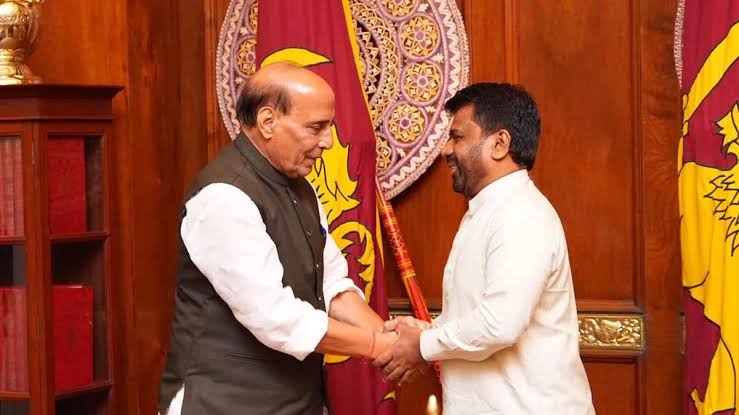
India and Sri Lanka moved to deepen their defence relationship on Wednesday, 9th September, 2026, as Defence Minister Rajnath Singh met Sri Lankan President Anura Kumara Dissanayake in Colombo, with both sides reaffirming their commitment to regional security, peace and development. Mr. Singh, who arrived in Sri Lanka on September 8 for a three-day official visit, held substantive discussions with President Dissanayake covering the broad India-Sri Lanka partnership. The meeting comes at a time when both countries are placing greater emphasis on their maritime relationship and cooperation in the Indian Ocean.
The two leaders described India and Sri Lanka as close neighbours and maritime partners and agreed to continue working together for the development and welfare of their people. Mr. Singh conveyed Prime Minister Narendra Modi’s greetings to President Dissanayake and congratulated him on the completion of two years of his government. The Indian Defence Minister also highlighted the longstanding links between the two countries, pointing to their historical and civilisational connections and the strong people-to-people relationship that has supported bilateral ties over the years.
For Sri Lanka, the meeting also provided an opportunity to reiterate its position on India’s security concerns. President Dissanayake said Sri Lanka would not allow its territory to be used for activities that could be harmful to India’s security interests. The assurance is significant given Sri Lanka’s location in the Indian Ocean and the importance both countries attach to maritime security. The talks also brought attention to India’s role in responding to emergencies in Sri Lanka. Dissanayake expressed appreciation for the assistance provided by India through Operation Sagar Bandhu following Cyclone Ditwah, as well as the wider rehabilitation package extended by New Delhi for reconstruction and rehabilitation in affected areas. Mr. Singh said India viewed supporting Sri Lanka during difficult periods not as a favour but as a responsibility as a close neighbour and first responder.
Defence cooperation was given a practical push during the visit with the exchange of three memoranda of understanding. One agreement covers the upgrading of six L70 air-defence guns operated by the Sri Lanka Air Force under a Government of India grant. The equipment had previously been provided to Sri Lanka by India, and the upgrade is intended to strengthen the country’s air-defence capabilities for critical assets. The other agreements focus on institutional and youth-level defence cooperation. An MoU between the National Defence Colleges of India and Sri Lanka will promote academic cooperation and knowledge sharing. Another agreement formalizes cooperation between the National Cadet Corps of the two countries, including a youth exchange programme that will provide Sri Lankan cadets opportunities to participate in NCC activities in India. Mr. Singh and President Dissanayake also virtually inaugurated three Bailey bridges constructed by the Indian Defence Forces. The development added a humanitarian and reconstruction element to a visit otherwise centred heavily on defence and regional security.
The visit is the first official trip to Sri Lanka by an Indian Defence Minister in 38 years. New Delhi had announced ahead of the trip that Singh would hold consultations with the Sri Lankan leadership and lead a high-level delegation comprising senior officials from the Defence and External Affairs ministries. India said the visit was intended to strengthen the traditionally friendly relationship, particularly in areas of maritime and defence cooperation. Mr. Singh’s visit will continue until September 10. It reflects the broader direction of India-Sri Lanka ties, where defence cooperation is increasingly being linked with maritime security, capacity building, humanitarian assistance and closer institutional engagement. For both governments, the emphasis remains on strengthening a partnership shaped by geography, shared history and common interests in a stable Indian Ocean region.