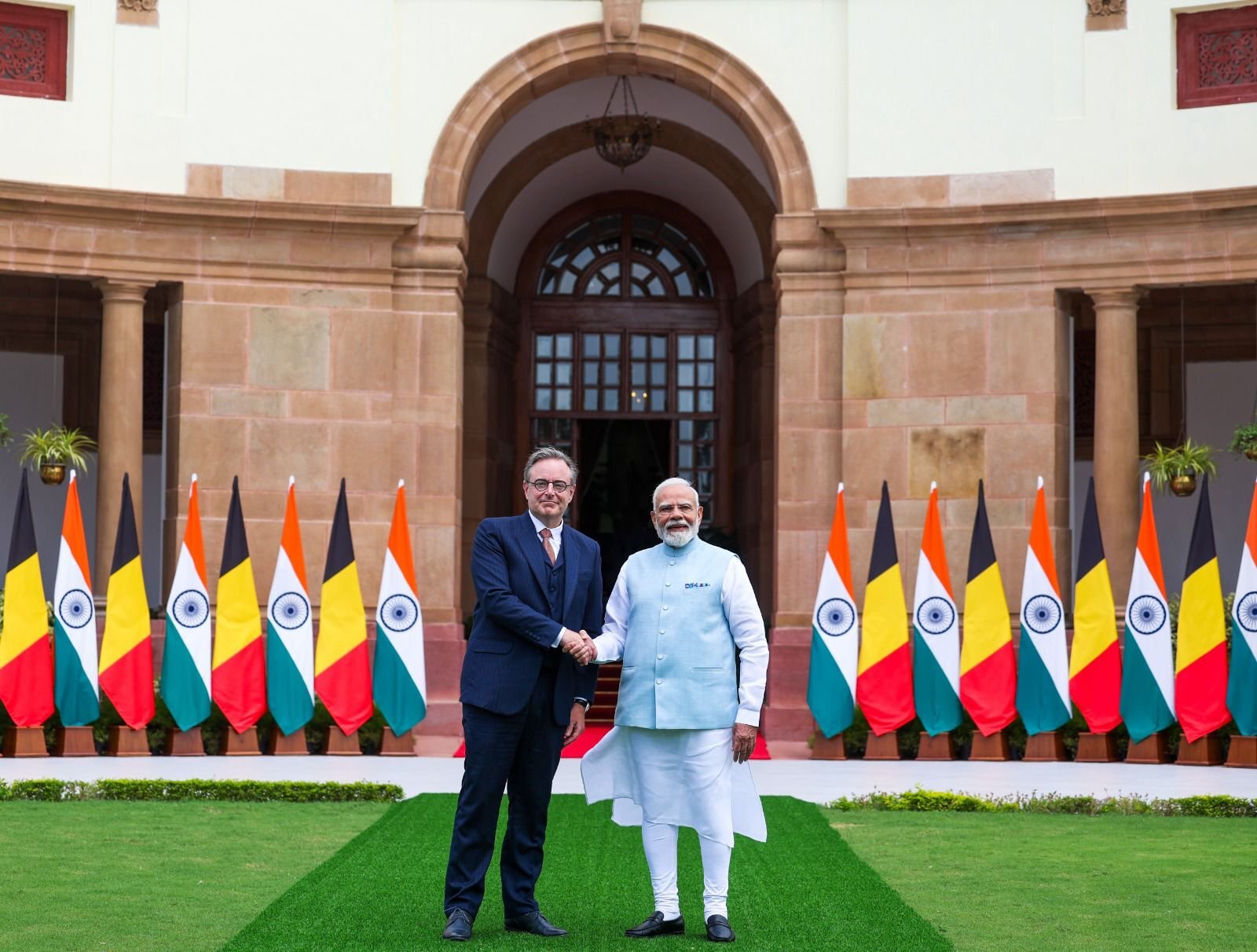
On Thursday, 3 September 2026, India and Belgium agreed to deepen cooperation in defence, renewable energy, semiconductors, critical minerals and intelligence sharing, as Prime Minister Narendra Modi held bilateral talks with Belgian Prime Minister Bart De Wever in New Delhi. PM De Wever, who arrived in the national capital on Wednesday for a three-day official visit, met Modi at Hyderabad House, where the two leaders reviewed the full range of bilateral relations as well as regional and global developments of mutual interest.
The talks resulted in the exchange of several agreements, including a Letter of Intent on Defence Cooperation and Memorandums of Understanding covering renewable energy, cybercrime and diplomatic training. The two sides also reviewed and signed pacts on defence industrial cooperation, aimed at bringing Belgian technology and expertise into India. The visit is being seen as an important step in taking India-Belgium relations beyond their long-standing economic ties and towards a broader strategic partnership.
Defence emerged as one of the key areas of discussion between PM Modi and PM De Wever. Belgium’s Minister of Defence and Foreign Trade, Theo Francken, accompanied the Belgian PM along with a delegation from the country’s defence industry. India and Belgium have agreed to expand cooperation in defence industrial production, with the two countries already working together on modern defence equipment, including the Zorawar tank.
The exchange of the Letter of Intent on Defence Cooperation is expected to provide a broader framework for this growing engagement. The focus on defence comes as the two countries look to expand their partnership into more strategic areas. PM Modi noted that cooperation between India and Belgium had traditionally centred on economic and commercial sectors but had increasingly moved into areas such as defence and clean energy.
“Ten years ago, I had the opportunity to visit Belgium, and I am very pleased that our partnership has made remarkable progress over the past decade,” PM Modi said. PM Modi said India and Belgium share the goal of building a clean energy future while ensuring reliable supply chains. The renewable energy MoU exchanged during De Wever’s visit is expected to give fresh momentum to cooperation in sustainability.
The two countries are already working together on a major green ammonia project in Kakinada, Andhra Pradesh, which PM Modi described as one of the largest projects of its kind in the world. The partnership is also expanding into critical minerals. India and Belgium have decided to increase cooperation in the processing and recycling of critical minerals, an area that has become increasingly important as countries seek more secure and resilient supply chains.
Semiconductors also featured prominently in the discussions, with both sides looking to combine their respective strengths. PM Modi said Belgium’s expertise and India’s scale offer complementary advantages in the semiconductor sector. As part of this effort, India and Belgium will work towards connecting Belgium’s imec with India’s growing semiconductor ecosystem. The proposed cooperation comes as India continues to develop its semiconductor capabilities and seek partnerships with countries and institutions possessing advanced technological expertise.
The two leaders also discussed international and regional issues, including the conflicts in Ukraine and West Asia. PM Modi said India and Belgium shared a belief in the rule of law, dialogue and diplomacy and supported efforts aimed at bringing conflicts to an early end and restoring peace. He also stressed that India and Belgium shared a commitment to combating terrorism. “And to eradicate every form of terrorism from its roots is our shared commitment,” he said. The remarks reflected the broader discussions between the two leaders on global developments and issues affecting international stability.
PM Modi used his press statement to underline the resilience of the Indian economy at a time of global uncertainty. He said the world was going through a period of major upheaval, with conflicts continuing in different parts of it. The uncertainty, he noted, was being felt across sectors, from food and fuel to global supply chains. Despite these challenges, he said, India’s economy had continued to maintain its momentum. PM Modi pointed to India’s latest quarterly growth figure of 7.8 per cent.
India’s economic performance was increasingly becoming a source of confidence and new opportunities for the wider global economy. The economic dimension is particularly relevant to the India-Belgium relationship, which has traditionally been anchored in trade, investment and business ties.
While the discussions focused heavily on new areas of cooperation, Modi also highlighted the historical foundations of relations between the two countries. He recalled the role played by thousands of Indian soldiers in Belgium during the First World War, describing their courage and sacrifice as an important part of the shared memory of India and Belgium. The Prime Minister said the two countries were natural partners because of their shared democratic values, market economies and strong people-to-people connections. Earlier on Thursday, PM De Wever visited Rajghat in New Delhi, where he paid tribute to Mahatma Gandhi.
PM De Wever’s visit is significant as it is his first trip to India since taking office in February 2025. It is also the first visit by a Belgian Prime Minister to India in two decades. The visit follows a series of developments that have given fresh momentum to bilateral ties. In March 2025, a Belgian Economic Mission led by Princess Astrid visited India, during which around 40 MoUs were signed. The two countries also held their inaugural India-Belgium Strategic Dialogue in July 2026. The current visit provides an opportunity to build on those developments and turn the recent political and economic momentum into concrete cooperation, particularly in strategic sectors.
After his engagements in New Delhi, PM De Wever is scheduled to travel to Mumbai on 4 September. The Mumbai visit will underline the economic foundations of the India-Belgium relationship. One of the key stops on his programme is the Bharat Diamond Bourse in the Bandra Kurla Complex.
The visit to the diamond exchange highlights the importance of the diamond trade to relations between the two countries, while also pointing to opportunities for further cooperation in the sector. De Wever will also deliver a keynote address at a Confederation of Indian Industry business event in the context of the India-EU Free Trade Agreement.
With defence, clean energy, critical minerals, semiconductors and economic cooperation all featuring prominently during the visit, India and Belgium are seeking to give their relationship a wider strategic dimension. For New Delhi and Brussels, the focus now appears to be on turning the agreements and areas of cooperation identified during De Wever’s visit into practical partnerships, building on the economic relationship that has connected the two countries for decades.