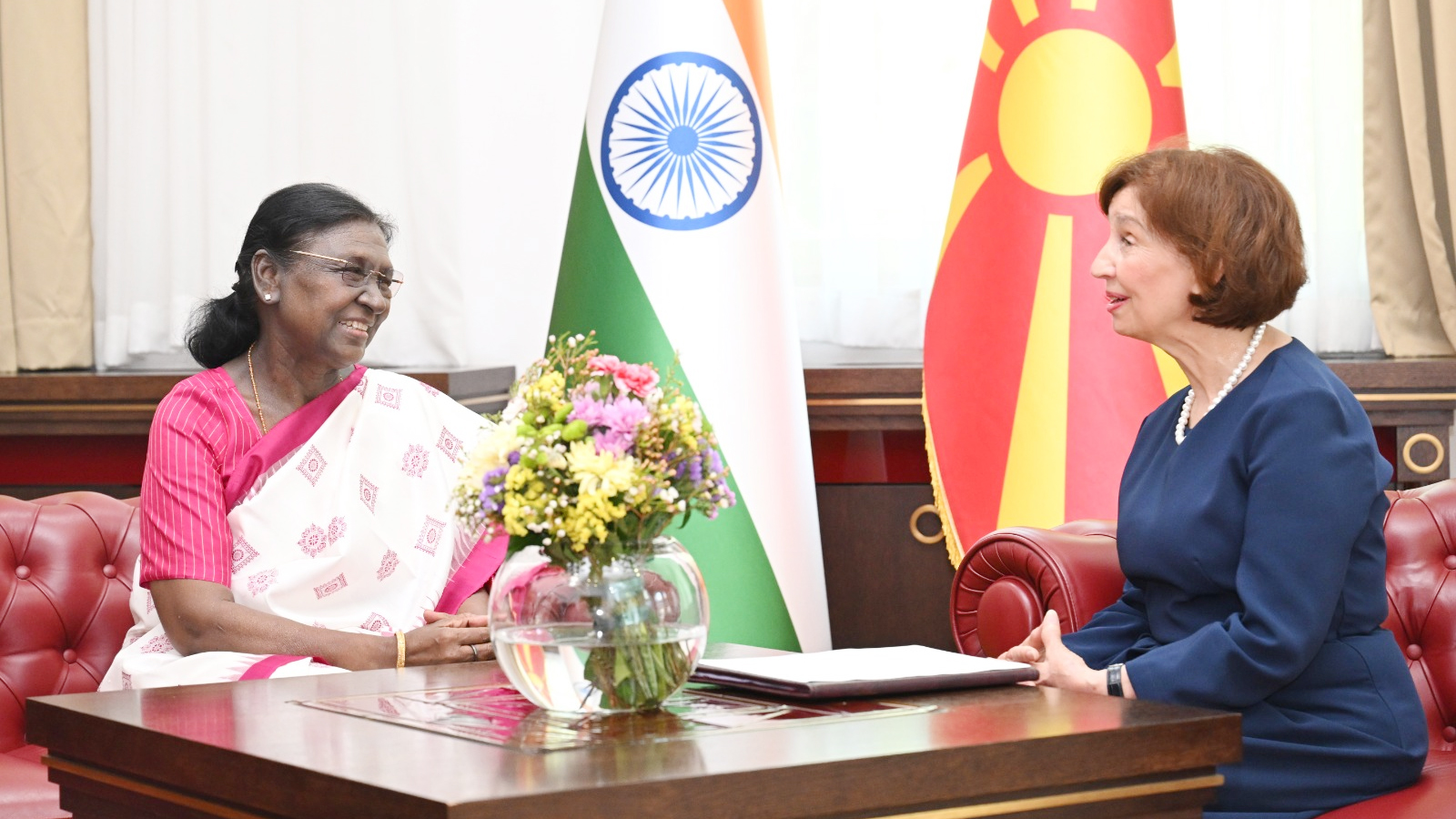
President Droupadi Murmu undertook the first-ever bilateral visit by an Indian Head of State to North Macedonia on 21–22 July 2026, as part of a wider three-nation tour. The visit, made at the invitation of North Macedonian President Gordana Siljanovska-Davkova, marked a significant milestone, coming more than three decades after India and North Macedonia established diplomatic relations in 1995.
During her stay in Skopje, President Murmu held bilateral talks with President Siljanovska-Davkova and met Prime Minister Hristijan Mickoski. She also addressed the North Macedonian Assembly and engaged with the Assembly’s President, reflecting the parliamentary dimension of the visit alongside the presidential-level exchanges.
Briefing the media on the visit, Ministry of External Affairs Secretary (West) Sibi George described the trip as reaffirming India’s commitment to strengthening partnerships with North Macedonia, as well as reflecting India’s broader engagement with Europe. He noted that the two sides had identified trade, technology and tourism as priority areas and that discussions had also touched on multilateral cooperation, with both countries reiterating their support for reform of the United Nations Security Council.
Economic cooperation featured prominently in the programme. Addressing the India–North Macedonia Business Forum in Skopje, President Murmu said the two countries’ trade relationship shows a steady positive trajectory and called for setting an ambitious target to double bilateral trade volume by the end of the decade. She pointed to India’s pharmaceutical sector as well-placed to invest through joint manufacturing facilities in North Macedonia and highlighted opportunities in agriculture, food processing, information technology and renewable energy. She also invited North Macedonia to join India-led global initiatives, including the International Solar Alliance, the Coalition for Disaster Resilient Infrastructure and the Global Biofuels Alliance.
North Macedonia expressed its intention to join several of these India-led platforms, underlining what officials described as a shared commitment to sustainable development. The two governments also renewed a memorandum of understanding on healthcare cooperation for a further five years, aimed at strengthening joint initiatives and technology development in the health sector.
Beyond formal engagements, the visit included cultural elements underscoring the historical ties between the two nations. Programmes scheduled during the visit included the joint unveiling of the bust of Mahatma Gandhi by the two presidents and a visit to the Mother Teresa Memorial House and Museum in Skopje, the city of her birth. President Siljanovska-Davkova also extended a guided walk around Skopje’s historic city centre as a gesture of goodwill.
The Indian delegation accompanying President Murmu included representatives from sectors such as information technology, artificial intelligence, renewable energy, healthcare, construction, textiles, food processing, and defence and aerospace, reflecting the breadth of areas both sides hope to develop further.
Officials described the visit as consolidating India’s outreach to Central and Eastern Europe, coming amid a broader diplomatic engagement that also included stops in Moldova and Romania during the same tour. The Ministry of External Affairs indicated that further institutional follow-up, including business delegations and sectoral dialogues, is expected to build on the outcomes of the visit in the months ahead.