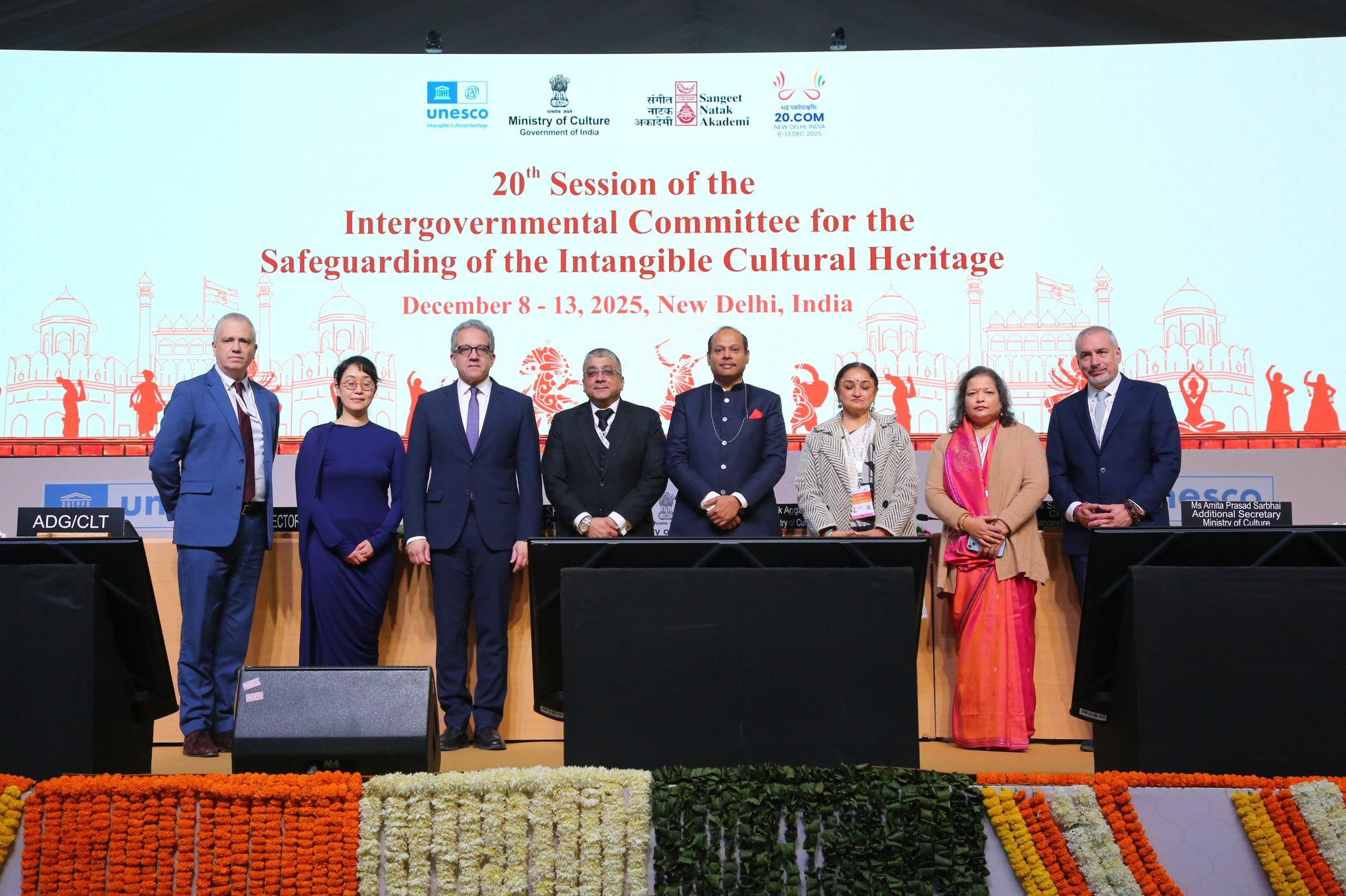
India is hosting the 20th Session of the UNESCO Intergovernmental Committee for the Safeguarding of the Intangible Cultural Heritage (ICH) from 8 to 13 December 2025 in New Delhi, marking a historic first for the country and a milestone in its cultural diplomacy. The session is being held at the iconic Red Fort, a UNESCO World Heritage Site, offering a symbolic and visually powerful backdrop for global discussions on protecting living cultural traditions. The Ministry of Culture and the Sangeet Natak Akademi (SNA) are the nodal agencies organising this year’s session, which brings together over 1,000 delegates from more than 180 countries, including committee members, UNESCO officials, experts, accredited NGOs, and practitioners.
The meeting coincides with the twentieth anniversary of India’s ratification of the 2003 UNESCO Convention, reaffirming the nation’s sustained commitment to safeguarding its diverse cultural expressions. Adopted in Paris at UNESCO’s 32nd General Conference, the 2003 Convention was designed to respond to global concerns that living traditions, oral arts, rituals, and craftsmanship were increasingly threatened by rapid social and economic change.
Prime Minister of India Shri Narendra Modi expressed delight at India hosting the prestigious session for the first time, noting that the gathering “reflects our commitment to harnessing the power of culture to connect societies and generations.”
The 20th session of the Intergovernmental Committee features a comprehensive programme that includes the opening of the session, adoption of the agenda and reports from the UNESCO Secretariat on activities undertaken between January 2024 and June 2025. The Committee will examine safeguarding reports submitted by States Parties for elements on the Urgent Safeguarding List, along with periodic reports from Asia-Pacific countries on elements inscribed on the Representative List. It will also evaluate new nominations for inscription on both the Representative List and the Urgent Safeguarding List, review proposals for inclusion in the Register of Good Safeguarding Practices, and consider requests for transfer of elements between lists. The session further includes the assessment of the use of the Intangible Cultural Heritage Fund for 2024-2025 and planning for its use in 2026-2027, as well as the review and accreditation of NGOs working under the Convention. The Committee will also hold thematic discussions on the role of intangible cultural heritage in sustainable development before concluding with the election of the next Bureau and a decision on the venue and dates of the 21st session.
India is chairing the session for the first time, led by H.E. Vishal V. Sharma, India’s Permanent Delegate to UNESCO. Over the years, India has served three terms on the Intergovernmental Committee and has 15 elements inscribed on UNESCO’s Representative List of the Intangible Cultural Heritage of Humanity. In a landmark addition this year, Deepavali (Diwali) became the 16th Indian tradition to receive UNESCO recognition, joining other celebrated elements such as yoga, Durga Puja, and Vedic chanting.
Built by Mughal emperor Shah Jahan, the Red Fort served as the palace-fort of Shahjahanabad and stands as one of India’s most powerful symbols of history and nationhood. During the conference, delegates are being welcomed with thematic exhibitions, cultural showcases, and curated performances illustrating India’s extraordinary spectrum of living heritage, from crafts and festivals to ritual practices and performing arts.
By hosting the Committee session, India aims to showcase its safeguarding model for intangible cultural heritage, strengthen international cooperation through joint nominations and capacity-building, and bring global attention to its lesser-known traditions. The event is also intended to inspire greater domestic participation, especially among youth, while advancing India’s cultural diplomacy and highlighting the role of living heritage in sustainable development, livelihoods, social cohesion, and cultural tourism.