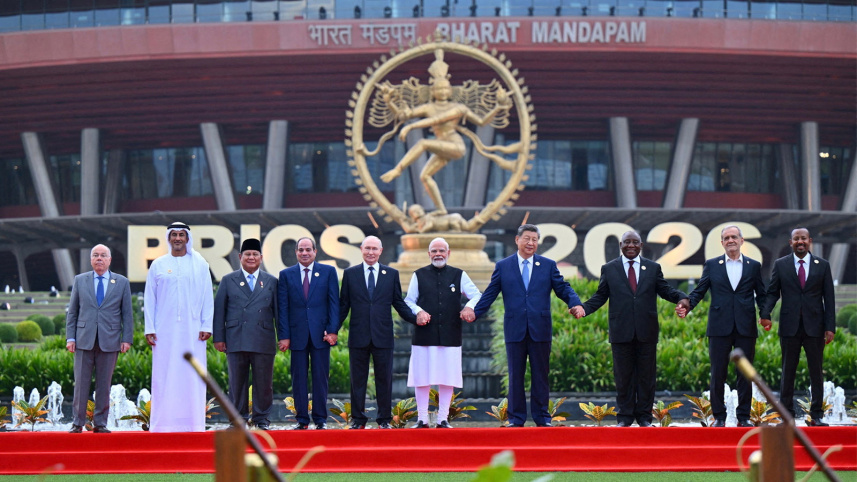
The second and concluding day of the 18th BRICS Summit in New Delhi brought the expanded grouping’s leaders together for discussions on global governance, development, economic cooperation and the wider role of emerging and developing countries. Hosted at Bharat Mandapam under India’s 2026 BRICS chairship, the summit was held under the theme “Building for Resilience, Innovation, Cooperation and Sustainability.” The two-day meeting also marked two decades of BRICS cooperation and brought the grouping’s expanded membership and partner countries into closer engagement. The summit’s discussions were framed around India’s effort to position BRICS as a practical platform for cooperation rather than simply a political grouping. The New Delhi Declaration said the grouping would continue work across its three broad pillars — political and security cooperation, economic and financial cooperation, and cultural and people-to-people exchanges.
Focus remains on a more representative global order
A central issue running through the summit was the reform of global governance. The New Delhi Declaration reaffirmed the members’ support for a multilateral system that is more representative, effective, responsive and accountable. The leaders also reiterated their support for strengthening multilateralism and multipolarity and for the central role of the United Nations in international affairs. For India, the discussion fits closely with the emphasis placed throughout its BRICS chairship on giving greater weight to the concerns of developing countries.
The declaration noted that BRICS has expanded considerably since its early years and now brings together countries from Asia, Africa, the Middle East and Latin America. It also recognised the contribution of BRICS partner countries and called for greater participation by emerging markets and developing countries in the grouping’s activities. India’s chairship had already produced more than 400 meetings and engagements involving ministers, parliamentarians, government officials, experts, businesses and other stakeholders across 30 cities, according to the declaration. That extensive programme was presented as part of India’s attempt to make the BRICS agenda broader and more practical, with cooperation extending beyond the annual leaders’ meeting.
PM Modi holds a series of meetings on summit sidelines
The second day was also marked by a busy schedule of bilateral meetings for Prime Minister Narendra Modi. PM Modi met South African President Cyril Ramaphosa on the sidelines of the summit. The two leaders reviewed the progress of the India-South Africa Strategic Partnership and discussed cooperation in areas including trade, critical minerals, infrastructure, food security and digital technologies. They also exchanged views on international issues and agreed to maintain close coordination in multilateral forums.
The two sides also discussed the India-SACU trade agreement and cooperation in mining and critical minerals. Against the backdrop of the successful transfer of cheetahs from South Africa to India, PM Modi invited South Africa to consider joining the International Big Cat Alliance. PM Modi also met Philippine President Ferdinand R. Marcos Jr., who attended the summit in his capacity as the current ASEAN chair. The two leaders reviewed bilateral relations and agreed to deepen cooperation in defence and security, trade and investment, space, railway infrastructure, fintech, education, tourism, science and technology, innovation and people-to-people exchanges. The Philippines also decided to join the Coalition for Disaster Resilient Infrastructure, an initiative in which India has played a leading role.
Kazakhstan talks cover energy, connectivity and critical minerals
Another important meeting on the sidelines was between PM Modi and Kazakhstan President Kassym-Jomart Tokayev. The two leaders reviewed the development of India-Kazakhstan relations and discussed political and economic cooperation, defence and security, connectivity, energy, critical minerals, emerging technologies, the creative economy and people-to-people ties. They also exchanged views on regional and international developments. The meeting came during a period in which supply chains, energy security and access to critical minerals have become increasingly important areas of international economic cooperation.
PM Modi and President Tokayev reaffirmed their intention to strengthen the strategic partnership between the two countries, with the stated objective of contributing to regional peace, stability, development and prosperity.
Africa remains a major part of India’s BRICS outreach
India’s engagement with African partners was another prominent feature of the second day. PM Modi met Uganda’s Vice President Jessica Rose Epel Alupo, with the discussions focusing on strengthening bilateral cooperation through technology partnerships, capacity building, knowledge sharing, investment facilitation and greater private-sector engagement. PM Modi reaffirmed India’s support for Uganda’s Vision 2040, while both sides stressed the importance of people-to-people ties and India’s development partnership with Uganda. The two leaders also called for closer engagement in support of the voice of the Global South.
PM Modi separately met Évariste Ndayishimiye, Chairperson of the African Union and President of Burundi. The meeting further underlined India’s effort to engage African countries through the BRICS platform. The Prime Minister’s Office listed the meeting among Modi’s engagements on September 13. Nigeria was also represented in PM Modi’s bilateral programme, with the Prime Minister meeting Nigerian Vice President Kashim Shettima on the summit sidelines. The meeting formed part of India’s wider engagement with African partners during the New Delhi summit.
Development, innovation and resilience at the centre
Beyond geopolitics, India’s BRICS presidency sought to place development and practical cooperation at the centre of the organisation’s work. The New Delhi Declaration highlighted cooperation aimed at strengthening resilience, promoting innovation-led economic growth and advancing sustainable development. It also placed emphasis on expanding people-to-people links and increasing the representation of BRICS countries in global governance.
The declaration also recognised the contribution of businesses, experts, officials and civil society-linked stakeholders to the BRICS process during India’s chairship. This wider approach reflects the evolution of BRICS from its original focus on coordination among major emerging economies into a much broader platform involving political, economic, technological, cultural and development-related cooperation.
India hands BRICS chairship to China
As the New Delhi summit drew to a close, attention also turned to the next phase of BRICS cooperation. The New Delhi Declaration formally expressed support for China’s BRICS chairship in 2027 and for China to host the 19th BRICS Summit. India was commended for its 2026 chairship and for hosting the 18th summit in New Delhi. The transition gives China responsibility for carrying forward the work developed during India’s presidency, while the declaration makes clear that BRICS intends to continue strengthening its institutional framework as its membership and partnerships expand.
A summit centred on expansion and practical cooperation
The second day therefore ended with a BRICS agenda that was wider than the traditional summit table. For India, the meeting provided an opportunity to place issues important to developing countries — including greater representation in global institutions, sustainable development, technology, infrastructure, energy and economic cooperation — at the centre of discussions.
The New Delhi Declaration described BRICS as an increasingly important platform for inclusive global governance and called for continued institutional development as the grouping expands. It also stressed that such development should remain responsive to the needs and priorities of its members. With China taking over the chair in 2027, the New Delhi summit closes one chapter of BRICS cooperation while setting out a broad framework for the next one. For India, the two-day gathering also served as the culmination of a year-long presidency built around resilience, innovation, cooperation and sustainability — and an effort to give the Global South a stronger voice in the institutions shaping the international order.