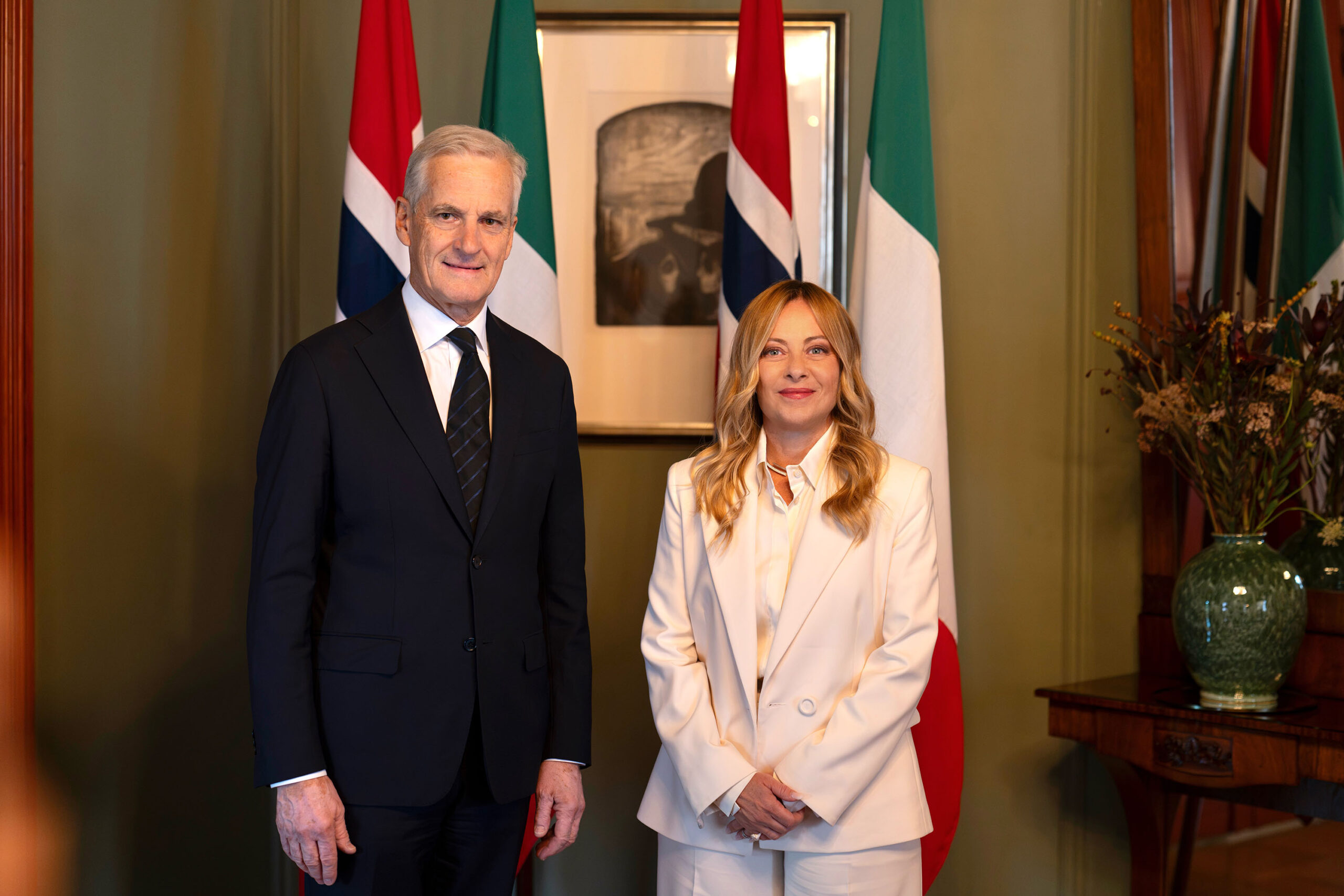
Italian Prime Minister Giorgia Meloni travelled to Norway on Thursday, September 17, 2026, for talks aimed at strengthening relations between Rome and Oslo, with energy, critical raw materials and wider strategic cooperation high on the agenda. The visit, made at the invitation of Norwegian Prime Minister Jonas Gahr Støre, is the first official visit to Norway by an Italian prime minister in almost 15 years. According to the Norwegian Government, Prime Minister Støre received President of the Council of Ministers Giorgia Meloni at the Norwegian Government’s representation facility in Parkveien in Oslo. The two leaders were also scheduled to hold a working dinner with representatives of Norwegian and Italian business. The meeting comes as both European countries look to deepen cooperation in sectors that are increasingly important to economic security, industrial resilience and the energy transition.
Energy at the centre of the relationship
Energy was one of the most important areas in the relationship between Italy and Norway. Norway has a significant role in European energy supply, while Italy has been working to strengthen and diversify its energy partnerships. For Rome, closer engagement with Oslo provides an opportunity to develop cooperation with a country that has extensive experience across the energy sector, including oil and gas as well as technologies and industries connected with the transition towards lower-carbon energy. Italy’s own government has identified diversification of energy supplies and the development of strategic energy infrastructure as important elements of its wider energy policy. Under its REPowerEU-related plans, the Italian Government has highlighted the importance of strengthening electricity and gas networks, increasing renewable energy production and improving the resilience of energy supply chain.
Norway, meanwhile, remains an important industrial and energy partner for Europe. The Norwegian Government’s recent policy work has increasingly linked energy-intensive industry, mineral processing and security of supply, reflecting the close relationship between energy availability and industrial production.
A Norwegian Government report published in June 2026 provides a detailed picture of the country’s position in critical and strategic raw-material value chains. The report covers the full chain, from geological deposits and mineral extraction through processing, refining and recycling. According to the Norwegian Government, Norway has seven geological deposits considered particularly relevant to critical and strategic raw materials, five active mining operations supplying input materials and 17 process-industry companies involved in producing critical materials, supplying critical value chains or developing substitute materials.
Norway currently exports critical raw materials worth approximately €9 billion, or NOK 100 billion, each year, with the majority going to European industry. Among the country’s major critical-raw-material exports are aluminium, nickel, zinc, silicon and ferrosilicon. The Norwegian Government has also highlighted opportunities linked to copper, rare earth elements, graphite and high-purity quartz. Two Norwegian projects have already been designated as strategic under the European Union’s raw-materials framework, while the Fensfeltet deposit in Telemark is described by the government as Europe’s largest confirmed rare-earth-elements deposit.
For European economies seeking more secure supply chains, these resources have become increasingly important because critical minerals are used in areas ranging from advanced manufacturing and renewable-energy technologies to digital equipment and defence-related industries. The Norwegian report notes that some of the greatest vulnerabilities in global critical-raw-material supply chains are concentrated in processing and refining. Norway’s established process industry therefore has potential to play a larger role in European and allied supply chains.
A broader industrial partnership
The discussions in Oslo are taking place within a wider effort to expand economic relations between Italy and Norway. The Norwegian Government has confirmed that Prime Minister Støre and President Meloni would meet representatives of Norwegian and Italian businesses at a working dinner following their official discussions. The format gives the visit an economic dimension alongside the government-to-government talks. For businesses, closer links between the two countries could create opportunities in energy, industrial technology, raw materials and other strategically important sectors.
Italy and Norway already maintain longstanding political relations. The Italian Embassy in Oslo describes bilateral relations as traditionally strong and notes that the two countries cooperate both directly and through organisations including NATO, the United Nations, the OSCE and the Council of Europe. The two countries have also maintained regular high-level contact. Norwegian Prime Minister Jonas Gahr Støre made an official visit to Rome in April 2024, where he met President of the Council of Ministers Giorgia Meloni.
The September 17 meeting therefore provides both governments with an opportunity to look beyond traditional bilateral relations and consider how their industries can work more closely in sectors that are becoming increasingly important to Europe’s economic and strategic resilience. For President Meloni and Prime Minister Støre, the talks in Oslo represent a renewed effort to build on the longstanding relationship between Italy and Norway while giving greater weight to energy, critical raw materials and industrial cooperation.