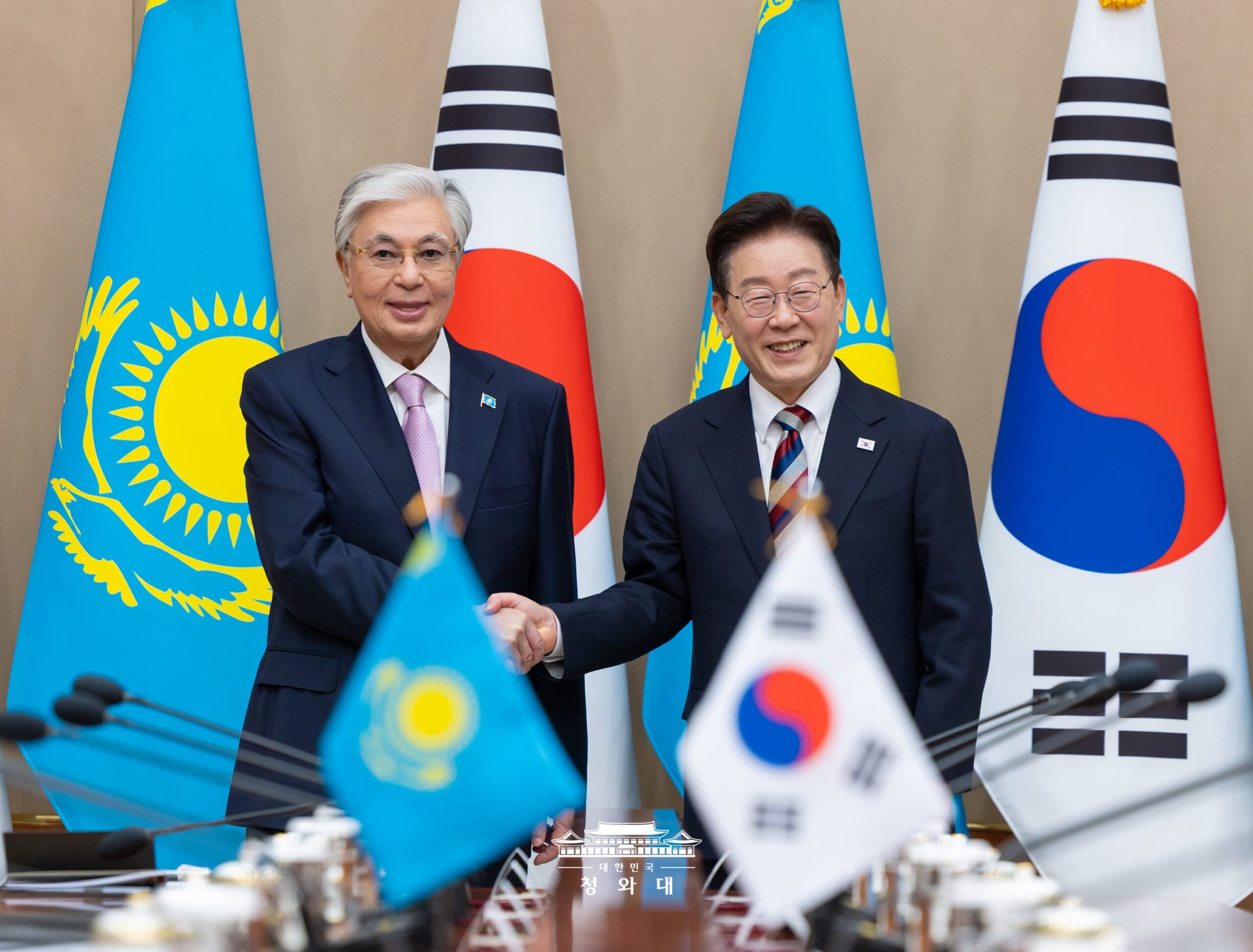
South Korea and Kazakhstan have moved to deepen their economic relationship, with commercial agreements worth $19 billion signed during Kazakhstan President Kassym-Jomart Tokayev’s state visit to Seoul. The agreements were announced following talks between Tokayev and South Korean President Lee Jae Myung on September 15, as the two countries agreed to broaden their economic relationship and give their strategic partnership a more practical focus. Kazakhstan’s presidential office said the agreements cover areas including investment, industrial development, urban development and other sectors.
The announcement came as Seoul hosted the first Central Asia–Republic of Korea Summit on September 16, bringing together the leaders of South Korea and the five Central Asian states. The summit aimed to create a higher-level framework for cooperation between South Korea and the region.
The $19 billion figure was highlighted by President Tokayev during his meetings in Seoul. The President of Kazakhstan reported that he announced the signing of commercial agreements worth $19 billion during the visit. during the visit. President Tokayev pointed to a number of projects under discussion, including the construction of hotels, an oil refinery and urban development projects. He also stressed the importance of expanding cultural and humanitarian ties between the two countries.
The figure represents the value of the commercial agreements announced during the visit rather than money already invested or spent. The Kazakh presidential office described the agreements as part of a broader effort to give greater practical substance to cooperation between the two countries. For Kazakhstan, the Korean relationship is particularly relevant as the country seeks to attract investment and expand industrial and technological cooperation. For South Korea, Kazakhstan offers access to energy and natural resources as well as opportunities for Korean companies in emerging sectors.
The economic agreements were accompanied by a significant change in the political framework of bilateral relations. South Korea and Kazakhstan agreed to upgrade their relationship, established as a strategic partnership in 2009, to a future-oriented comprehensive strategic partnership. The South Korean government said the decision reflected more than three decades of accumulated relations and was intended to provide a foundation for cooperation over the coming decades. The two governments also signed 13 agreements and memorandums of understanding following the leaders’ talks. Seoul said these documents are intended to provide an institutional basis for turning the two countries’ political agreements into concrete cooperation projects. The upgraded relationship also reflects a broader expansion in the areas being discussed between Seoul and Astana.
Energy remains an important part of the relationship, but the latest discussions placed considerable emphasis on newer areas of economic cooperation. The two governments agreed to strengthen cooperation involving rare metals, nuclear power, artificial intelligence, science and technology, new-city development, renewable energy and clean energy, according to South Korea’s official government information service.
The two sides also referred to an agreement reached in April concerning the potential import of 18 million barrels of Kazakh crude oil. The latest talks are intended to provide greater direction to cooperation in the oil sector. The focus on critical minerals is significant for Seoul’s wider economic strategy. South Korea has been seeking to strengthen supply chains for resources needed by advanced industries, while Kazakhstan has considerable reserves of natural resources and has been seeking greater investment in processing and industrial development. President Lee said South Korea viewed Kazakhstan as an important economic-security partner. Kazakhstan’s natural resources and potential in high-technology industries were highlighted as areas where the two countries could combine their respective strengths. The Kazakh presidential office reported that Lee also expressed South Korea’s readiness to support Kazakhstan’s industrial modernisation through Korean industrial and digital technologies.
Urban development was another prominent element of the discussions. During Tokayev’s visit, the Kazakh president and South Korean Prime Minister Han Seong-sook reviewed plans for Alatau City, a major urban development project in Kazakhstan. According to Kazakhstan’s presidential office, the presentation covered modern infrastructure, investment conditions, digital technologies and new forms of urban mobility. Korean organisations including KIND, KAIST and Korea Airports Corporation were presented as potential partners in areas ranging from smart-city development and education to research, urban air mobility and digital modelling. The project therefore provides an example of how the new phase of Kazakhstan–South Korea relations could extend beyond conventional trade and investment into technology-driven urban development.
The bilateral agreements were announced on the eve of a wider diplomatic gathering in Seoul. On September 16, President Lee hosted the first Central Asia–Republic of Korea Summit, involving Kazakhstan, Uzbekistan, Kyrgyzstan, Tajikistan and Turkmenistan. South Korea’s government had described the meeting as the first multilateral summit between Seoul and the five Central Asian countries at leaders’ level.
Seoul has identified critical minerals, energy, technology, infrastructure and supply-chain cooperation as areas where South Korea and Central Asia can develop stronger links. The Korean government has also said it wants to connect Central Asia’s mineral and energy resources with Korean exploration and processing technologies. For Kazakhstan, the timing gives its bilateral agreements with Seoul a wider regional context. For South Korea, the new framework creates another channel for economic engagement with a region that is becoming increasingly important for resources, industrial cooperation and connectivity.
The $19 billion package announced during President Tokayev’s visit is therefore one part of a much broader effort. With the bilateral relationship upgraded and 13 government agreements signed, Seoul and Astana are seeking to translate their longstanding political ties into projects spanning energy, critical minerals, technology, infrastructure, urban development and investment.