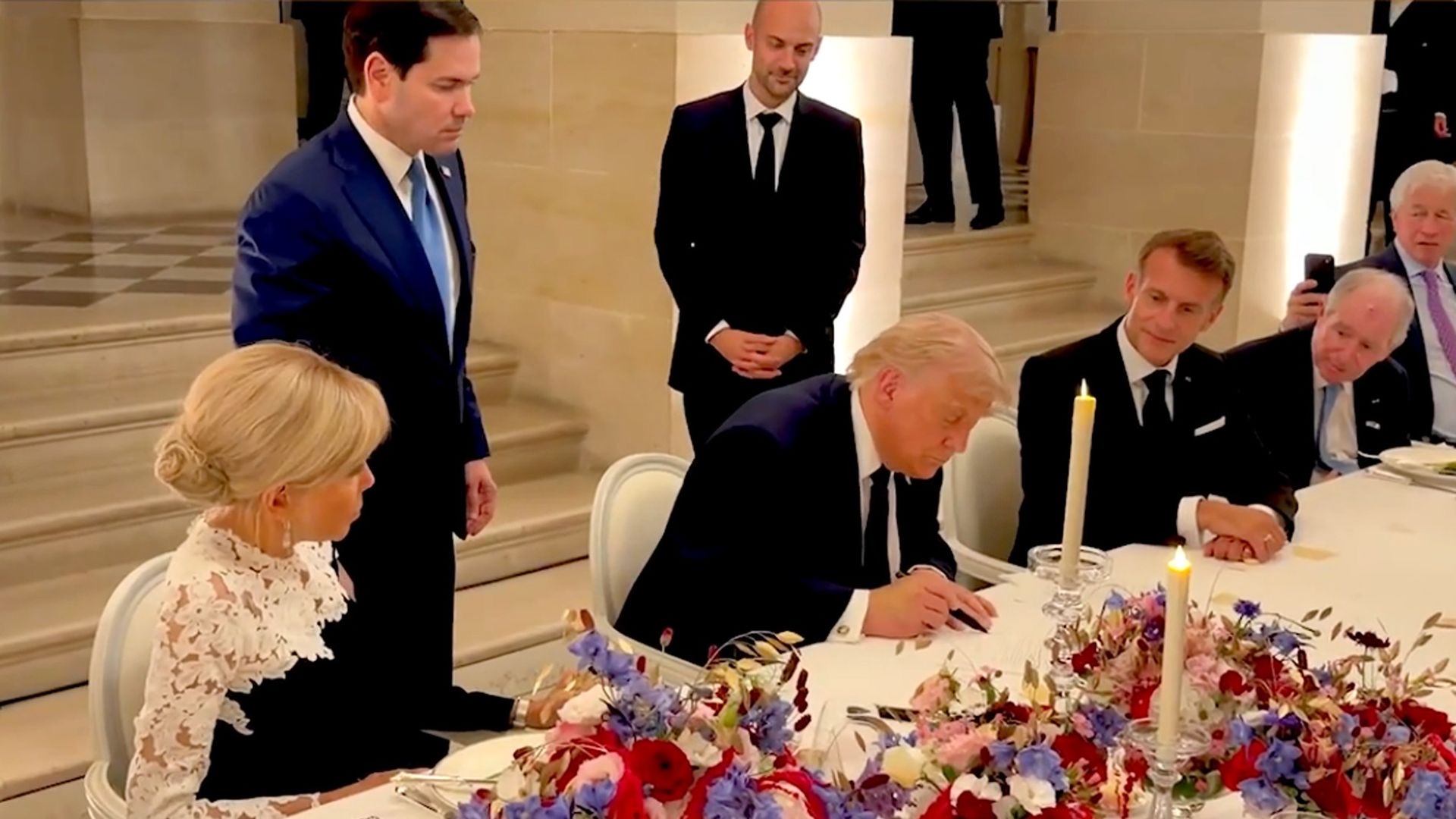
President Donald Trump has formally signed a Memorandum of Understanding (MOU) with the Iran, ending more than fifteen weeks of active conflict between the two countries. President Trump signed the document during a dinner with French President Emmanuel Macron and his wife Brigitte Macron at the Palace of Versailles, near Paris, on the evening of 17 June 2026. The signing came on the final day of the 52nd G7 Summit, held in Évian-les-Bains, France.
White House Press Secretary Karoline Leavitt confirmed ahead of the summit that there would be “quite a few bilateral meetings between the president and other foreign leaders.” President Trump held confirmed bilateral meetings with the leaders of Qatar, the United Arab Emirates, and Egypt, with discussions centred on Middle East tensions, regional security, and the stabilisation of global oil supply chains. On the sidelines, Trump and Prime Minister Keir Starmer signed a tariff agreement between the United States and the United Kingdom. President Trump also held crucial face to face bilateral meet with PM Modi after 16 months. The two leaders discussed energy cooperation, H-1B visa policies, regional security and the evolving situation in Middle East.
The 14-point agreement declares “the immediate and permanent termination of military operations on all fronts, including in Lebanon,” with both parties undertaking not to initiate any further war or military operation against each other. Both sides commit to negotiating and achieving a final deal within a maximum of 60 days, extendable by mutual consent.
Immediately upon signing, the United States will begin removing its naval blockade of Iran, with full removal within 30 days, and US forces are to withdraw from the proximity of Iran within 30 days of the final deal. Washington is also expected to lift sanctions on Iran and unfreeze funds and assets linked to its government. Iran, for its part, is to facilitate the safe passage of commercial vessels through the Strait of Hormuz at no charge for 60 days.
On nuclear matters, the MOU states that Iran reaffirms it will not procure or develop nuclear weapons, and that both sides will resolve the disposition of stockpiled enriched material in the final agreement.
Iran’s Foreign Ministry spokesperson Esmaeil Baghaei confirmed the agreement had gone into effect, stating: “The text of the Islamabad Memorandum of Understanding was finalised with the signatures of the presidents. Now it is time to test the implementation of the agreement.”
Iranian President Masoud Pezeshkian shared the signed MOU on X, showing his signature alongside Trump’s and that of Pakistani Prime Minister Shehbaz Sharif, who mediated the negotiations. Pezeshkian described it as “a historical document and a message from a powerful Iran,” writing: “Peace will be realized in the shadow of mutual respect.” He added that the Islamic Republic remained committed to global peace, its own dignity and independence, and to regional cooperation.
The deal entered into force with immediate effect following Trump’s personal signing at Versailles on 17 June, after an initial digital signing on 15 June by Vice President JD Vance for the United States and Iranian Parliament Speaker Mohammad Bagher Ghalibaf for Iran. The memorandum was finalised in both English and Farsi, upon Iran’s insistence, for purposes of transparency.
Vice President Vance confirmed at a White House briefing that the US Navy had lifted its blockade on Iranian ports by allowing more than a dozen ships to pass through. Both governments now have 60 days to negotiate a permanent final agreement.