Prime Minister Narendra Modi attended the G7 Summit in Évian-les-Bains, France, on 16 and 17 June 2026, at the invitation of French President Emmanuel Macron. This marked India’s thirteenth invitation to a G7 Summit and Prime Minister Modi’s seventh consecutive participation in the G7 leaders’ gathering. Alongside the summit sessions, Prime Minister Modi maintained a full schedule of bilateral and pull-aside meetings with world leaders over the two days.
United States
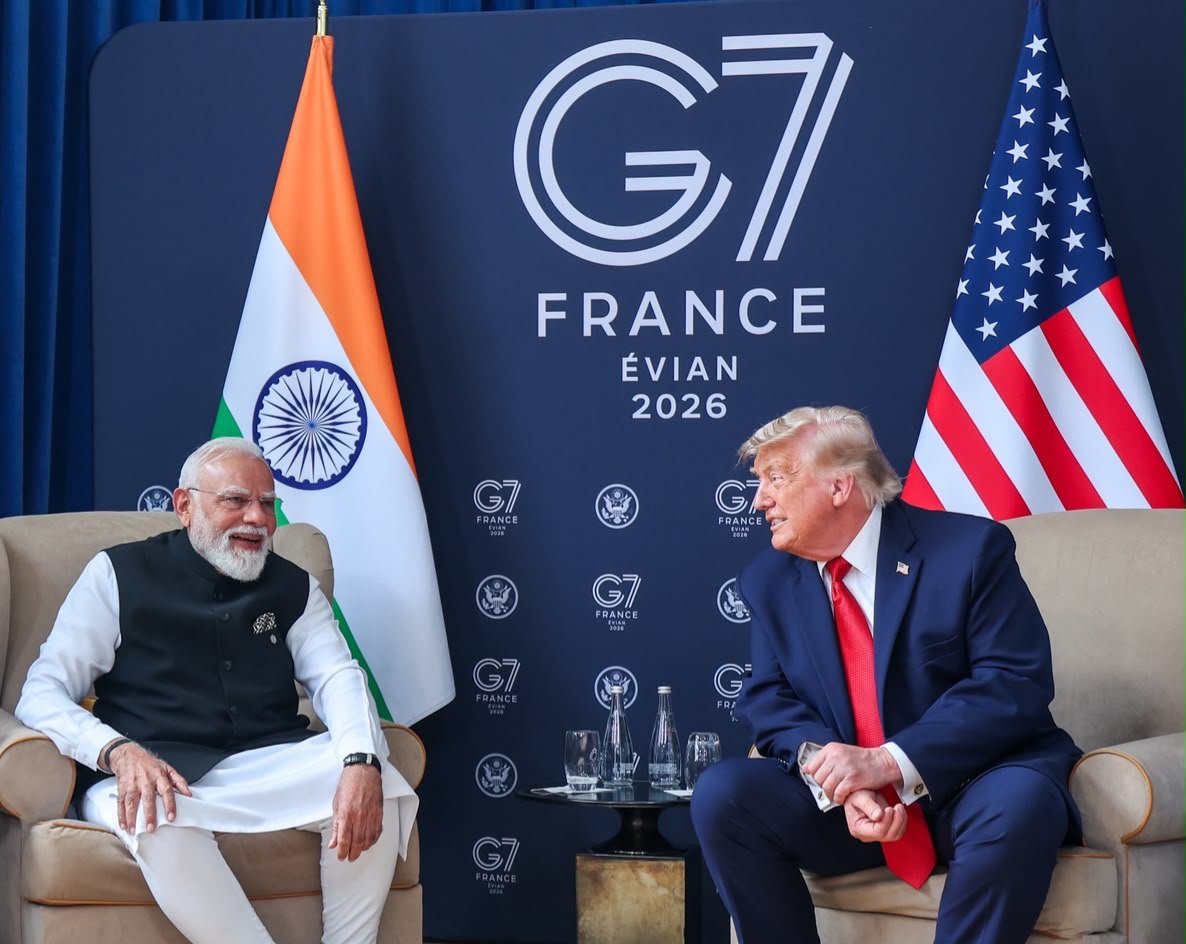
Prime Minister Modi met President Donald J. Trump on the margins of the G7 Summit on 17 June 2026. The two leaders reviewed the substantial progress achieved under the India–U.S. COMPACT (Catalysing Opportunities for Military Partnership, Accelerated Commerce and Technology) since their meeting in Washington D.C. in February 2025. They welcomed key developments across the defence, strategic technologies, energy, and bilateral trade sectors.
The leaders noted with particular satisfaction the significant progress made in negotiations towards an interim bilateral trade agreement and instructed their officials to work towards a balanced, mutually beneficial, and commercially meaningful agreement at the earliest. The US Trade Representative, Mr. Jamieson Greer, will visit India the following week in connection with these discussions.
United Kingdom
Prime Minister Modi held a bilateral meeting with UK Prime Minister Sir Keir Starmer. The two leaders reviewed the strong momentum in India–UK relations and welcomed progress across all pillars of Vision 2035, including trade and economic growth, defence and security, climate action and green energy, technology and innovation, and education and people-to-people ties.
The leaders looked forward to the early entry into force of the Comprehensive Economic and Trade Agreement (CETA), which is set to commence on 15 July 2026. In this regard, PM Modi stated, X: “It will also unlock numerous opportunities for Indian farmers, workers, MSMEs, start-ups, and innovators and contribute meaningfully to the realisation of Viksit Bharat 2047.”
European Union
Prime Minister Modi held a meeting with European Council President António Costa and European Commission President Ursula von der Leyen. Recalling the 16th India–EU Summit held in India in January 2026, the leaders welcomed the progress made in India–EU bilateral relations since then. The leaders emphasised the recent conclusion of negotiations for the India–EU Free Trade Agreement as a historic achievement and stressed its expeditious signing and implementation, which would unlock opportunities for trade and investment and contribute towards diversification of supply chains, particularly in the current turbulent geopolitical context.
Germany
Prime Minister Modi held a bilateral meeting with German Chancellor Friedrich Merz. This marked their second meeting in 2026, building on the momentum from Chancellor Merz’s visit to India in January 2026. Discussions encompassed trade, investment, defence cooperation, and the India–Germany Strategic Partnership. Chancellor Merz extended an invitation to Prime Minister Modi for the 8th India-Germany Inter-Governmental Consultations (IGC), scheduled to take place in Germany later this year.
United Arab Emirates
Prime Minister Modi met UAE President His Highness Sheikh Mohamed bin Zayed Al Nahyan. This was their third meeting in 2026, underscoring the robust India–UAE Comprehensive Strategic Partnership. The leaders reviewed bilateral cooperation across technology, trade, investment, energy, and defence, following the UAE President’s visit to India in January 2026 and Prime Minister Modi’s visit to the UAE in May 2026. Prime Minister Modi also invited the UAE President to attend the BRICS Summit, which India will host later this year.
Canada
During his meeting with Canadian Prime Minister Mark Carney, both leaders agreed to accelerate ongoing efforts to reset bilateral ties. They reaffirmed their commitment to conclude negotiations on a Comprehensive Economic Partnership Agreement by the end of the year. Cooperation in energy, including LNG, LPG, and metallurgical coal, was reviewed, and the importance of resilient supply chains for strengthening global energy and food security was emphasised. Both sides agreed to initiate negotiations on a General Security of Information Agreement (GSOIA) to facilitate deeper defence and intelligence cooperation. The creation of “Raisina Americas”, a new platform to promote dialogue and cooperation, was also announced. Prime Minister Modi thanked Prime Minister Carney for the invitation to visit Canada later this year, and both leaders agreed to remain engaged to finalise the dates for the visit.
Pull-aside Meetings
Beyond the formal bilateral discussions, Prime Minister Modi held a series of informal interactions with several world leaders. He met Italian Prime Minister Giorgia Meloni, continuing the warm personal engagement that characterises the India–Italy relationship. He also met Japanese Prime Minister Sanae Takaichi, noting that India and Japan would continue to deepen cooperation, particularly in trade and investment. Furthermore, he interacted with South Korean President Lee Jae-myung, observing the two countries’ collaboration in trade, commerce, and other futuristic sectors. PM Modi met Ukrainian President Volodymyr Zelenskyy too. The Prime Minister met Kenyan President William Ruto, reaffirming India’s commitment to strengthening cooperation with Africa and advancing the aspirations of the Global South. He also held talks with Egyptian President Abdel Fattah El-Sisi, describing India–Egypt ties as a long-standing friendship.