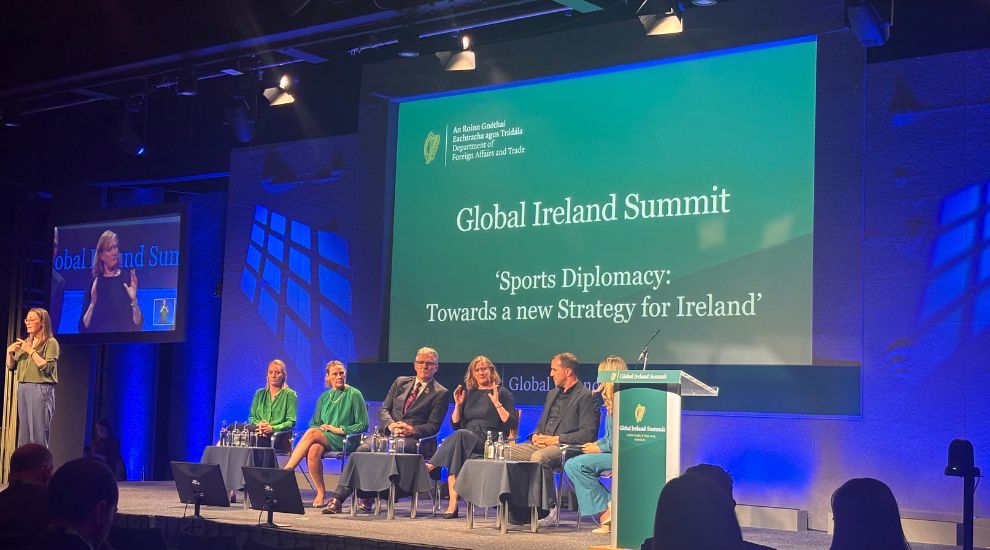
Ireland has published its first-ever International Sports Diplomacy Strategy, covering the period 2026 to 2030. The strategy sets out how the Irish government plans to use sport as a soft power tool to advance the country’s interests, strengthen international relationships, and promote Ireland on the global stage.
The document describes itself as one of the first strategies of its kind to be published anywhere in the world. It was developed by a steering group drawn from various government departments and state agencies, informed by extensive consultation with athletes, sporting bodies, businesses, diaspora communities, and researchers.
Minister for Foreign Affairs McEntee drew a parallel with Ireland’s existing approach to cultural diplomacy, stating: “For many years, we have successfully used the soft power of cultural diplomacy to advance our values and our interests. We are proud to showcase our literature, our music, and our artists. Now it is time that we do the same when it comes to our sportspeople.” Minister O’Donovan added: “Nothing unites Irish people as sport does.”
Four Goals, 68 Actions
The strategy is built around four main goals. The first is to promote Ireland as a sporting nation through public diplomacy campaigns and by supporting Irish athletes competing internationally. The second is to use sport, and Gaelic Games in particular, to strengthen connections with Irish diaspora communities around the world.
The third goal is to build international sporting partnerships that reflect Ireland’s values, including support for women in sport, disability inclusion, and sport-for-development programmes in humanitarian and development contexts. The fourth goal is to maximise the economic value of sports diplomacy, with a focus on Ireland’s growing sports technology sector and major international events.
Across these four goals, the strategy sets out 68 specific actions to be delivered over its five-year term.
Funding and Key Initiatives
A new International Sports Diplomacy Fund will be established, with a budget of at least 1 million euro over the lifetime of the strategy. A pilot fund of 200,000 euro is set to launch in early 2026. The strategy also commits to a new Global Ireland Sports Leaders initiative, which will involve current and former athletes in promoting Ireland internationally, with participants to be announced in 2026.
An international Irish Sports Administrators Network will be created to connect Irish people working in international sporting organisations. The government also plans to host a major international sports diplomacy conference, bringing together domestic and global stakeholders.
To date, significant and ongoing investment has been made in sports facilities across the country, including over 75 million euro at the Sports Ireland Campus in Dublin 15 and over 874 million euro on sports facilities overall.
Gaelic Games and Major Events
Gaelic Games feature prominently throughout the strategy. Ireland intends to nominate Gaelic football for UNESCO Intangible Cultural Heritage status, building on hurling’s recognition in 2018. Promoting Gaelic games will also be part of Ireland’s programme during its 2026 EU Council presidency.
On the events side, the strategy references the Ryder Cup in 2027, UEFA Euro 2028, which Ireland is co-hosting with the UK, and the T20 Cricket World Cup in 2030 as major opportunities for sports diplomacy.
Implementation
A new International Sports Diplomacy Implementation Group will be established in the first quarter of 2026. Progress will be reported to the government annually, with a mid-term review planned for 2028. The strategy will feed into Ireland’s forthcoming Global Ireland 2040 plan and a new diaspora strategy due in 2026.