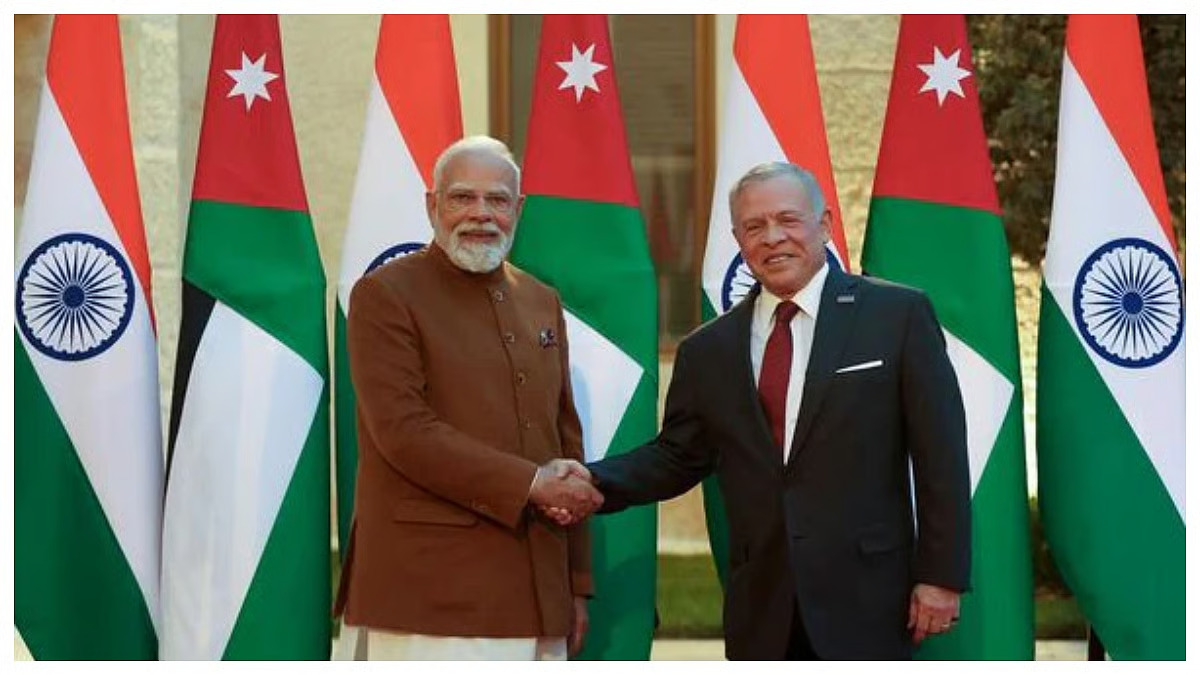
Prime Minister Narendra Modi on 15th December, 2025, Monday held wide-ranging talks with Jordan’s King Abdullah II ibn Al Hussein at the Husseiniya Palace in Amman, marking a landmark moment in bilateral relations as the two countries celebrate 75 years of diplomatic ties. The meeting took place during Mr Modi’s two-day official visit to Jordan, undertaken at the invitation of King Abdullah II. In a gesture reflecting the warmth of the relationship, the Indian Prime Minister was personally received by the King, underlining the significance Amman attaches to the visit.
This is the first full-fledged bilateral visit by an Indian Prime Minister to Jordan in 37 years and forms the opening leg of Mr Modi’s four-day, three-nation tour that will also take him to Ethiopia and Oman. The visit comes against a backdrop of heightened regional tensions and renewed efforts by New Delhi to deepen engagement across West Asia and Africa. During delegation-level talks, the two leaders discussed a broad spectrum of bilateral and regional issues, including trade, fertilisers, digital technology, infrastructure development and people-to-people exchanges. Mr Modi expressed confidence that the meeting would “give a new impetus and depth” to India–Jordan relations, noting that cooperation between the two nations would continue to expand across multiple sectors.
“We will continue our cooperation in areas such as trade, fertilisers, digital technology, infrastructure and people-to-people ties,” the Prime Minister said. He also underlined the shared position of India and Jordan on counter-terrorism, praising King Abdullah II’s leadership and Jordan’s “strong and strategic message to the world against terrorism, extremism and radicalisation”. Referring to the ongoing conflict in Gaza, Mr Modi said both countries hoped for peace and stability in the region, and commended Jordan’s “active and positive role” on the issue. He thanked the King for the warm welcome extended to him and his delegation, and acknowledged the Jordanian leader’s commitment to strengthening ties with India.
“This year, we are celebrating the 75th anniversary of our diplomatic relations. This milestone will continue to inspire us to move forward with renewed energy for many years to come,” Mr Modi said. He also recalled their earlier interactions, including King Abdullah II’s visit to India in 2018 and their first meeting on the sidelines of the United Nations in 2015, both of which focused on countering violent extremism and promoting moderation. King Abdullah II, in his remarks, welcomed the Indian Prime Minister back to Jordan and said the visit carried “deep significance” as both nations marked 75 years of diplomatic engagement. “I believe this visit reflects decades of friendship, mutual respect and productive cooperation between our two nations,” he said.
Highlighting the strength of the partnership, the King noted that collaboration between India and Jordan had steadily expanded over the years. “Your visit provides an important opportunity to chart new paths of economic cooperation,” he said, adding that both countries shared a desire to advance prosperity for their people. The visit has also yielded tangible outcomes in the cultural and tourism spheres. Among the most notable developments is the twinning agreement between Petra in Jordan and Ellora in India—both UNESCO World Heritage Sites. The agreement is expected to pave the way for closer cultural exchange and joint tourism initiatives, linking two ancient centres that once lay along historic trade routes.
India and Jordan enjoy robust economic ties, with New Delhi currently Amman’s third-largest trading partner. Bilateral trade stands at around $2.8 billion, with Jordan being a key supplier of phosphates and potash to India. The Arab nation is also home to a vibrant Indian diaspora of more than 17,500 people, employed across sectors such as textiles, construction and manufacturing. Upon his arrival in Amman, Mr Modi was welcomed by Jordan’s Prime Minister Jafar Hassan, who later described the visit as a reflection of “seventy-five years of close and enduring relations”. Mr Hassan said both sides looked forward to expanding cooperation, particularly in economic, investment and technological fields.
The Prime Minister was also greeted by members of the Indian community in Jordan, whom he thanked for their affection and for their role in strengthening bilateral ties. “Their pride in India’s progress and strong cultural bonds reflect the enduring connection between India and its diaspora,” Mr Modi said in a post on social media. On Tuesday, Mr Modi and King Abdullah II are scheduled to jointly address an India–Jordan business event attended by leading entrepreneurs from both countries. The Prime Minister, along with the Crown Prince, is also expected to visit the ancient city of Petra, weather permitting.
Following his engagements in Jordan, Mr Modi will travel to Ethiopia for his first state visit to the East African nation, before concluding his tour in Oman. Analysts see the multi-nation visit as part of India’s broader foreign policy push to reinforce traditional partnerships in the Arab world while expanding its economic and strategic footprint across Africa and the Gulf.