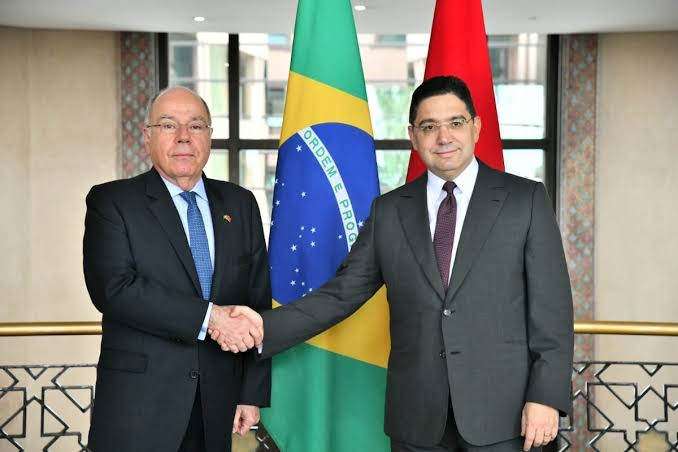
Morocco and Brazil are working to deepen their bilateral cooperation, with agriculture, fertiliser supplies, food security, scientific research and fisheries emerging as important areas of shared interest. Developments reported by Brazilian government ministries in October 2026 highlight a growing effort to build on established commercial ties and explore new opportunities for investment, technology exchange and long-term economic cooperation. The relationship has gained fresh momentum following a series of meetings held in Morocco in September, involving Brazilian government representatives, Moroccan authorities, research institutions and business leaders. Official updates published by Brazil’s Ministry of Agriculture and Livestock in late October have brought renewed attention to the discussions, particularly those concerning fertiliser supplies, agricultural research and expanding trade between the two countries.
One of the clearest indicators of the relationship’s economic significance is the volume of bilateral trade. According to Brazil’s Ministry of Agriculture and Livestock, trade between Brazil and Morocco reached approximately US$2.8 billion in 2025. During the first half of 2026, bilateral trade amounted to nearly US$1.6 billion, representing an increase of almost 30 per cent compared with the corresponding period in 2025. The two economies have complementary strengths. Brazil is a major agricultural producer and exporter, supplying international markets with products including maize, raw sugar and poultry. Morocco, meanwhile, is an important source of phosphate-based fertilisers, essential inputs for agricultural production in Brazil. This established exchange provides a foundation for expanding cooperation beyond the movement of goods towards investment, research and more integrated supply chains.
Fertiliser security has become a particularly important element of the partnership. During an official visit to Morocco in September, Brazil’s Minister of Agriculture and Livestock, Mr André de Paula, participated in discussions concerning the supply of phosphate fertilisers and opportunities to strengthen cooperation across the agricultural sector. The Brazilian delegation visited the industrial complex at Jorf Lasfar, operated by Morocco’s OCP Group, which specialises in phosphate products and fertiliser production. Discussions covered potential supplies to Brazilian agricultural operators, joint technical research, the development of fertiliser formulations and more efficient nutrient management. A memorandum of understanding between Brazil’s Ministry of Agriculture and Livestock and OCP Nutricrops was also signed during the September visit. The document established a reference volume of 3.8 million tonnes of phosphate fertilisers for potential supply during the 2026–2027 period. However, actual purchases remain dependent on commercial negotiations between the relevant operators. The memorandum therefore represents an important framework for cooperation rather than a guarantee that the entire volume will be delivered.
The agreement also points towards broader collaboration in sustainable agriculture. Areas under consideration include soil mapping, biofertilisers, agricultural technologies, low-carbon production methods and solutions adapted to Brazil’s varied growing conditions. Such cooperation could help improve the efficiency with which farmers use fertilisers while strengthening the resilience of agricultural supply chains. Scientific research represents another promising dimension of the relationship. During his September visit to Rabat, Minister André de Paula visited the International Center for Agricultural Research in the Dry Areas, known as ICARDA, to examine research partnerships addressing the challenges faced by farmers in arid and semi-arid regions. Researchers from Brazil and Morocco have common interests in improving agricultural productivity under difficult climatic conditions, particularly where water scarcity, irregular rainfall and soil degradation affect farming communities. Cooperation involving Brazil’s Agronomic Institute of Pernambuco, Morocco’s National Institute for Agricultural Research and ICARDA includes work on improving forage cactus varieties.
Forage cactus is important to livestock production in semi-arid environments because of its ability to withstand challenging growing conditions. Research has focused on genetic improvement, the exchange of plant genetic material, animal feed and the control of the carmine cochineal pest, which damages the crop in both countries. Progress in these areas could support livestock producers and contribute to more resilient agricultural systems. The two countries are also exploring opportunities in fisheries and aquaculture. At a Brazil–Morocco Business Seminar held in Casablanca on 17 September, government officials and business representatives discussed trade, investment and partnerships throughout the seafood supply chain.
Brazil is seeking to expand its fishing and agriculture products, including tilapia. Morocco’s established fishing industry, processing capabilities and port infrastructure could provide opportunities for commercial partnerships. Discussions have included seafood processing, certification, product traceability and compliance with sanitary requirements. Brazilian officials also indicated that memoranda of understanding were expected to be signed in Rabat to support cooperation in fisheries and aquaculture; these should not be treated as completed agreements without subsequent official confirmation. Trade in livestock and meat products remains another significant element of the relationship. Morocco temporarily suspended import duties on specified live sheep and red-meat products from 27 July until 31 December 2026. The measure applies to imports originating from all countries, rather than Brazil alone, and aims to increase domestic supplies. Nevertheless, it creates a relevant commercial context for Brazilian exporters operating in the Moroccan market.
Looking ahead, the challenge for both countries will be to translate the recent discussions into sustained commercial activity, stronger research partnerships and investment opportunities. Better logistical connections, closer institutional coordination and continued engagement between businesses could help broaden the relationship beyond its traditional concentration on agricultural commodities. As of October 2026, the latest documented developments suggest that Morocco and Brazil are seeking a more diversified partnership, linking agricultural production with fertiliser security, scientific innovation and access to international markets. Although many of the proposed initiatives will require further negotiations and implementation, the existing trade relationship and recent government engagements provide a substantial basis for continued cooperation between the two countries.