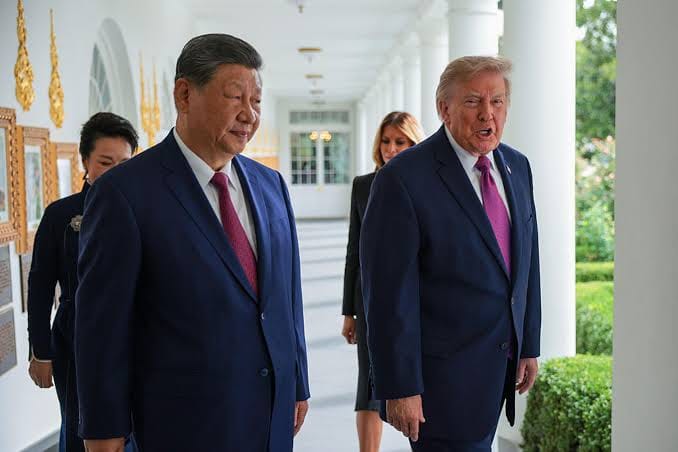
China’s latest panda diplomacy initiative has brought an unmistakable people-to-people dimension to its renewed engagement with the United States, with two giant pandas having arrived at Zoo Atlanta following Chinese President Xi Jinping’s state visit to Washington from 23 to 25 September, 2026. The announcement came alongside a series of understandings between the two countries, including a reciprocal tariff-reduction arrangement covering US$30 billion in goods on each side.
For Beijing, the pandas represent a longstanding tradition of cultural exchange and wildlife conservation. Their arrival has drawn public attention at a time when both governments are seeking to advance cooperation in trade, diplomacy and other areas. President Xi announced the imminent arrival of the pandas, Ping Ping and Fu Shuang, during his remarks at the White House on 24 September. Addressing US President Donald Trump and other guests at the arrival ceremony, the Chinese President described giant pandas as envoys of friendship between the Chinese and American peoples.
The announcement was subsequently included among the outcomes of the state visit, with the US side welcoming the arrival of the pair, which China has loaned to Zoo Atlanta. The timing has given the latest panda exchange particular significance. While the two governments have been negotiating economic and trade arrangements, the pandas have provided a separate channel for public engagement, one rooted in conservation, cultural familiarity and decades of contact between the two countries.
China’s use of giant pandas as a symbol of international friendship has a history stretching back well before the current trade discussions. The animals have featured prominently in its diplomatic engagement with the United States, particularly since the establishment of formal relations between the two countries in the early 1970s.
In 1972, following President Richard Nixon’s historic visit to China, two giant pandas, Ling-Ling and Hsing-Hsing, arrived at the Smithsonian’s National Zoo in Washington. Their arrival became an important public feature of the emerging relationship between Beijing and Washington, bringing an aspect of Chinese culture and wildlife into the daily lives of American visitors. The exchange also established a precedent for cooperation between Chinese and American zoological institutions. Over subsequent decades, panda programmes developed beyond the initial diplomatic symbolism to include breeding, veterinary research, habitat protection and the exchange of scientific expertise.
China’s modern panda partnerships generally operate through conservation and research agreements rather than permanent transfers of ownership. The animals remain under Chinese ownership, while participating overseas institutions provide care and collaborate with Chinese experts. This arrangement has allowed China to maintain oversight of the animals, while China it has continued to describe these partnerships as part of its wider international conservation efforts.
The arrival of Ping Ping and Fu Shuang at Zoo Atlanta on 27 September is the latest development in this relationship. Zoo Atlanta has previously hosted giant pandas under its cooperation arrangements with China, making the latest agreement a continuation of an established relationship rather than an entirely new initiative. The return of pandas to the Atlanta institution carries significance for the zoo and its visitors, but it also reflects the broader effort to maintain exchanges between Chinese and American institutions during a period of renewed diplomatic engagement.
President Xi also announced an invitation for 100,000 young Americans to visit China for exchange and study programmes over the next five years. He presented the initiative as part of a wider effort to strengthen friendship between the peoples of the two countries. The pandas and the proposed youth exchanges represent different aspects of the same diplomatic approach: encouraging contact beyond official meetings and economic negotiations.
The panda announcement formed part of a wider set of outcomes from President Xi’s state visit, which concluded on 25 September. President Xi and President Trump agreed to advance a constructive China-US relationship based on strategic stability, respect, fairness and reciprocity.
The two leaders also endorsed the outcomes of their economic and trade teams, including the establishment of trade and investment mechanisms and a reciprocal tariff-reduction arrangement covering approximately US$30 billion in goods on each side. The framework emerged from the latest round of economic and trade consultations, held in New York and Washington from 20 to 23 September.
On 28 September, China’s Ministry of Commerce said the consultations had produced positive consensus and that the two countries had agreed to establish a Board of Trade under their economic and trade consultation mechanism. Under the arrangement, tariffs on approximately US$30 billion worth of goods imported from each other are to be reduced on a reciprocal basis. China’s Ministry of Commerce said tariffs on around 90 per cent of the covered products would be lowered to most-favoured-nation rates.
The United States Trade Representative’s 27 September statement also described the recommendations as covering US$30 billion in non-sensitive goods on each side. The US statement identified agricultural products, fish and seafood, timber products, cosmetics and medical devices among the goods recommended for more favourable treatment for American exports to China. For US imports from China, the statement referred to household goods, toys and other products. Both governments have presented the framework as a means of improving market access and supporting bilateral trade. The two sides have also agreed to establish a Board of Investment to provide a regular channel for discussions on investment opportunities and barriers.
The trade arrangements follow earlier rounds of negotiations in 2026, including consultations in May, when the two governments agreed in principle to discuss reciprocal tariff reductions on products worth US$30 billion or more on each side.
At the official level, both governments have continued discussions on economic relations, investment, law enforcement and other matters. The September state visit also produced an agreement to establish a China-US artificial intelligence dialogue, with the next exchange planned for November 2026.
The panda programme is built around conservation and public engagement, while the trade framework concerns market access and the treatment of goods moving between the two economies. The pandas’ arrival on 27 September has become one of the more visible public outcomes of President Xi’s September visit. Their presence has brought renewed attention to a relationship that has relied on panda conservation as a symbol of friendship for more than half a century.