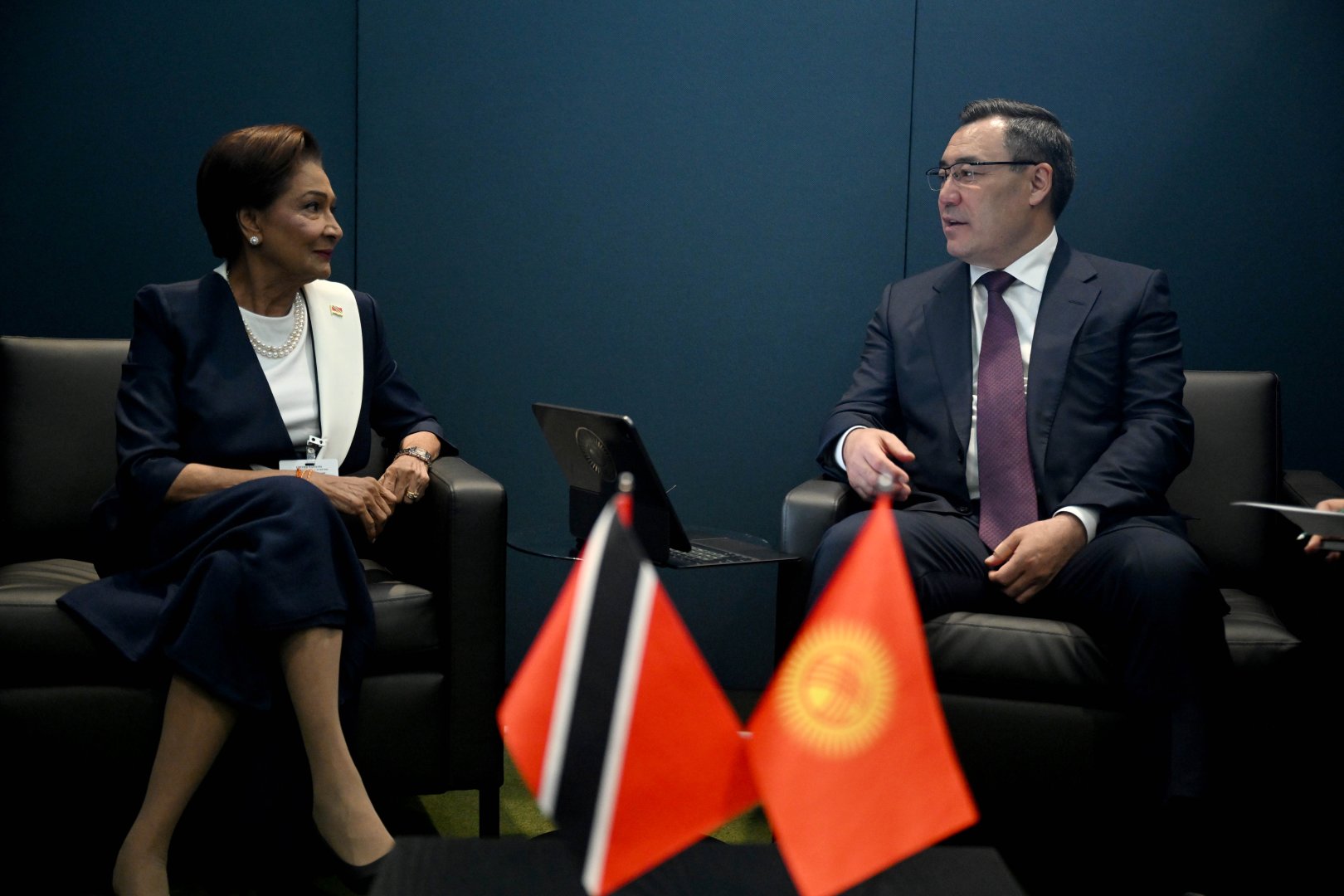
Kyrgyzstan and Trinidad and Tobago have discussed ways to broaden their bilateral relationship, with trade, energy, renewable energy, cultural cooperation and maritime transport emerging as potential areas for closer engagement. The discussions took place on September 22, 2026, on the sidelines of the 81st session of the United Nations General Assembly in New York, when President of the Kyrgyz Republic Sadyr Zhaparov met with the Prime Minister of the Republic of Trinidad and Tobago, the Honourable Kamla Persad-Bissessar.
The two leaders reviewed prospects for developing bilateral relations and also discussed cooperation through international organisations. The meeting comes as both countries prepare to take on non-permanent seats on the United Nations Security Council for the 2027–2028 term, giving their diplomatic engagement an additional multilateral dimension. During the meeting, President Zhaparov highlighted Kyrgyzstan’s interest in expanding its relations with countries in Latin America and the Caribbean. He stressed the importance of establishing closer contacts with Trinidad and Tobago as part of that broader effort.
For Kyrgyzstan, the discussions offer an opportunity to strengthen links with a country in the Caribbean while widening its diplomatic and economic engagement beyond its traditional regional partners. The Kyrgyz side also placed particular emphasis on cooperation between small and developing states, an issue that has gained greater attention within multilateral forums. President Zhaparov congratulated Prime Minister Persad-Bissessar on Trinidad and Tobago’s election to the United Nations Security Council for the 2027–2028 period. Trinidad and Tobago secured 181 votes out of 190 in the June 2026 election, according to the country’s Ministry of Foreign and CARICOM Affairs. The result secured the Caribbean nation a non-permanent seat on the Council for the forthcoming term. The Kyrgyz president expressed readiness for close cooperation with Trinidad and Tobago within the Security Council. The two sides also highlighted the importance of advancing the interests of small and developing states, particularly countries facing heightened vulnerability to climate change.
For Trinidad and Tobago, the conversation also opened several practical areas for expanding engagement with Kyrgyzstan. Prime Minister Persad-Bissessar expressed interest in developing cooperation in trade and the wider economy, as well as in energy and cultural-humanitarian relations. Renewable energy was specifically identified as an area where the two countries could exchange experience.
Energy could provide an especially useful avenue for future exchanges. Trinidad and Tobago has a long-established energy sector and remains an important energy producer in the Caribbean, while Kyrgyzstan has significant potential in renewable energy, particularly hydropower. The official account of the meeting did not announce a specific energy agreement, but identified renewable energy experience-sharing as an area of interest between the two countries.
Maritime connectivity was another notable element of the discussion. Prime Minister Persad-Bissessar expressed Trinidad and Tobago’s readiness to assist Kyrgyzstan in expanding opportunities to access maritime transport routes. As a landlocked country in Central Asia, Kyrgyzstan relies on transport links through neighbouring states to reach international markets and sea routes. The issue therefore has a direct connection with the country’s wider efforts to improve trade and logistics. The discussion of maritime transport also points to the potential importance of connectivity in any future expansion of economic relations. Better access to international transport networks could help facilitate commercial exchanges between Central Asia and the Caribbean, although the meeting itself did not announce a specific transport project or agreement.
Trinidad and Tobago’s foreign policy places emphasis on maintaining and developing relations at bilateral, regional and multilateral levels, alongside respect for state sovereignty, international law and the United Nations Charter. The country’s Ministry of Foreign and CARICOM Affairs describes active participation in the United Nations and other international organisations as an important part of its foreign policy.
The forthcoming Security Council terms of both countries could therefore provide a regular channel for diplomatic consultation. Kyrgyzstan has identified preventive diplomacy and dialogue as priorities for its future Security Council role, while its Foreign Minister, Jeenbek Kulubaev, has also proposed closer coordination among the newly elected non-permanent members. Trinidad and Tobago is among the countries included in that group of incoming Council members. For now, the September meeting represents an expression of intent rather than the announcement of major bilateral agreements. No trade, investment or energy deal was announced in the official account of the talks. Instead, both governments indicated their willingness to continue dialogue and explore areas where cooperation could be developed.
The discussions in New York nevertheless provide a starting point for closer contact between Kyrgyzstan and Trinidad and Tobago. With both countries preparing for their respective roles on the UN Security Council, and with interests ranging from trade and energy to renewable technology, cultural ties and transport connectivity, the meeting has created several possible avenues for further engagement. The two sides concluded by reaffirming their commitment to constructive cooperation and to further developing relations between Kyrgyzstan and Trinidad and Tobago.