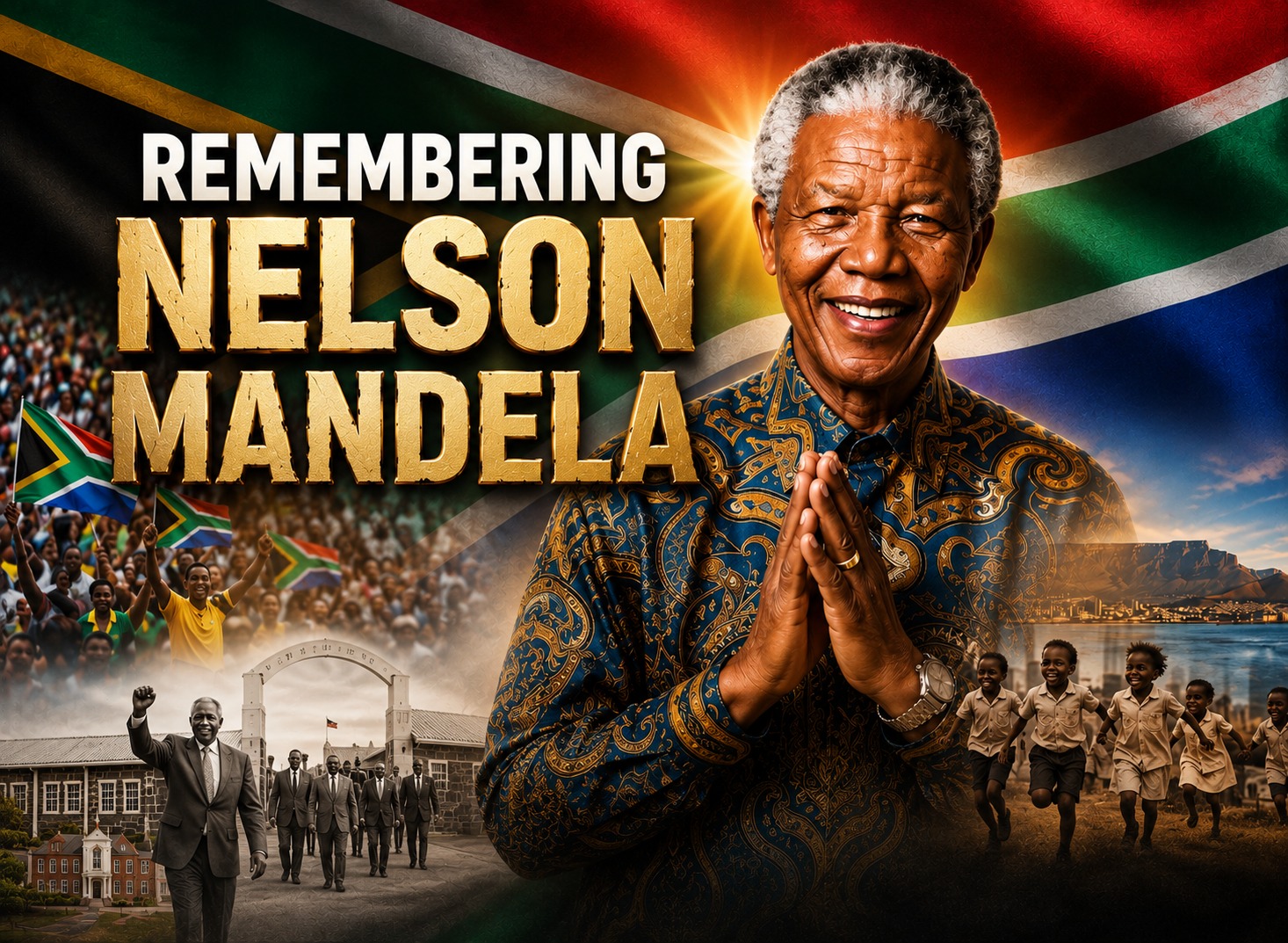
It was in November 2009 that the United Nations General Assembly declared that 18 July, the birth anniversary of Nelson Mandela, would be observed as the Nelson Mandela International Day in recognition of his contributions towards peace and justice. On the occasion of the 17th Nelson Mandela International Day on 18 July 2026, the Secretary-General of the United Nations, António Guterres, called the South African leader a “towering figure of peace, reconciliation, justice, and human rights.” Nelson Mandela’s life and his vision of a just world continue to guide communities around the globe.
Life and Education
Nelson Mandela’s life story portrays a leader who lived his life with fortitude, steadfastly dedicated to his people and their upliftment. Mandela was born Nelson Rolihlahla Mandela on 18 July 1918 in Mvezo, South Africa. He first joined the University College of Fort Hare for his Bachelor of Arts degree in 1939. He completed his BA degree from the University of South Africa in 1942, also graduating from Fort Hare in 1943. Thereafter, he studied law at the University of the Witwatersrand, Johannesburg. His education enabled him and Oliver Tambo to open the only native African-owned law firm in Johannesburg in the 1950s, where they did pro bono work, offering free representation to other native African people. Many decades later, Mandela would make the famous statement on the importance of education during the launch of an educational multimedia network, “Education is the most powerful weapon we can use to change the world.”
Nelson Mandela supported access to equitable education through the Nelson Mandela Foundation that he established in 1999. The foundation partnered with the United Nations Children’s Fund (UNICEF) in 2004 to initiate the Schools for Africa Campaign, which has since aided 30 million children across 13 countries.
The Leader of South Africa
Nelson Mandela became closely involved with the anti-apartheid movement in South Africa from the mid-1940s. His leadership in the movement and his opposition to the system of racial segregation led to a 27-year long incarceration. The negotiations to end the unjust laws began upon his release, which were successful in securing the adoption of an interim Constitution and elections with universal suffrage in 1994. In May 1994, he was sworn-in as the first democratically elected president of South Africa.
Nelson Mandela had always advocated for equality and democracy, stating in 1964, “I have cherished the ideal of a democratic and free society in which all persons live together in harmony and with equal opportunities.” He remained committed to these values during his presidency between 1994 and 1999 as he guided the country through the transition to a democratic system. In a historic step, the Constitution of South Africa was signed into a law in 1996. He is remembered as the cherished leader who ushered in a new era of equality and justice.
The Champion of Human Rights
Nelson Mandela established three foundations during his lifetime that still operate today. The Nelson Mandela Children’s Fund was established in 1995 during his presidency. He continued his work for social justice even after stepping down from active politics, establishing the Nelson Mandela Foundation in 1999 and the Mandela-Rhodes Foundation in 2003. The foundations have consistently engaged in archival work, children’s education and health, and global leadership. The work of the Fund, for instance, has contributed to the Southern African Development Community (SADC). The Mandela-Rhodes Foundation aids students and scholars by providing postgraduate scholarships and a Leadership Development Programme. Their efforts have reached out to more than 760 scholars and 38 countries. The Nelson Mandela Foundation’s most recent endeavour is the launch of the Nelson Mandela Global Leadership Forum on 15 July 2026 in New York. The forum aims to bring communities together in a dialogue about the challenges faced by contemporary leadership.
Nelson Mandela also founded The Elders, a group of global leaders working for peace, human rights and the environment.
International Engagements
Mandela addressed the forty-sixth session of the General Assembly of the United Nations in 1991. He emphasised the democratic developments in South Africa and acknowledged the role of international organisations in upholding human rights and guaranteeing economic development, social justice and emancipation to a global community. He toured, consistently engaged the international fora and interviewed with leading networks to espouse his vision of democracy and social justice.
He was conferred the Nobel Prize in 1993 with F.W. de Klerk for their efforts in establishing the foundation of modern South Africa. In his Nobel Prize Lecture, he called it a victory not only for the South African nationals, but for all those who envision a world that is free and fair for all.
Nelson Mandela has been honoured across the world for work and contributions. His birth anniversary on 18 July has been celebrated as the Nelson Mandela International Day since 2009, when it declared at the United Nations General Assembly. A Nelson Mandela Peace Summit was convened by the UN in 2018, where the period between 2019 and 2028 was declared the Nelson Mandela Decade of Peace to globally promote the principles he stood for. The United Nations Educational, Scientific and Cultural Organization (UNESCO) declared fourteen sites in South Africa as World Heritage Sites. They are a part of the Nelson Mandela Legacy Sites and commemorate his leadership in the long struggle towards equality and liberation.
The Relations with India
Nelson Mandela was profoundly inspired by the Father of India, Mahatma Gandhi. Mahatma Gandhi’s principles of Satyagraha, moral courage and forgiveness feature prominently in Mandela’s own approach of reconciliation and inclusivity in his presidency of South Africa. India was one of the countries he visited upon his release in 1990. In his address, he noted the historical bonds between India and Africa, highlighting Mahatma Gandhi as a figure who influenced both nations, and emphasising values of democracy, quality and human dignity shared by both the countries. Nelson Mandela was conferred the Bharat Ratna, India’s highest civilian honour, during this visit.
Nelson Mandela unveiled a Gandhi Memorial in South Africa in 1993, calling him “a hero of millions of people worldwide.”
Conclusion
Nelson Mandela’s life stands as a testament to the power of courage and principled leadership. The Nelson Mandela International Day is a reminder of his influential legacy. His championship of human rights, education, and reconciliation continues to inspire the world.