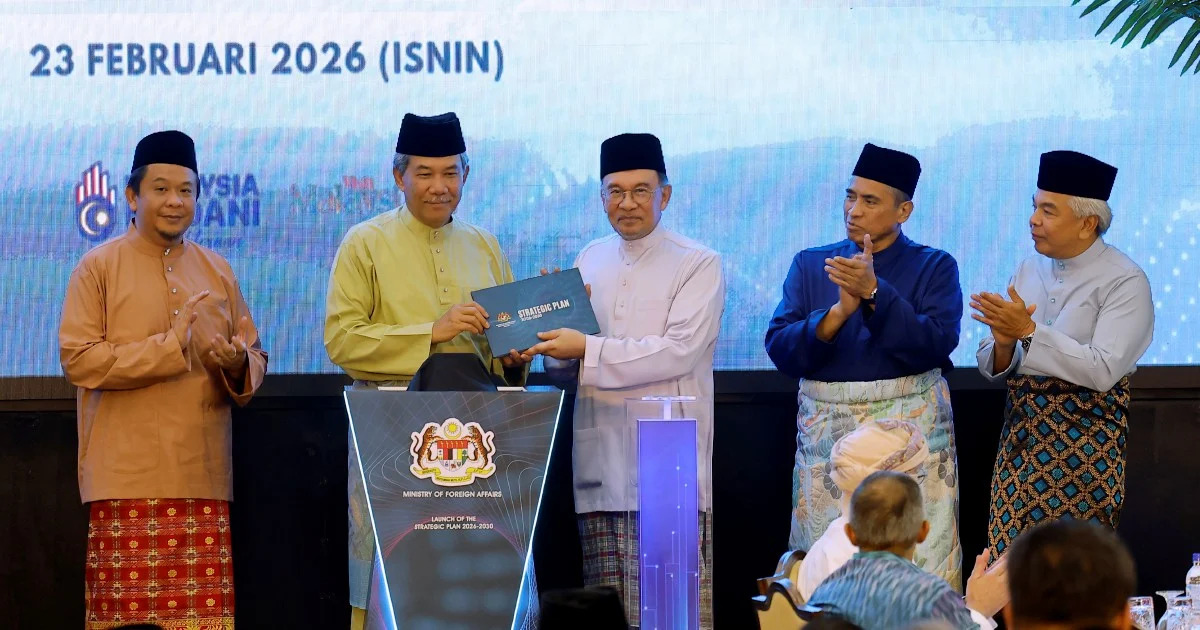
The Ministry of Foreign Affairs Strategic Plan 2026–2030 was formally introduced by Prime Minister Dato’ Seri Anwar Ibrahim on February 23 2026, during the Ministry’s MADANI Iftar Event in Putrajaya, which was hosted by Foreign Affairs Minister Dato’ Seri Utama Haji Mohamad Haji Hasan.
The Strategic Plan, based on the Malaysia MADANI framework, aligns with the Public Service Reform Agenda (ARPA), the Thirteenth Malaysia Plan (RMK13), and the MADANI Economy framework. With 33 strategies and 139 specific programmes, it is structured around eight Strategic Thrusts. These cover important areas such as enhancing bilateral and multilateral diplomacy, advancing Malaysia’s proactive role in ASEAN, protecting maritime interests and national sovereignty, improving public diplomacy and service delivery, building institutional capacity, and continuing to fulfil commitments under agreements like the Chemical Weapons Convention.
The Plan reaffirms Malaysia’s unwavering commitment to ASEAN Centrality and the strengthening of regional collaboration, building on the country’s successful chairmanship of ASEAN in 2025. This commitment is intended to help maintain peace and shared prosperity in Southeast Asia amidst shifting geopolitical factors. One of the Plan’s key features is its deliberate incorporation of technology, digital transformation, science, and innovation into diplomatic operations. This approach encourages technology exchanges, collaborative research projects, and the creation of digital infrastructure, positioning technological cooperation as the cornerstone of bilateral partnerships. Priority areas include climate technologies, renewable energy systems, the digital economy, and more general scientific and technological developments. Through these programmes, Malaysia aims to position itself as a hub for innovation and sustainable development, while also contributing to the shaping of the global security and economic landscapes.
Malaysia will actively participate in discussions on digital governance, emerging technologies, and sustainable development in multilateral venues such as the United Nations, the Organisation of Islamic Cooperation, and the Non-Aligned Movement. This entails contributing to the development of standards, formulating regulatory frameworks, and implementing technical capacity-building initiatives to address current global challenges such as l digital inequality and climate change.
The Plan places a high priority on ASEAN’s technological capacity-building, innovation-led growth, and enhanced digital connectivity. Greater emphasis will be placed on digital infrastructure, cross-border data initiatives, and science-driven development as the Association approaches its 60th anniversary in 2027 and advances towards the ASEAN 2045 Vision. This is expected to strengthen intra-regional ties and enhance ASEAN’s influence in an increasingly technology-driven global order.
The Strategic Plan calls on the Ministry to modernise its institutions in order to support these goals. This includes implementing cutting-edge technologies to accelerate policy analysis, public service delivery, administrative procedures, and diplomatic coordination. These steps are intended to improve data management, increase operational efficiency, and ensure greater agility in responding to global developments.
Through data-driven approaches, these initiatives aim to shape geopolitical narratives effectively, combat disinformation, and promote informed public participation both domestically and internationally.
Additionally, the Plan touches on national issues that cut across all sectors, particularly environmental sustainability, health resilience, and energy transition. By supporting commitments to emissions reduction, climate adaptation, and post-pandemic recovery, collaborative efforts in renewable energy technology, climate innovation, and digital health infrastructure connect diplomatic action to broader societal and international objectives.