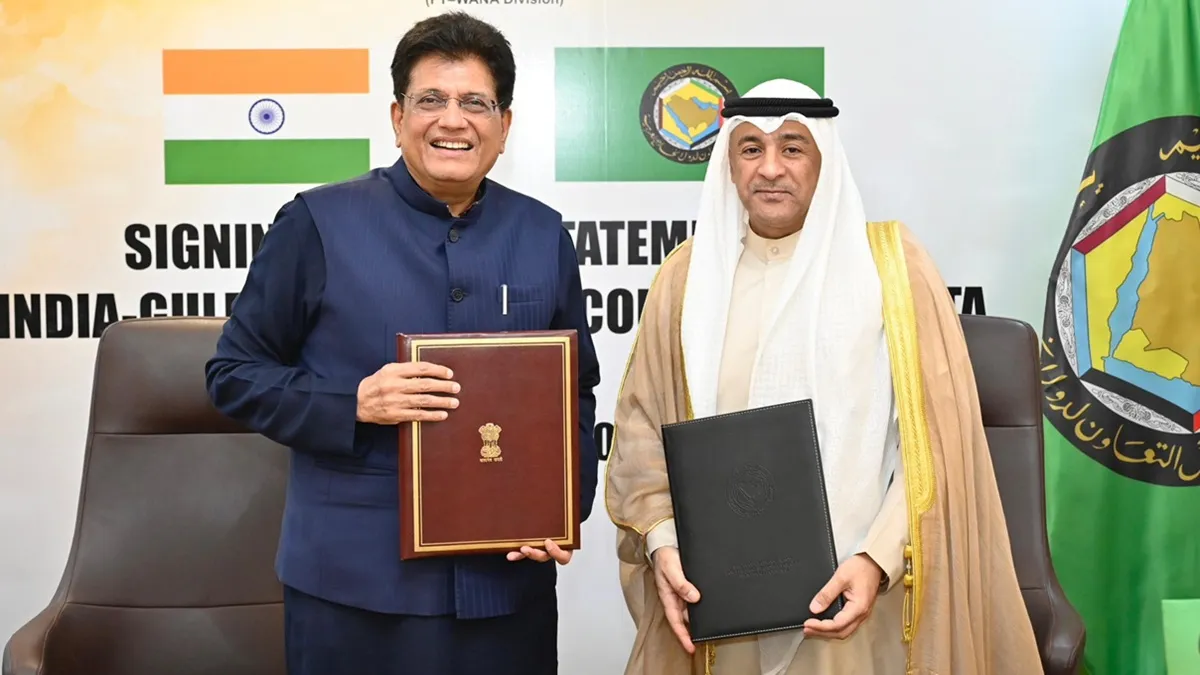
India and the Gulf Cooperation Council (GCC) formally launched negotiations for a Free Trade Agreement (FTA) on 24 February 2026, with the signing of a Joint Statement in New Delhi.
The Joint Statement was signed by Piyush Goyal, Union Minister of Commerce and Industry, and Jasem Mohamed Albudaiwi, Secretary General of the Gulf Cooperation Council. The signing follows the Terms of Reference (ToR) agreed on 5 February 2026, and marks the formal start of negotiations towards a comprehensive bilateral trade agreement.
Scope of Negotiations
The Terms of Reference provide the framework for negotiations across several areas. Both sides have agreed to explore cooperation in trade in goods, customs procedures, trade in services, and digital trade. The framework also covers sanitary and phytosanitary (SPS) measures, intellectual property rights, and matters related to micro, small, and medium enterprises (MSMEs).
What Both Sides Said
Speaking at the signing ceremony, Albudaiwi described the launch of negotiations as marking a new phase of strategic partnership between the GCC and India. He said the bonds between the two sides go beyond economic interest, rooted in centuries of cultural and historical proximity. He described India as one of the GCC’s most vital global trading partners and called deeper cooperation a strategic economic necessity, given growing integration in areas such as energy, food security, and technology. He expressed the aim for an agreement that eliminates tariff and non-tariff barriers and boosts investment flows in both directions.
Piyush Goyal said the Joint Statement and the Terms of Reference together represent a significant step in India–GCC relations. He underlined that a trade agreement would harness mutual complementarities and that the current period of global economic uncertainty made it the right time to pursue a robust trading arrangement.
On the same day, India’s External Affairs Minister, Dr S. Jaishankar, received Albudaiwi in New Delhi as part of the GCC Secretary General’s official visit to India. The two sides reviewed the state of GCC–India relations and discussed proposals across various fields. They also noted that the second Joint Ministerial Meeting between the GCC states and India is scheduled to take place later in 2026. Both sides exchanged views on regional and international developments, with an emphasis on maintaining security and stability.
Trade in Numbers
The GCC is India’s largest trading partner bloc. Bilateral trade reached USD 178.56 billion in 2024–25, accounting for 15.42 per cent of India’s total global trade. India’s trade with GCC has grown at an average annual rate of 15.3 per cent over the past five years. India’s key exports include engineering goods, rice, textiles, machinery, and gems and jewellery. Imports are dominated by crude oil, LNG, petrochemicals, and precious metals. Cumulative GCC investment into India has exceeded USD 31.14 billion as of September 2025. The GCC collectively represents a market of 61.5 million people and a GDP of USD 2.3 trillion. Nearly ten million members of the Indian community reside across the GCC region.