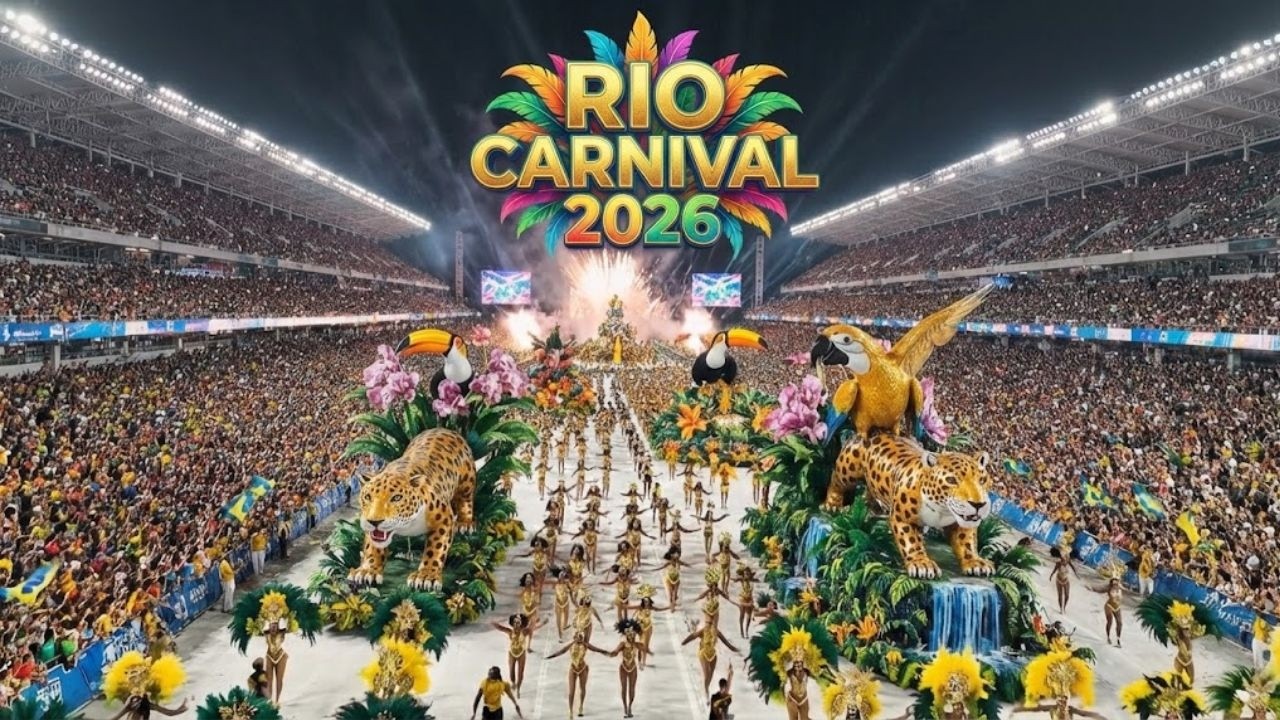
Rio Carnival is a vibrant, citywide festival rooted in the ancient European tradition of ‘Carne Vale’ (‘goodbye to meat’) before Lent in the city of Rio de Janeiro, Brazil. Over time, it has been profoundly transformed by African influences brought by enslaved people, including masks, ritual dances, and the rhythmic foundations of Samba. Today, it stands as a vast cultural showcase comprising three principal components: the Samba Parades, Copa Ball, and Blocos.
For the 2026 season, Rio Carnival is scheduled to officially begin on 13 February 2026 and conclude on 21 February 2026. The programme features the Série Ouro parades on 13 and 14 February, followed by the premier Special Group parades on 15 and 16 February. The festivities culminate in the Champions Parade—a ‘victory lap’ for the winning schools—on the final day, 21 February 2026.
The event holds immense global significance and is often described as ‘The Greatest Show on Earth’ owing to its unmatched vibrancy and artistic scale. It functions as a major hub for international tourism, drawing visitors from every corner of the globe to witness a spectacle that blends history, folklore, and contemporary issues. Its magnitude is illustrated by the scale of participation in street parties such as Cordão do Bola Preta, which alone attracts over 200,000 people, reinforcing Rio’s status as an epicentre of global celebration and cultural fusion.
A Journey Through History
The festival traces its origins to ancient celebrations marking the end of winter, characterised by dance, music, and feasting. These traditions evolved from Greek and Roman festivities into medieval European customs and were eventually incorporated into the Christian calendar as pre-Lenten observances. The name ‘Carnival’ derives from the Latin ‘Carne Vale’, meaning ‘goodbye to meat’, reflecting the period of abstinence observed before Easter.
Although Europeans introduced the concept of Carnival to Brazil, the festival’s distinctive character was shaped significantly by African traditions brought by enslaved people. These influences introduced masks, costumes, and ritual dances that infused the celebration with distinctive vibrancy. Most notably, Samba—now synonymous with the festival—emerged from West African and Angolan traditions and flourished in Rio’s ‘Little Africa’.
The modern structure of Carnival began to take shape in the 1920s with the emergence of Samba Schools (Escolas de Samba). These evolved from informal community gatherings into formal associations that became central to the festivities. This development culminated in 1984 with the construction of the Sambadrome, a purpose-built venue designed to host the grand parades that define the event today.
Main Events
Samba Parades: Often described as ‘The Greatest Show on Earth’, the Samba Parades are the principal competitive events at the Sambadrome. Here, Samba Schools—community-based associations—present thematic performances through elaborate floats, costumed dancers, and original music. The parades are divided into categories: the Série Ouro highlights traditional schools with strong community roots, while the Special Group features the premier schools with the most lavish productions. The top schools return for a ‘victory lap’ at the Champions Parade.
Copa Ball: The Copa Ball is the festival’s most exclusive and glamorous event, held at the iconic Copacabana Palace Hotel. Unlike the street celebrations, it is a formal occasion requiring black tie and gala attire or elaborate costumes.
Street Parties (Blocos): Known as ‘Blocos’, these free, open-air gatherings reflect the inclusive spirit of Carnival. Organised by over 300 neighbourhood bands, they range from small local events to vast crowds. The largest, Cordão do Bola Preta, attracts over 200,000 people, while other popular blocos include Simpatia é Quase Amor and Monobloco.
The Rio Carnival functions as an economic driver, cultural symbol, and instrument of global visibility. It generates substantial revenue through tourism and supports thousands of jobs across both formal and informal sectors. Culturally, it reflects Brazil’s Afro-Brazilian heritage and community identity, particularly through the Samba Schools, which operate year-round. Internationally, it shapes Brazil’s image as a nation of creativity and vibrancy, thereby boosting its soft power.