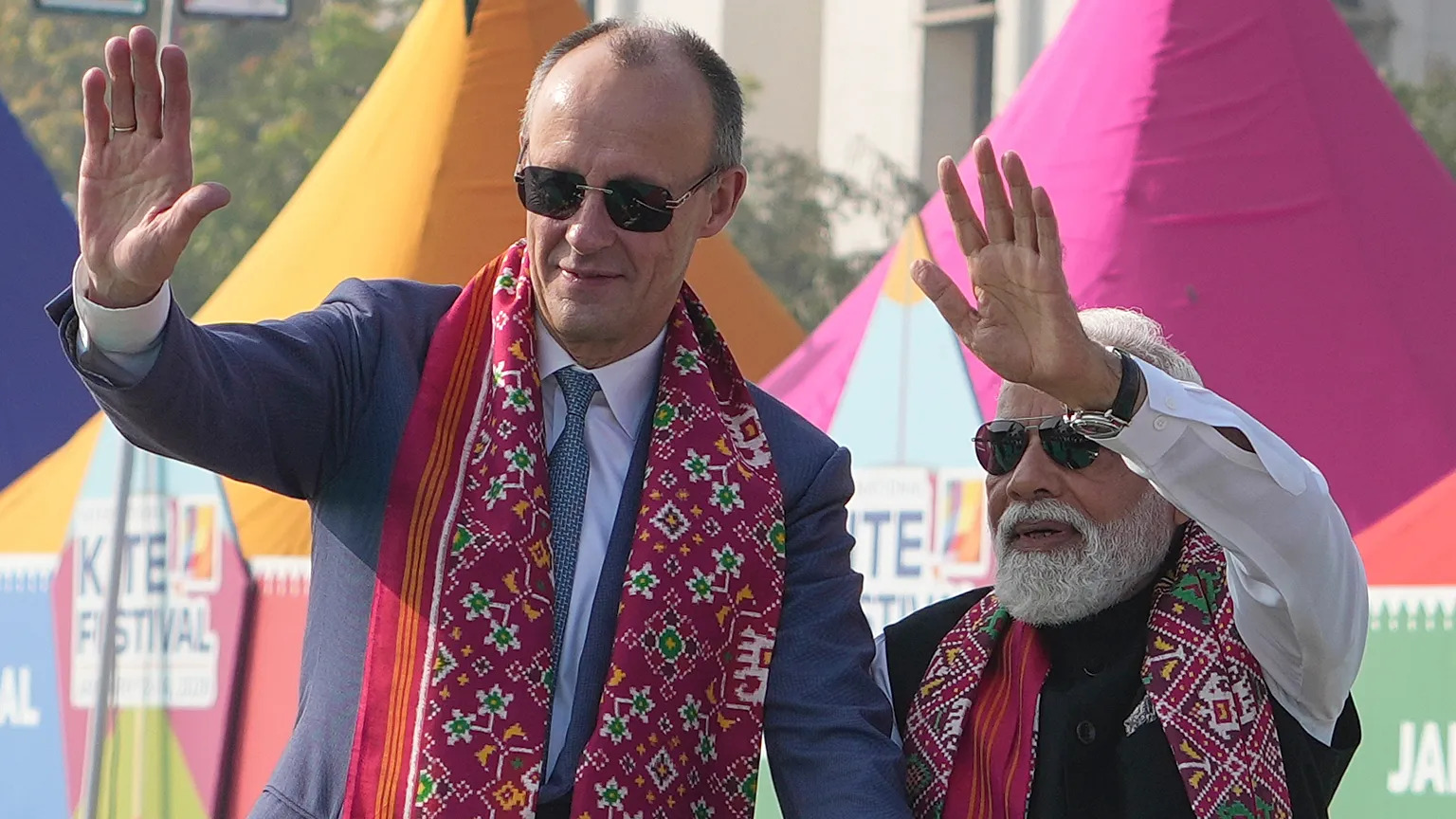
German Chancellor Friedrich Merz and Indian Prime Minister Narendra Modi on 12, January, 2026, held wide-ranging talks aimed at strengthening economic, strategic and people-to-people ties, as both countries look to diversify global partnerships. The meeting took place in Gandhinagar, the capital of the western Indian state of Gujarat, where PM Modi formally welcomed Merz on his first official visit to India and his first trip to Asia since taking office as Federal Chancellor last year. The visit combined diplomacy with symbolism, underscoring a renewed push to elevate relations between Europe’s largest economy and one of the world’s fastest-growing major markets.
Following bilateral talks, the two leaders oversaw the signing of 19 agreements and memorandum of understandings spanning defence cooperation, skills development, health, education, science and technology, semiconductors, critical minerals and sports. A key outcome was a Joint Declaration of Intent to develop a Defence Industrial Cooperation Roadmap, designed to promote long-term collaboration between German and Indian companies, including joint development, co-production and technology partnerships. Of particular significance was the commitment to intensify defence ties, an area where cooperation has historically been limited. German industrial group Thyssenkrupp is expected to partner with Indian firms in New Delhi’s plan to build six advanced conventional submarines domestically, part of India’s broader effort to modernise its armed forces and reduce dependence on imports. India’s Foreign Secretary, Vikram Misri, later said talks on the submarine project would continue to gather momentum, noting that Germany had begun facilitating faster export clearances for defence equipment.
Trade and economic cooperation featured prominently in the discussions. Merz said negotiations on a long-pending free trade agreement between India and the European Union could be concluded as early as the end of January, raising the prospect of a landmark deal at a time of rising global protectionism and stalled U.S.–India trade talks. He added that senior EU leaders would travel to India to seal the agreement if negotiations were wrapped up in time. Bilateral trade between India and the EU stood at around €120 billion in 2024, making the bloc India’s largest trading partner. Germany is India’s most important economic partner within the EU, with PM Modi noting that trade between the two countries has crossed a record USD 50 billion. “Close cooperation between the economies of countries like India and Germany is important for all of humanity,” PM Modi said, adding that growing trade and investment ties had injected new energy into the strategic partnership.
The proposed EU–India agreement is seen as a chance for both sides to strengthen supply chains. Brussels has been pushing for sharp tariff cuts on cars, medical devices, wine and spirits, as well as stronger intellectual property protections, while New Delhi is seeking duty-free access for labour-intensive exports and quicker recognition of its expanding automotive and electronics sectors. The leaders also announced measures to deepen people-to-people links. Germany will introduce a visa-free transit facility for Indian passport holders passing through its airports, a step expected to significantly ease travel for Indian nationals. The move, announced in a joint statement, was described as a way to further intensify exchanges between students, researchers, skilled professionals, artists and tourists. Both sides acknowledged the contribution of the Indian community to Germany’s economy, innovation and cultural life and agreed to expand cooperation in education, vocational training and youth exchanges.
Climate action and green development formed another pillar of the talks. PM Modi said India and Germany were jointly advancing projects in climate mitigation, renewable energy, urban development and mobility. He highlighted a major green hydrogen initiative involving companies from both countries, describing it as a potential “game-changer” for the energy systems of the future. On global and regional issues, the two leaders reaffirmed their commitment to a free and open Indo-Pacific and expressed strong support for the India–Middle East–Europe Economic Corridor. They unequivocally condemned terrorism in all its forms, including cross-border terrorism, and called for coordinated international action. The joint statement also reiterated the need for comprehensive reform of the United Nations Security Council, with expansion of both permanent and non-permanent membership to reflect contemporary geopolitical realities — an issue of shared interest, as both India and Germany are candidates for permanent seats.
Beyond formal talks, the visit carried strong symbolic overtones. Modi and Merz visited the Sabarmati Ashram in Ahmedabad, once home to Mahatma Gandhi, where the German Chancellor removed his shoes in keeping with local custom. They later attended the International Kite Festival at the Sabarmati riverfront, where both leaders joined revellers in flying kites — a gesture widely seen as highlighting cultural connection and goodwill.
Merz, who is accompanied by a large delegation of German business leaders, is due to travel on to Bengaluru, India’s technology hub, for meetings with executives and innovators from both countries. His visit comes ahead of a planned India–EU summit later this month, where expectations are rising that tangible progress could finally be made on a free trade agreement that has been under discussion for years. As global economic and strategic fault lines continue to shift, both New Delhi and Berlin appear keen to position their partnership as a cornerstone of a more diversified and resilient international order.