Over the years, India and Kenya have strengthened their collaboration in the Western Indian Ocean, which has become a central part of their partnership. India and Kenya seek to prioritise security, trade and the blue economy. This is the result of their individual responses to the changing dynamics of global power.
Historical Context and Strategic Setting
India and Kenya have a history of partnership in the Indian Ocean, linked to trade, the migration of Indians, and a few shared histories, resulting in an interwoven network of relations and trade. This history has led the two nations to have significant political trust. The relationship is framed between the two countries as “maritime neighbours”.
The Western Indian Ocean has become a zone of intensified strategic competition. For both India and Kenya, maritime governance is no longer a technical question but a core security concern connected to trade routes, energy flows, and coastal development, making cooperation both a necessity and a geopolitical instrument.
The BAHARI Vision: Framing the Partnership
The 2023 India-Kenya Joint Vision Statement on Maritime Cooperation in the Indian Ocean Region, also known as BAHARI (the Swahili word for ocean), serves as the basis for their current maritime partnership. The document explicitly links Indian Prime Minister Narendra Modi’s SAGAR policy (Security and Growth for All in the Region) with Kenya’s Vision 2030, thereby pairing bilateral maritime partnerships with domestic socio-economic development and regional security frameworks.
BAHARI outlines six pillars: promotion of maritime trade and industry, enhancement of maritime security, exploitation of the blue economy, improvement of connectivity with reinforced capacity and information sharing. The pillars mark an unprecedented level of collaboration that transcends occasional and episodic naval port calls. The framing positions India and Kenya as beneficiaries of the Western Indian Ocean’s regional security, and also as joint providers of its public goods (sustainable fisheries and maritime domain awareness).
Capacity-building and Defence Industrial Linkages
India’s operational engagement in Kenya emphasises Nairobi’s capacity building needs and differentiates India from other actors who have opted for permanent basing and large scale deployments. New Delhi’s training offers, “training of trainers,” for parachute and other equipment transfers to the Kenyan Defence Forces, avoid operational exposure and sensitivities associated with foreign bases.
As far as Defence Cooperation goes, in 2023, a Memorandum of Understanding (MoU) was signed between Goa Shipyard Limited and Kenya Shipyard Limited on ship design and construction and broader Defence Industrial Cooperation, initially funded through capacity building and explicitly linked to the BAHARI agenda.
Maritime Security Cooperation
The navy’s collaborations have led to Kenya’s participation in events such as the Africa India Key Maritime Engagement (IAIKEYME), a maritime exercise that Kenya acknowledges as a building block for capacity enhancement. It reinforces a collective desire to maintain stability in the region. Kenya’s involvement in some of the region’s of the Indian Ocean Rim Association (IORA) and the Indian Ocean Naval Symposium (IONS) multilateral military activities began with the annual staff talks between the Navies, Kenya’s participation in the Joint Defence sector meetings, and the Kenyan Navy’s participation in the AIKEYME maritime exercises.
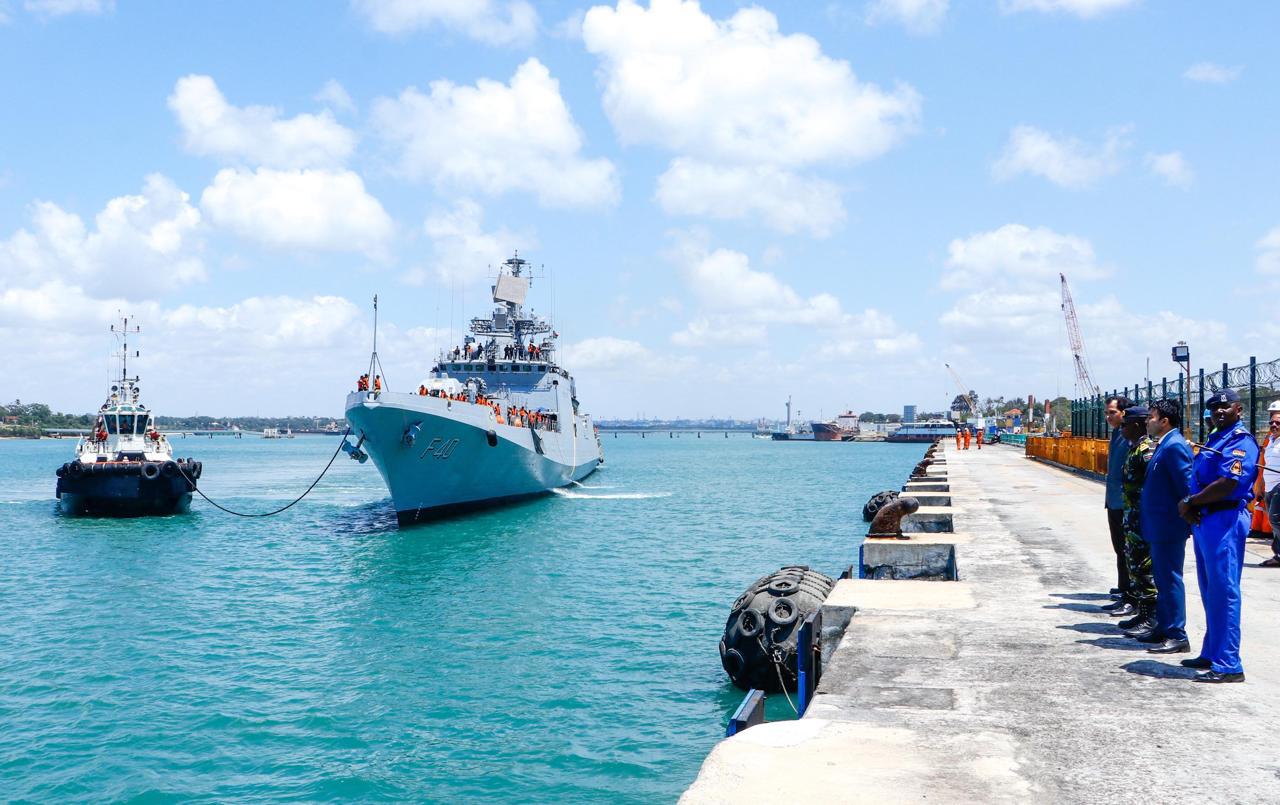
Training, operational coordination, and hydrographic cooperation were the main subjects of the naval commander’s talks in India in 2025 with the Navy Chief of India. This recent high-level naval collaboration shows that the agenda is not simply an academic exercise but rather a well-planned, actionable one. Consequently, the Indian navy’s recent and scheduled personnel port activities serve the dual purpose of enhancing the operational capacity of its military munitions and establishing India as a trusted primary military partner in the Eastern Indian Ocean, as Mombasa is to be Kenya’s primary military port.
The Blue Economy and Coastal Development
Unlike the other pillars of geostrategic cooperation with India, the blue economy also sits at the intersection of geopolitics, development and security. The two countries aim to balance marine resource exploitation with the management of fishing cooperatives, as well as with ongoing initiatives in spatial management and other techniques that address development, the creation of sustainable employment opportunities, and the control of coastal overfishing and illegal, unreported, and unregulated (IUU) fishing.
Indian Ocean Connectivity and Trade Corridors
Cooperation takes a particular form in terms of accessibility and commerce. The Western Indian Ocean routes are essential for India’s energy and export market security. For Kenya, these routes are important for its gateway positioning. BAHARI specifically calls for measures to strengthen trade logistics and cooperative port development. The emphasis on the other Kenyan harbours alongside Mombasa on India’s side parallels their attempts to assist in developing alternative routes. It has helped Kenya expand and diversify its external partnerships. Maritime corridors development in this particular case enhances both countries’ strategic autonomy.
Evolving Dimensions of Maritime Cooperation
The maritime collaboration between India and Kenya is taking place in a quickly shifting geopolitical landscape, characterised by the presence of major powers and infrastructure visions in the Western Indian Ocean (WIO). The region’s strategic geography, with its key sea lanes, chokepoints, and anticipated blue-economy resources, has made it a focus of long-term geopolitical competition.
India’s relationship with Kenya falls within the broader national scope of India, with the African coastline under the SAGAR policy. India has offered the training, technology, and development assistance needed for many of the smaller and mid-sized projects that Kenya uses, as well as other lines of credit. The Nairobi government has begun to increase its international investment and other strategic initiatives, with these investments and international engagement solidified with most other nations.
India-Kenya Maritime Partnership addresses non-traditional issues such as illegal fishing, trafficking, and climate change, while taking into consideration historical issues of naval power competition. Kenya seeks to engage with India economically, along with potential military alliances. This continues to show the new depth of the relationship between India and Kenya. Kenya is India’s soft power and a peek into Kenya’s spirituality and economic control.
The Western Indian Ocean’s and Indian Ocean’s Indo Pacific regional architecture incorporates India and Kenya’s maritime collaborations. It includes the IORA, an emphasis on the blue economy and maritime disaster risk reduction, and collaboration on naval symposia. These allow India and Kenya to advocate for IORA principles, such as freedom of navigation and adherence to international law, to support trade on the seas and develop their economies, part of India’s SAGAR strategy and Kenya’s regional diplomacy.
Regional Dynamics in the Western Indian Ocean
The Indian Ocean West Africa is a unique subregion with a distinct naval presence, access approvals, and maritime capacity building, as secondary references, signifying strategic contestation. In this region, India has established its own network of regional arrangements while collaborating with other countries similarly situated to enhance and streamline responses to domain awareness, piracy, trafficking, and other non-traditional threats.
This form of cooperation is about information and white shipping data. It involves integrating Nairobi into an emerging security web that connects its coastal surveillance to other systems in the Indian Ocean. It also involves issues of data governance, sovereignty, the balance of security cooperation, the technical dependence of systems, and security arrangements, which are essential within the context of the politics of domain awareness in the maritime sector.
Conclusion
India-Kenya maritime cooperation seeks to influence the Western Indian Ocean in several ways. With the full implementation of SAGAR and BAHARI’s plan, especially in blue economy governance, capacity building, and multilateral cooperation, the region will serve as a model bilateral framework for low-cost security partnerships. BAHARI’s framework will focus on finding a balance between the perceived gains from this partnership. Thus, India-Kenya maritime cooperation strengthens regional stability and economic connections by reaffirming a shared commitment to a free, safe, and sustainable Indian Ocean.