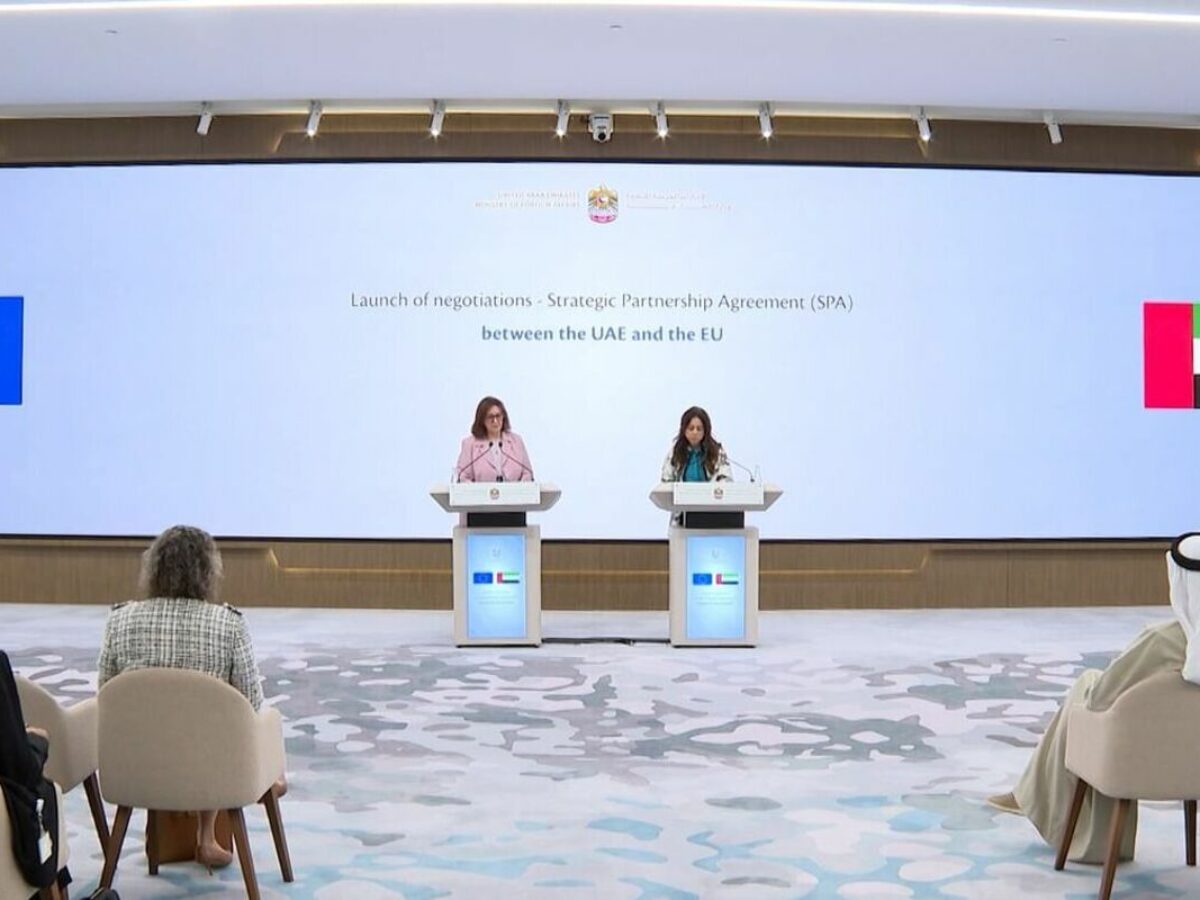
Senior officials from the United Arab Emirates and the European Union formally opened negotiations on a Strategic Partnership Agreement on 8th December, 2025, Monday, signalling what both sides described as a decisive new chapter in their relationship. The launch ceremony, held at the Ministry of Foreign Affairs in Abu Dhabi, drew diplomats, officials, and media representatives. Afra Al Hameli, the Ministry’s Director of Strategic Communications, set the tone by calling the moment “a defining milestone in the UAE–EU relationship”. She said the prospective agreement would strengthen alignment on core priorities and establish “an ambitious roadmap for the years ahead”.
A Shared Vision for Deeper Cooperation
The announcement was followed by a joint press conference with Lana Zaki Nusseibeh, Minister of State, and Dubravka Šuica, EU Commissioner for the Mediterranean. Both officials framed the negotiations as part of a longstanding and increasingly strategic partnership. Commissioner Šuica stressed that the EU views the UAE as “a strategic partner” and highlighted decades of cooperation spanning trade, development, and regional diplomacy. She said the agreement would help reinforce joint efforts to promote stability and prosperity across neighbouring regions. Opening the conference, Nusseibeh said the UAE and EU share a clear belief that closer cooperation is vital. “It is my pleasure to take this important step towards deepening the strategic partnership between the UAE and the EU,” she said, noting that the two sides see significant untapped potential in their political and economic ties. She also welcomed progress in Brussels towards similar bilateral negotiations with GCC states, a move aimed at establishing comprehensive strategic partnerships across the region.
Progress on Trade and Economic Integration
Much of the discussion centred on economic cooperation, particularly the ongoing work towards a Free Trade Agreement. Nusseibeh said talks were “progressing rapidly”, underpinned by shared interests in expanding trade, investment flows, and business collaboration. She pointed out that the EU is the UAE’s largest investment partner and its second-largest trading partner globally. Comprehensive partnerships previously concluded by the UAE, she added, have shown how such agreements can deliver transformative benefits for both sides.
Šuica echoed this view, describing the UAE as a key economic hub linking Europe with the Middle East and Asia. The proposed Free Trade Agreement, she said, is intended to create a broad framework for cooperation across research, innovation, energy, artificial intelligence, digital transformation, humanitarian action, and education. She noted that the negotiations form part of a wider agenda adopted in 2024 and aligned with the EU’s 2032 Strategy, aimed at shaping a more resilient and globally engaged Europe.
Building a Modern Strategic Framework
According to Nusseibeh, the Strategic Partnership Agreement currently under negotiation will offer a structured mechanism for cooperation in high-priority fields such as digitalisation, AI, and renewable energy. But she stressed that the partnership is not limited to economic matters. She highlighted the UAE’s recent pledge of $550 million to support the UN’s 2025 Global Humanitarian Appeal, describing it as an example of the country’s commitment to ensuring international cooperation delivers “dignity and hope” to vulnerable communities. The central task now, she said, is to translate the growing alignment into practical outcomes that produce real benefits for citizens, businesses, and the wider global community.
Sudan: A Focus of Joint Diplomatic Efforts
Responding to questions from reporters about the crisis in Sudan, Nusseibeh said the UAE remains in close consultation with European partners on mediation efforts. She welcomed recent decisions by the European Parliament and the EU Foreign Affairs Council reaffirming the need for an immediate humanitarian truce and a path towards a permanent ceasefire. She referred to the September statement by the Quad Group as a “historic step” that outlines a realistic roadmap for de-escalation and rejects any future for Sudan shaped by extremist groups. An independent civilian government, she said, remains “the only path toward a stable and secure Sudan.”
Looking Ahead
Both sides emphasised that the launch of negotiations marks not an end point but a beginning. The UAE, Nusseibeh said, is ready to work with the EU on the basis of mutual respect and shared interests, with the aim of promoting multiculturalism, diversity, and constructive engagement on the global stage. For the EU, Šuica noted, the coming months will be critical in shaping a modern, ambitious partnership capable of addressing shared challenges and seizing emerging opportunities across a rapidly changing geopolitical landscape.