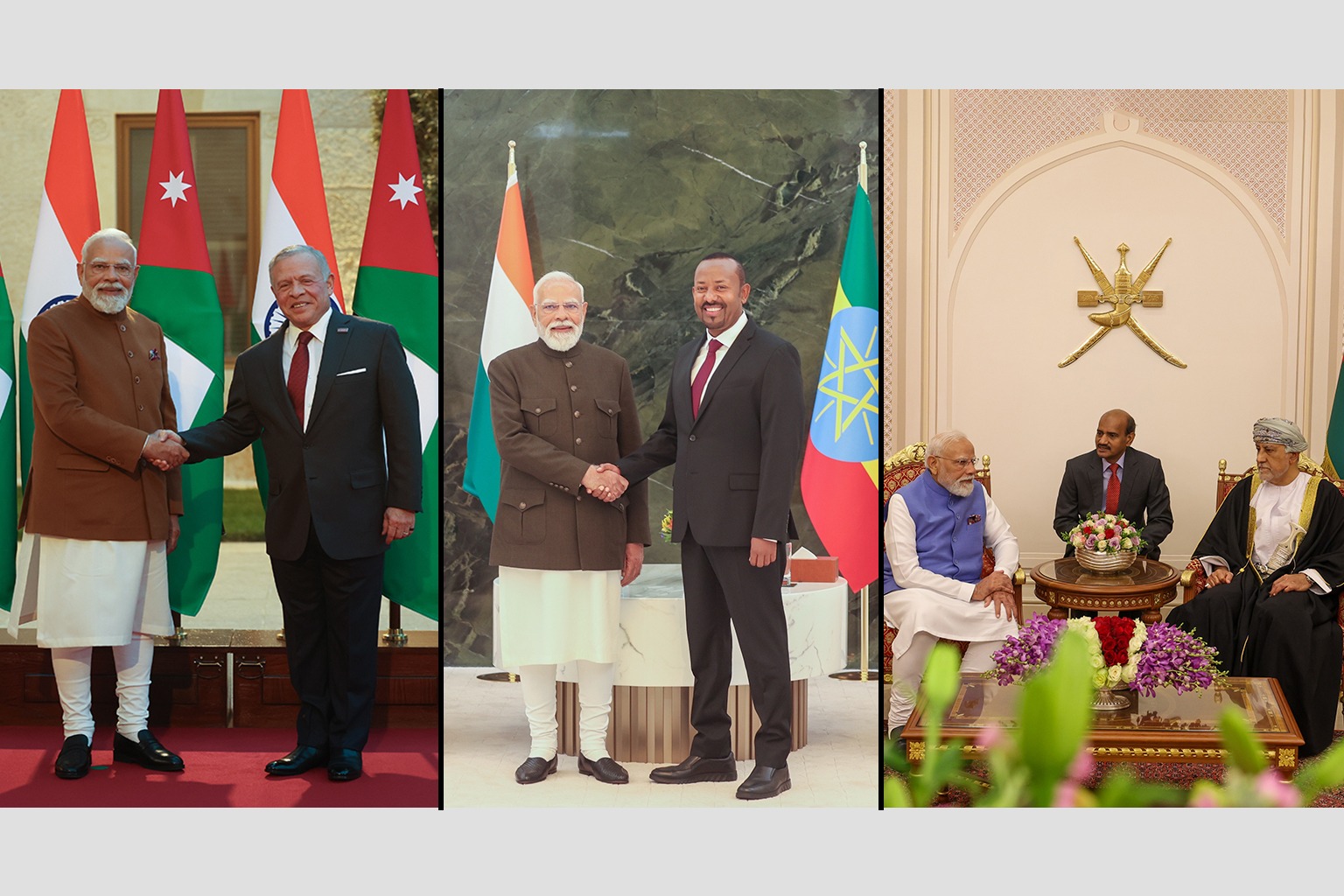
Prime Minister Narendra Modi’s state visit to Jordan, Ethiopia, and Oman from December 15 to 18, 2025, marked a significant diplomatic engagement aimed at strengthening India’s strategic, economic, and developmental partnerships across West Asia and Africa, reflecting New Delhi’s calibrated outreach to regions of growing geopolitical and economic importance. The visit began in Jordan, coinciding with the 75th anniversary of India-Jordan diplomatic relations, and reaffirmed the long-standing political trust between the two countries. Prime Minister Modi held discussions with King Abdullah II bin Al Hussein on regional security, counter-terrorism, and economic cooperation, while several memorandum of understandings were exchanged in areas such as renewable energy, water management, digital public infrastructure, cultural exchanges, and heritage cooperation, including the twinning of Petra and Ellora, underscoring shared priorities in sustainable development and people-to-people ties.
In Ethiopia, the visit represented a major diplomatic milestone, as it marked Prime Minister Modi’s first-ever bilateral engagement with the country on December 16-17, 2025, and signalled India’s deepening partnership with Africa. The engagement culminated in the elevation of India-Ethiopia relations to a strategic partnership, opening a new phase of long-term cooperation. In recognition of his role in strengthening bilateral ties, PM Modi was conferred the ‘Great Honour Nishan of Ethiopia’, the country’s highest civilian award. India and Ethiopia signed eight memoranda of understanding and agreements covering a wide spectrum of cooperation, including the establishment of a data centre at Ethiopia’s Ministry of Foreign Affairs to strengthen digital governance and secure data management, as well as an agreement on debt restructuring under the G20 Common Framework, reflecting India’s support for Ethiopia’s economic recovery and financial stability. Additional agreements focused on cooperation in United Nations peacekeeper training, education, skill development, capacity building, and institutional collaboration. The discussions also highlighted India’s expanding economic footprint in Ethiopia, where Indian investments play a significant role in employment generation and industrial growth, particularly in pharmaceuticals, manufacturing, and agro processing.
The visit to Oman was the most consequential, coinciding with 70 years of India-Oman diplomatic relations and resulting in a significant upgrade of bilateral ties. Prime Minister Modi was conferred the Order of Oman (First Class) by Sultan Haitham bin Tarik, underscoring the depth of strategic trust between the two countries. The centrepiece of the visit was the signing of the Comprehensive Economic Partnership Agreement, a landmark trade pact expected to substantially boost bilateral trade and investment. Both sides acknowledged India’s rapid economic growth and Oman’s progress in economic diversification and expressed interest in expanding investments across priority sectors such as infrastructure, technology, manufacturing, food security, logistics, hospitality, and energy, while recognising the strong potential of the Oman-India Joint Investment Fund and welcoming progress on the Bilateral Investment Treaty and discussions on trade in local currencies. Energy cooperation was identified as a major growth area, with emphasis on enhancing collaboration in oil and gas, global exploration and production, and renewable energy, including green hydrogen and green ammonia, through joint investments and technology transfer. Defence and maritime cooperation were reaffirmed through commitments to joint exercises, training, information sharing, and initiatives to counter maritime crimes and piracy, supported by the adoption of a Joint Vision Document on Maritime Cooperation. The two sides also agreed to deepen cooperation in health, traditional medicine, agriculture, technology, education, and capacity building, alongside strengthening cultural exchanges and people-to-people ties, while appreciating the contribution of the Indian community in Oman. The visit concluded with the signing of a Comprehensive Economic Partnership Agreement and several MoUs across key sectors such as agriculture, trade and commerce, maritime, and higher education, reaffirming the commitment to further strengthen the India-Oman partnership.
Taken together, the outcomes of the three-nation tour underscored India’s integrated foreign policy approach, combining strategic partnerships, economic diplomacy, digital cooperation, and development assistance, while firmly positioning Ethiopia and Oman as key pillars of India’s expanding regional and global engagement.