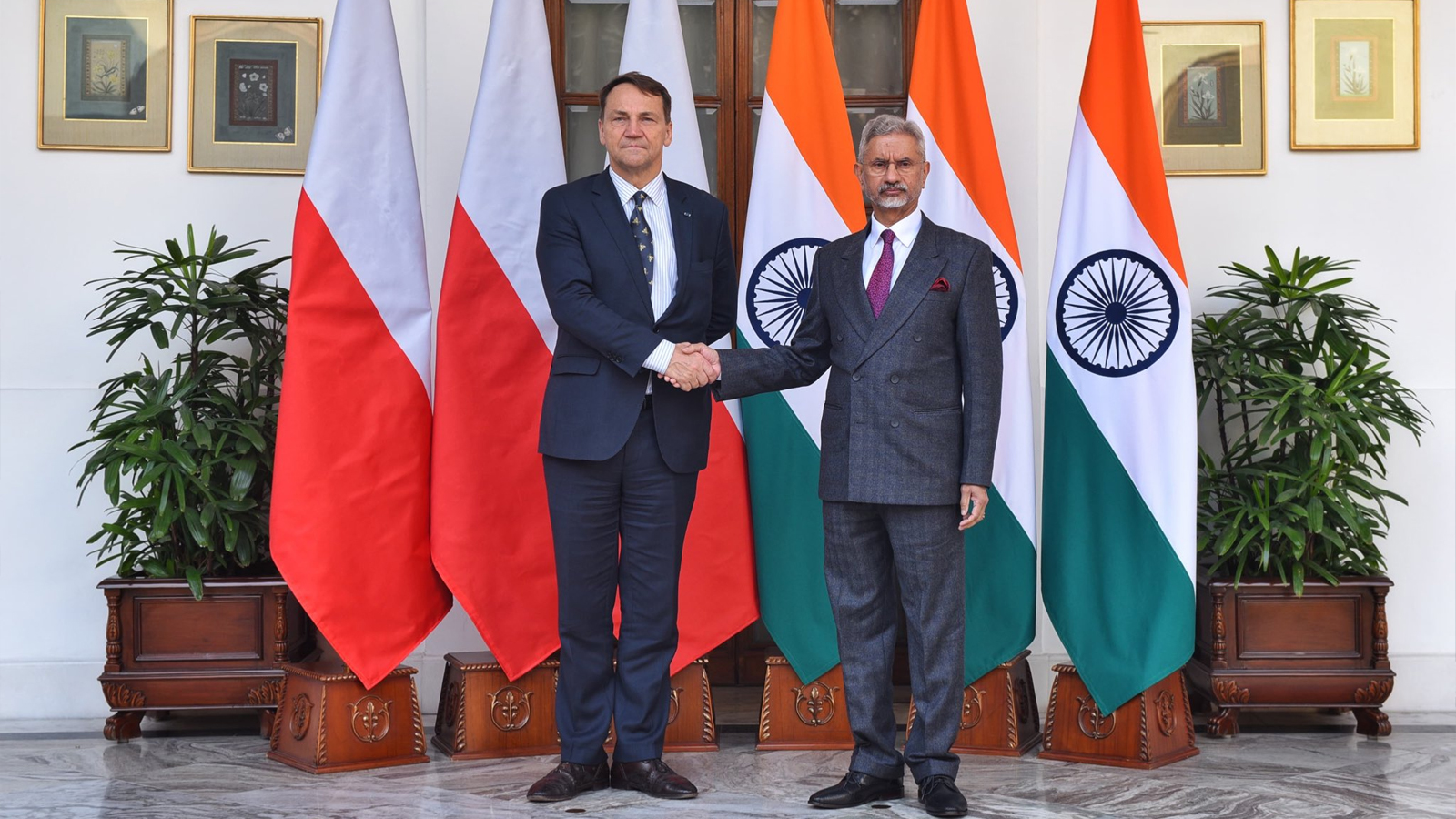
External Affairs Minister S. Jaishankar on 19th January, 2026, Monday, held comprehensive discussions with Poland’s Deputy Prime Minister and Minister of Foreign Affairs, Radoslaw Sikorski, in New Delhi, reviewing the full spectrum of bilateral relations while also exchanging views on regional and global developments at a time of growing international volatility. The talks covered cooperation in areas ranging from trade, investment and defence to technology, mining, clean energy and people-to-people exchanges. Both sides also discussed multilateral issues and the evolving global order, reflecting the expanding scope of engagement between India and Poland following the elevation of ties to a strategic partnership last year.
Describing the meeting as timely and constructive, EAM Jaishankar said it provided an opportunity for a candid exchange of perspectives. In a post on X, he noted that the discussions focused on advancing cooperation across economic, technological and security domains, while also acknowledging Poland’s support for stronger India–European Union relations. Welcoming Sikorski and his delegation, EAM Jaishankar observed that the discussions were taking place against the backdrop of significant global churn. He said that as countries located in different regions, India and Poland faced distinct challenges and opportunities, making it valuable to exchange assessments and experiences.
While noting steady progress in bilateral ties, the External Affairs Minister emphasised the need for sustained engagement. He recalled Prime Minister Narendra Modi’s visit to Poland in August 2024, during which the relationship was elevated to a strategic partnership. Jaishankar said the two sides would closely review the Action Plan for 2024–28 aimed at unlocking the partnership’s full potential. He said the focus would be on strengthening trade and investment, deepening defence and security cooperation, and expanding collaboration in clean technologies and digital innovation. Highlighting the economic dimension of the relationship, Jaishankar noted that Poland is among India’s leading trading partners in Central Europe, with bilateral trade standing at around USD 7 billion after nearly tripling over the past decade.
Indian investments in Poland have crossed USD 3 billion, he said, generating substantial employment, while India’s robust economic growth, large market and pro-investment policies continue to offer attractive opportunities for Polish companies. Jaishankar also underscored the importance of cultural and educational links, pointing to historical connections and people-to-people exchanges. Referring to the legacy of the Jam Saheb of Nawanagar, who sheltered Polish refugees during the Second World War, he said the Maharaja remained a cherished symbol of the bond between the two nations. He also highlighted the popularity of yoga and the growing interest in Indology in Poland.
Raising the issue of terrorism, Jaishankar urged Poland to maintain a firm stance against the threat. He said Poland was well aware of the challenges posed by cross-border terrorism and stressed that there should be zero tolerance for terrorism or any support that fuels terrorist infrastructure in the region. Responding to the discussions, Sikorski thanked India for the invitation and said he was pleased to be visiting the country once again, including his participation in the Jaipur Literature Festival. While he has travelled to India on several occasions, he noted that this was his first visit since the establishment of the India–Poland strategic partnership.
Describing India and Poland as dynamic players in their respective regions, Sikorski said there was considerable scope to explore new avenues of cooperation. He drew parallels between the historical experiences of the two countries, observing that both had faced periods of foreign domination in the 19th century, which continued to shape their national outlooks. Echoing Jaishankar’s views on terrorism, Sikorski said Poland had recently faced acts of sabotage and state-linked terrorism, reinforcing the need for close international cooperation. He also expressed concern over selective tariff targeting in global trade, warning that such measures could have wider disruptive consequences for the international economic system.
Sikorski further noted India’s expanding diplomatic footprint across Europe, saying it reflected New Delhi’s growing engagement with the European Union. He expressed hope that the Polish Prime Minister would be able to visit India in the near future, giving further momentum to the strategic partnership between the two countries.