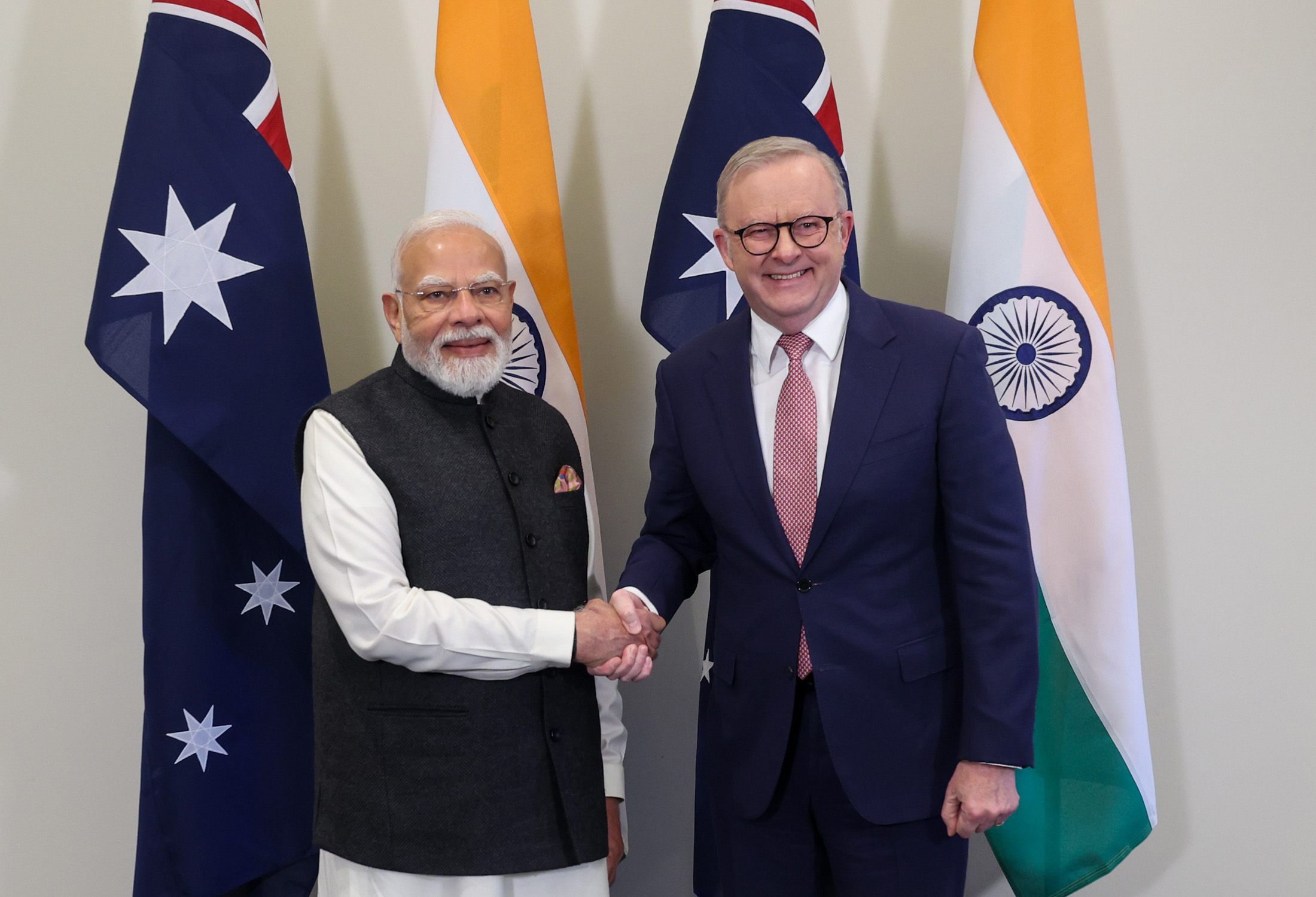
The Prime Minister of India, Shri Narendra Modi visited Australia from 8 to 10 July 2026 on the second leg of his overseas mission. The Indian leader was hosted in the city of Melbourne, in the Naarm region of the indigenous Boon Wurrung peoples. PM Modi’s visit at the invitation of the Prime Minister of Australia, Mr Anthony Albanese MP, marks the Third India-Australia Annual Leaders’ Summit. This is the second meeting between the two leaders since they last met on the sidelines of the G20 Summit in 2025. The two countries share a Comprehensive Strategic Partnership since June 2020 and the visit marks another step in strengthening this cooperation, especially in the areas of defence and maritime security, education, cultural exchanges, investment, technology collaboration in energy and space, and Indo-Pacific Cooperation.
PM Modi addressed large a gathering of Indian diaspora on 8 July at the Marvel Stadium in Melbourne’s Docklands area, at an event titled ‘Melbourne Meets Modi’. PM Albanese, while welcoming PM Modi remarked in his speech, “Over the years, this stadium has seen some loud and legendary events – and none more significant than this. The energy we feel in here tonight defines the Australia-India partnership.” The Australian leader’s address reflected upon his personal connection with India and lauded the contributions of the Indian-Australians to the Australian multicultural society, the country’s businesses, and its IT and health sector.
On 9 July, PM Modi was accorded a warm ceremonial welcome at the Government House before being received by PM Albanese for the 3rd India-Australia Annual Leaders’ Summit, at the conclusion of which the leaders issued their Joint Statements. The day’s events also included the Australia-India CEOs Forum and the Economic Roadmap Business event. Announcements of major Memorandums of Understanding, agreements and areas of cooperation were made across these meetings. PM Modi also met the Governor-General of Australia, Ms Samantha Mostyn AC in Melbourne the same day.
Economy
The Australia-India Economic Roadmap Business Reception was organised on 9 July, at the Centre for Australia-India Relations in Melbourne. The event was attended by the Prime Ministers and ministers of both countries, the Chair of the Centre for Australia-India Relations, Ms Swati Dave, and business leaders. PM Albanese called for greater collaborations between India and Australian businesses as the former charts the path of becoming the third largest economy by the decade’s end.The Australian pension fund AustralianSuper’s plan to invest $500 million in India’s National Investment and Infrastructure Fund for clean energy, education and skills, agribusiness, and tourism was conveyed to the gathering.
Multiple announcements were made during the reception. A senior business delegation led by the Business Council of Australia shall visit India in December for the Australian Week. The Austrade and the Australian High Commission in New Delhi will convene an investment roundtable in Mumbai. Several initiatives were announced particularly for the education sector, including the approval for eight Australian branch campuses to be opened in India, and a $75 million investment by an Australian university in the form of scholarships, study assistance and exchange programmes. The agribusiness sector is set on path of major growth as Australia’s largest urea manufacturing facility opens in the Western Australian city of Karratha by an Indian-Australian company.
On the economic front the leaders reaffirmed their commitment to the early conclusion of a balanced and mutually beneficial Comprehensive Economic Cooperation Agreement (CECA), building on the existing India–Australia Economic Cooperation and Trade Agreement (ECTA), which already reduces tariff barriers to benefit both consumers and businesses. The two sides also agreed to progress a Bilateral Investment Treaty.
The leaders emphasised the impact of “A New Roadmap for Australia’s Economic Engagement with India”, the CEOs’ Forum held during the visit, and the inaugural Track 1.5 Dialogue held in Sydney in May 2026. Scope for further collaboration in manufacturing was noted in the similarities between the “Make in India” initiative and the “Future Made in Australia” policy.
While addressing the Australia-India CEOs Forum and the Economic Roadmap Business event, PM Modi encouraged the gathered CEOs, investors and vice-chancellors of leading universities to explore the scope of business opportunities in India in manufacturing, mining, fintech, education and clean energy.
Defence
The bilateral discussions about defence resulted in certain key outcomes. An enhancement in security relations and regional defence comes with the Prime Ministers announcement of the “Joint Declaration on Defence and Security Cooperation”. The establishment of the “Annual Defence Ministers’ Dialogue” advances the existing interoperability through consultation, working in tandem with the defence exercises and exchanges under the existing Mutual Logistics Support Arrangement. The “India-Australia Maritime Security Collaboration Roadmap” promotes peace and stability in the Indo-Pacific through information sharing, capability development and operational coordination. The Memorandum of Understanding (MoU) between the Maritime Border Command and the Indian Coast Guard was signed to affirm this collaboration. As work on the MoU for the Provision of Defence Articles and Defence Services progresses, the leaders encouraged collaboration on defence industry and research, and welcomed Australia’s first defence trade mission to India and the Australia-India Defence Industry Roundtable. Cooperation in military education will see a boost with the placement of an Indian military instructor at Australian Defence College in 2028-2029, and through the upcoming 4th General Rawat India-Australia Young Officers’ Exchange Programme to be hosted by Australia this year.
The leaders reaffirmed their commitment to Indo-Pacific security and stability through the Quad partnership, the Indian Ocean Rim Association (IORA) chaired by India, the Indo-Pacific Oceans Initiative (IPOI), Pacific Islands Forum (PIF) and its 2050 Strategy for the Blue Pacific Continent, Forum for India-Pacific Islands Cooperation (FIPIC), ASEAN Outlook on the Indo-Pacific (AOIP), and Australia-India-Indonesia trilateral mechanism for cooperation. The recent initiatives that were lauded include the training in rescue missions conducted for IORA countries in June at the Maritime Rescue Coordination Centre (MRCC), Chennai, by India and Australia; and the 6th meeting of the IORA Working Group on Maritime Safety and Security conducted in Perth in June.
Energy and Technology
The “Joint Statement on Energy Security” was welcomed in the energy sector. It focused on energy transition through renewable and affordable energy supply, energy security, and electrification. Particular emphasis was given to strengthening the supply chains of fuels between India and Australia. Progress made under the “India–Australia Renewable Energy Partnership” through initiatives such as Rooftop Solar Academy was reiterated. Recognising the vulnerabilities of developing countries in the Pacific and Indian Ocean to climate change, the countries emphasised climate finance, technology transfer and capacity building support. The countries advanced an important step in the Australia-India Nuclear Cooperation Agreement with the signing of the Administrative Arrangement. This ensures an Australian supply of uranium to India, which the latter intends to utilise for peaceful purposes under the International Atomic Energy Agency (IAEA) safeguards.
Encouraging technology exchange and collaboration, the leaders announced the “Australia-India Partnership on Cyber, Critical Technologies and Supply Chains” (PACTS). The partnership focuses on supply chain diversification, cyber security, digital resilience, and defence research. Critical minerals cooperation also featured prominently in the talks, reflecting the sector’s growing importance to both countries’ clean energy and technology ambitions. The MoU on Australia–Canada–India Technology and Innovation (ACITI) Partnership was signed. Australia stays committed in its support for India’s Gaganyaan Human Space Flight Program. A temporary space tracking terminal has been commissioned on the Cocos (Keeling) Islands which form a part of the Australian territory. The Indian Space Research Organisation (ISRO) and the Australian Space Agency (ASA) shall continue exploring avenues of collaboration.
Cultural
Both the countries also led initiatives along the cultural front. $10 million were announced for the Centre for Australia-India Relations’ Maitri grants. To strengthen cooperation among democratic institutions, the significance of Parliamentary Friendship Group with Australia in India’s Lok Sabha was noted, along with that of the Parliamentary Friends of India Group in the Australian Parliament.
An agreement was signed between the Western Australian Government and the Government of India to establish a National Centre of Excellence for Skilling in Mining at the National Skill Training Institute, in Bhubaneswar, Odisha. A Letter of Intent (LoI) by India’s University Grants Commission (UGC) was issued to an Australian university for establishing a campus in Bengaluru, and a Letter of Approval (LoA) was issued to another university to operationalise in Gurugram, Haryana.
On July 10, PM Modi visited the Melbourne Cricket Ground accompanied by PM Albanese. Sportspersons Mr Steve Waugh and Ms Lisa Sthalekar also attended the sporting event. The “India-Australia Sports Collaboration Roadmap” was brought into action at the event to enhance cooperation in sporting events, such as the organisation of India-Australia Youth Sports Festival. Sporting cooperation between the two countries was praised as they both gear up for the 2032 Olympics to be held in Brisbane, Australia and the 2030 Commonwealth Games in Ahmedabad, India.
Additionally, several Indian cultural artefacts held in Australian institutions were also handed over to India. India promised the repatriation of an Australian First Nations ancestor whose remains are housed in the Government Museum of Chennai. The Australian Minister for the Arts, Tony Burke commented, “The repatriation of ancestors and the voluntary return of items of cultural significance are both examples of the values shared between Australia and India.”
Conclusion
In the joint media statement, the Indian Prime Minister, Shri Narendra Modi stated, “Our Comprehensive Strategic Partnership has made unprecedented progress over the last few years and today, our third Annual Summit, has added several new dimensions to our cooperation.” PM Modi’s visit to Australia accomplishes important landmarks in strengthening the India-Australia partnership by making progress across education, energy and defence, besides honouring the ties between the Indian and Australian communities.
PM Modi will visit New Zealand on 10-11 July for the third leg of his overseas visits. The visit is significant as it will be the first by an Indian Prime Minister in 40 years.