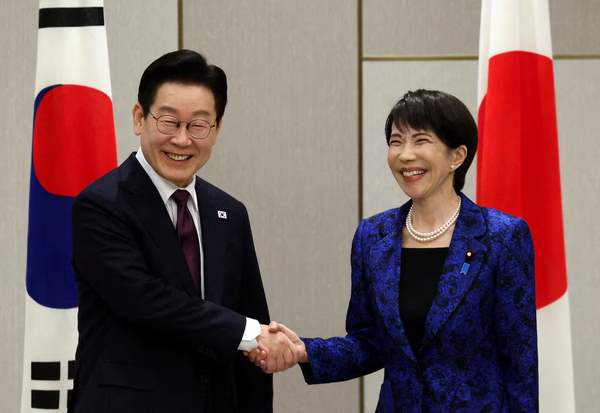
South Korean President Lee Jae Myung and Japanese Prime Minister Sanae Takaichi met in the historic city of Nara on 12th January, Monday for a summit that underscored a shared determination to move beyond long-standing grievances and deepen cooperation at a time of rapid geopolitical and technological change. The talks, held during President Lee’s two-day visit to Japan, focused on reconciling historical issues while laying the groundwork for broader collaboration in economic security, science and technology, and regional stability. Both leaders framed the meeting as an opportunity not only to reflect on six decades of diplomatic relations but also to chart a course for the next sixty years.
“Let us overcome the painful past and move forward together toward a new 60 years,” President Lee said during the summit. He stressed that strengthening and widening cooperation between Seoul and Tokyo was no longer optional, describing it as “a task of our times that can no longer be postponed” amid what he called a major civilisational turning point. The summit was the second between the two leaders since Prime Minister Takaichi took office. It began with a 20-minute small-group discussion, followed by an expanded meeting lasting more than an hour, allowing both sides to address sensitive historical questions alongside forward-looking policy agendas.
A key outcome of the talks was an agreement to advance discussions on unresolved historical issues through practical measures, notably cooperation on the recovery of victims’ remains from the Joseishi Mine and the use of DNA identification to establish their identities. President Lee later described this commitment as “small but meaningful progress”, signalling a willingness on both sides to pursue tangible steps rather than symbolic gestures alone. In the expanded talks, President Lee noted that more than six decades had passed since the normalisation of diplomatic relations between South Korea and Japan. “Today’s meeting has special significance,” he said, “in that we are starting another new 60 years.”
Prime Minister Takaichi echoed this sentiment, while placing the bilateral relationship in a broader strategic context. “As the environment surrounding both countries becomes more challenging, the importance of Korea–Japan relations and Korea–U.S.–Japan coordination is growing even greater,” she said. Welcoming the resumption of reciprocal visits by leaders, she added that she hoped to elevate relations further over the course of the year. Beyond historical reconciliation, the leaders agreed to strengthen comprehensive cooperation in economic security and science and technology, with a particular emphasis on artificial intelligence and the protection of intellectual property. They also committed to pursuing concrete outcomes in regional growth initiatives and to working jointly to combat cross-border scam crimes, an issue of growing concern in both countries.
The summit reaffirmed the importance of close coordination not only between Seoul and Tokyo but also within the broader trilateral framework involving the United States. At the same time, both sides recognised the need for continued communication among South Korea, Japan and China, reflecting the complex diplomatic landscape of East Asia. Speaking at a joint press announcement, President Lee highlighted the volatility of the current international environment. “Today’s international situation and trade order are fluctuating in unprecedented ways, and technological innovations, including AI, are fundamentally changing our lives and future,” he said. He added that the two leaders had held extensive discussions on practical measures to sustain future-oriented cooperation, building on the foundation of shuttle diplomacy established between the two governments.
President Lee’s visit to Japan forms part of a renewed effort to maintain momentum in improving bilateral ties through regular leader-level exchanges. He and Prime Minister Takaichi first held summit talks on the sidelines of the Asia-Pacific Economic Cooperation forum in Gyeongju in October last year and briefly met again during the G20 leaders’ meeting in South Africa in November. Following Monday’s talks, President Lee attended a summit conversation and a dinner hosted by Prime Minister Takaichi. On Tuesday, he is scheduled to visit the Horyuji temple complex, a renowned cultural heritage site, alongside the Japanese leader, before meeting overseas Koreans and returning to South Korea.
Both leaders expressed hope that the Nara summit would mark a turning point, signalling a shared resolve to address the burdens of history while working together to navigate an increasingly uncertain regional and global order.