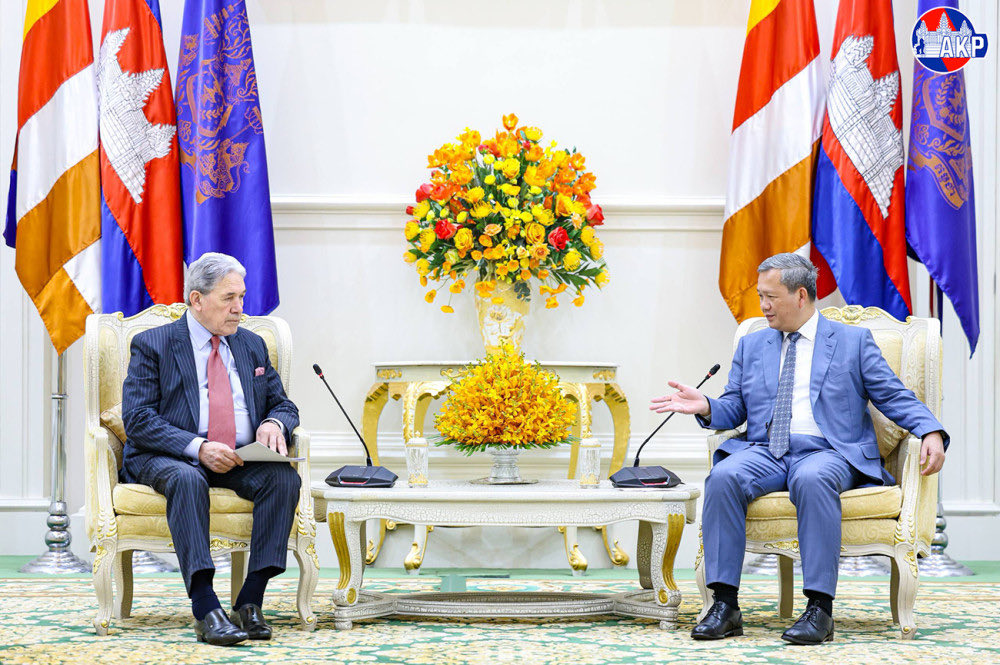
Cambodia and New Zealand have signalled a renewed phase in their long-standing relationship, marked by a stronger economic and strategic alignment. The shift was underscored during the official visit of New Zealand’s Foreign Minister, Winston Peters, who was received at the Peace Palace in Phnom Penh by Prime Minister Samdech Moha Borvor Thipadei Hun Manet on 28 November, 2025.The meeting, described by both sides as timely, reaffirmed shared ambitions to broaden cooperation across trade, investment, agriculture, education, tourism, and civil-society exchanges, building on more than three decades of partnership.
A Visit Aligned With Cambodia’s Momentum
During the discussions, Peters commended Cambodia’s continued socio-economic progress. With GDP growth recorded at 5.4 per cent in 2023 and forecasts pointing to nearly 6 per cent this year, Cambodia now stands among the more dynamic economies in ASEAN. He noted that New Zealand, a consistent development partner since the early 1990s, remains committed to supporting Cambodia’s economic modernisation and integration into regional value chains. Hun Manet echoed the sentiment, expressing confidence that the visit would help solidify the direction of bilateral engagement. He highlighted New Zealand’s enduring support for Cambodia’s peace process and development efforts, while pointing to the successful third round of bilateral consultations between the two foreign ministries held in August 2025. He suggested that such exchanges should be institutionalised to ensure more coherent policy coordination and wider avenues for private-sector cooperation.
Trade Relations: Small but Expanding
The economic relationship between the two nations remains modest but shows signs of steady growth. In 2024, Cambodian exports to New Zealand reached approximately US$48 million, while New Zealand’s exports to Cambodia totalled just over US$14 million. Although limited in scale, the figures reveal an upward trajectory, driven largely by Cambodian manufactured goods and New Zealand’s agri-food products.To strengthen commercial ties, Hun Manet drew attention to the recent establishment of a Cambodian Chamber of Commerce representation office in New Zealand. The initiative is designed to promote investment possibilities and foster connections among businesses, investors, and chambers of commerce.
Officials in Phnom Penh hope the move will encourage investment from New Zealand firms looking to diversify operations across Southeast Asia, especially in areas such as agro-industry, higher-value textiles, digital services, and tourism.
Sectoral Cooperation: Agriculture, Education, Tourism
Beyond trade, cooperation between the two countries continues to expand into strategic sectors essential for long-term development. New Zealand has, for several years, supported programmes in “climate-smart agriculture”, humanitarian demining, the protection and resilience of the Angkor archaeological park, and workforce training. These initiatives are viewed as important in modernising Cambodia’s agricultural systems, improving rural security, and enhancing the country’s tourism potential. Education remains a central pillar of the relationship. Manaaki New Zealand scholarships have enabled Cambodian students and professionals to pursue higher education and specialised training in New Zealand. Cambodian authorities, in turn, are working to advance student mobility, joint academic programmes, and university partnerships, recognising that the country’s competitiveness will depend heavily on strengthening its pool of engineers and skilled professionals.
Within a Wider ASEAN–New Zealand Framework
The latest boost in bilateral ties comes as part of a larger regional development. In October 2025, ASEAN and New Zealand agreed in Kuala Lumpur to elevate their partnership to a Comprehensive Strategic Partnership, built upon the pillars of peace, prosperity, people, and the planet. A 2026–2030 action plan is now guiding cooperation in fields ranging from economic integration to climate resilience and digital innovation. Phnom Penh has taken an active role within this framework, helping to strengthen ASEAN–New Zealand connectivity, including in aviation and trade facilitation. Both Hun Manet and Peters reaffirmed their intention to coordinate more closely in regional and international bodies, including ASEAN, the East Asia Summit, and other multilateral platforms. Their shared priority is to maintain a rules-based regional order, promote stability, and encourage sustainable growth in the Indo-Pacific.
Diplomacy and a Commitment to Peace
Before concluding the meeting, Hun Manet briefed Peters on recent developments regarding Cambodia’s border situation with Thailand—a matter with significant implications for regional stability. He reiterated Cambodia’s commitment to the joint declaration signed in Kuala Lumpur and stressed that all disputes would be addressed peacefully, in line with bilateral agreements, international treaties, and established legal norms. For New Zealand, which has long championed multilateralism and peaceful conflict resolution, Cambodia’s position aligns closely with Wellington’s broader regional approach.
A Relationship Looking Ahead
The two leaders ended their discussions with a joint pledge to further strengthen ties for the benefit of both nations and their peoples. Peters expressed gratitude for Cambodia’s support of the recently announced ASEAN–New Zealand Comprehensive Strategic Partnership, unveiled during the 47th ASEAN Summit in Malaysia. Hun Manet, for his part, reiterated Cambodia’s desire to deepen trade and investment links and acknowledged New Zealand’s sustained contributions to the Kingdom’s development over the decades. With expanding trade prospects, growing educational links, and a shared commitment to regional stability, the Cambodia–New Zealand partnership is entering a more strategic phase—one anchored in both economic opportunity and a common vision for the Indo-Pacific’s future.