The 11th edition of the Raisina Dialogue is being held from 5 to 7 March 2026 in New Delhi. The conference is organised by the Observer Research Foundation (ORF) in partnership with the Ministry of External Affairs (MEA), Government of India. It has been held annually since 2016 and is recognised as India’s flagship conference on geopolitics and geo-economics.
This year the event brings together heads of state, ministers, senior officials, think tank experts, industry leaders, academics, and journalists from 110 countries around the world. From India, the delegation includes S. Jaishankar, Minister of External Affairs, and Vikram Misri, Foreign Secretary. Christopher Landau, Deputy Secretary of State, is leading the United States delegation. Neighbouring and regional countries are also well represented, with Lyonpo Dina Nath Dhungyel, Minister for Foreign Affairs of Bhutan; Dhananjay Ramful, Minister of Foreign Affairs, Regional Integration & International Trade of Mauritius; Barry Faure, Minister for Foreign Affairs & Diaspora of Seychelles; and Vijitha Herath, Minister of Foreign Affairs, Foreign Employment & Tourism of Sri Lanka all participating.
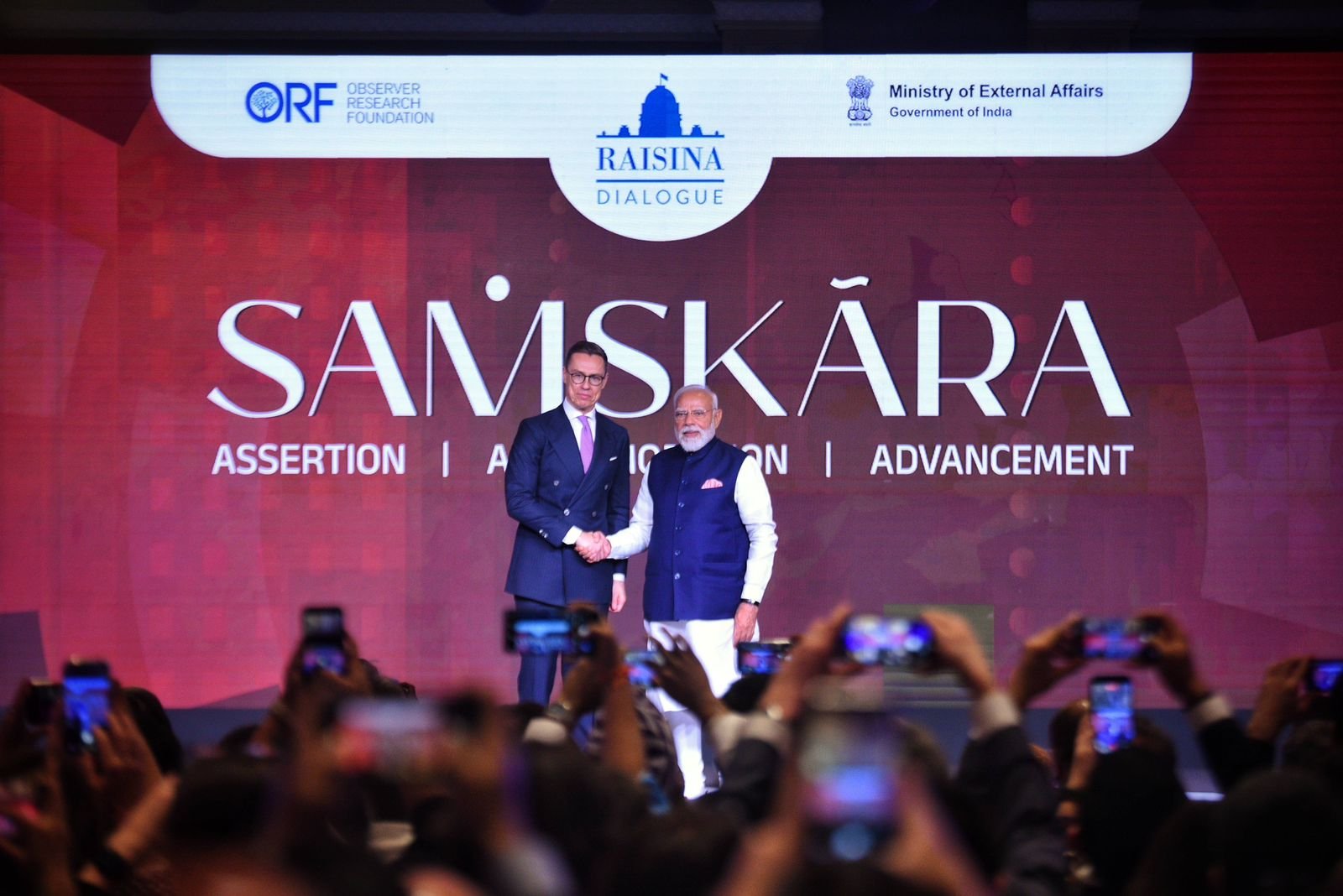
The theme of the 2026 edition is Saṁskāra: Assertion, Accommodation, Advancement.
Inauguration
Prime Minister Narendra Modi inaugurated the conference on 5 March 2026, alongside Chief Guest President Alexander Stubb of Finland, who delivered the keynote inaugural address.
At the joint press briefing with President Stubb held at Hyderabad House, Prime Minister Modi reaffirmed the deepening India-Finland Strategic Partnership, highlighting cooperation in artificial intelligence, 6G technology, and defence. Underlining a shared commitment to the peaceful resolution of conflicts, he stated that “India and Finland both believe in the rule of law, dialogue, and diplomacy.”
President Stubb’s keynote address covered the state of the global order, institutional reform, and the decisive role of the Global South. He stated that the world order is undergoing major change, placing India at the centre of what comes next. He remarked: “The Global South will decide what the next world order will look like. India, as a major power, will be a major force in deciding whether the world will tilt towards conflictual multipolarity characterised by deals, transactions, and spheres of interest.”
President Stubb praised India’s long-standing tradition of strategic autonomy and principled engagement, saying that Western nations have much to learn from India’s approach to foreign policy. “It is time we all became a bit more Indian,” he remarked, grounding the observation in India’s practice of multi-alignment.
On institutional reform, President Stubb made a firm call for a permanent United Nations Security Council seat, stating plainly that “Clearly, India should hold a seat.” He concluded by calling for world leaders to convene in New Delhi for a reform summit of the ambition of the 1945 San Francisco Conference, declaring: “I can hardly think of a better place to do it than New Delhi. We need a New Delhi moment.”
Six Thematic Pillars
The conference is structured around six discussion pillars over three days: Contested Frontiers: Power Polarity and Periphery; Repairing the Commons: New Groups, New Guardians, New Avenues; White Whale: The Pursuit of 2030; The Eleventh Hour: Climate, Conflict, and the Cost of Delay; Tomorrowland: Towards the Tech-topia; and Trade in the Times of Tariff: Recovery, Resilience, Reinvention.